
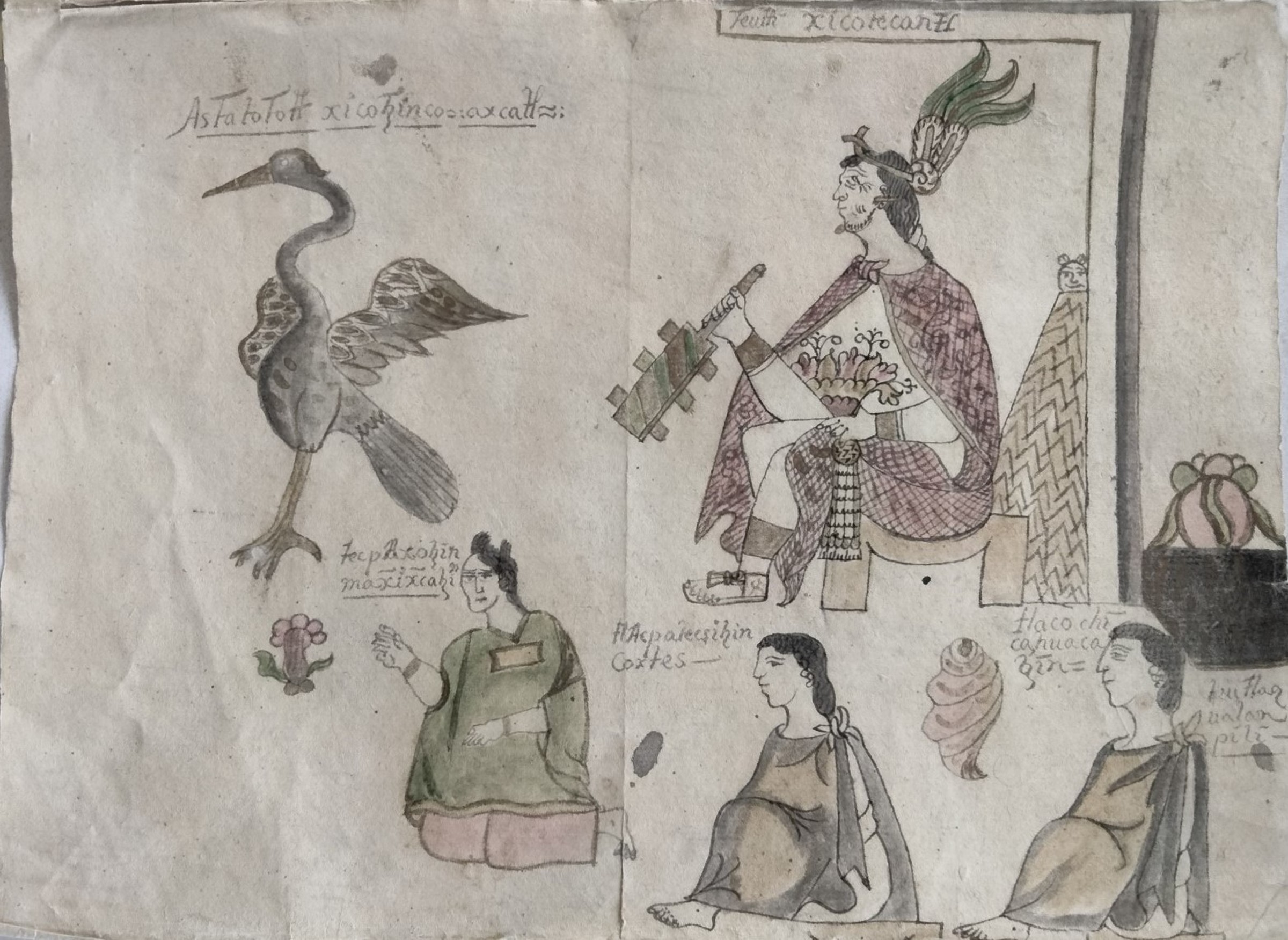
© State Archive of Tlaxcala (AHET)
- Language:
- Nahuatl (Aztec)
- Place of origin:
- The Native community of Santo Toribio Xicohtzinco in Tlaxcala, Mexico, produced this pictorial document. Tlaxcala is now a state just east of Mexico City.
- Time of origin:
- The community claimed that the pictorial document had been drawn in 1560, but the community most likely produced it in the early eighteenth century during a lawsuit against the adjacent hacienda (estate).
- Transcription & Translation:
- The astatototl xicotzinco: axcatl (heron Xicohtzinco property) is on the upper left. The heron represents Tlaxcala and affirms Xicohtzinco’s belonging to the polity. The teu[c]tli (Lord) Luis Xicotencatl is seated on the upper right with an obsidian sword in his hands. Below him sit three Native nobles, among them Lady Tecpaxohtzin (translates as flint foot, note the foot glyph on her right) Maxixcatzin, who had donated land to the community. Next to her are seated Tlacpatecsitzin (translates as ? conch shell, note the glyph) Cortés and Tlacochicahuacatzin (strong sage plant), and on the right the words huey Tlaxcalan pili (great noble(s) of Tlaxcala).
- Contact person:
- Prof. Dr. Christoph Rosenmüller
Additional information:
Santo Toribio Xicohtzinco sued the adjacent hacienda owners over land and access to the community between 1680 and 1721.
In 1720, the hacienda’s enslaved steward blocked the trails to the community and whipped two Native officials for trespassing. As a result, the community makes several legal claims. The community drew on Roman servitus (easement) rules that provided access across somebody else’s land, in this case, by walking the hacienda trails.
The community also provided the pictorial documents to underline the long history of the pueblo (polity) going back to the period right after the Conquest of Mexico (1519–1521). The image represents a gathering of important Tlaxcalan nobles in 1535 that gave land to Santo Toribio Xicohtzinco. Among them was Luis Xicotencatl, the heir of the great lord who fought with the Spanish conquistadors against the Aztecs (Mexica) during the Conquest.
Established as a pueblo, Santo Toribio Xicohtzinco was legally entitled to about 420 meters communal land measured in each cardinal direction, including ample hacienda property. Nonetheless, the hacienda owner rejected the claims. He presented evidence that Francisca de la Cerda Xicotencatl, great-granddaughter of Luis Xicotencatl, had sold the land to the hacendado’s predecessor in 1606, questioning the status of the pueblo, its officials, communal land, and access. The lawsuit was not resolved in 1721, but the community has endured until today (drawing on Dos códices del pueblo de Santo Toribio Xicohtzingo, ed. Mercedes Meade de Angulo. Tlaxcala: Instituto Tlaxcalteca de la Cultura, 1985; and others).
Click here to get back to game!