
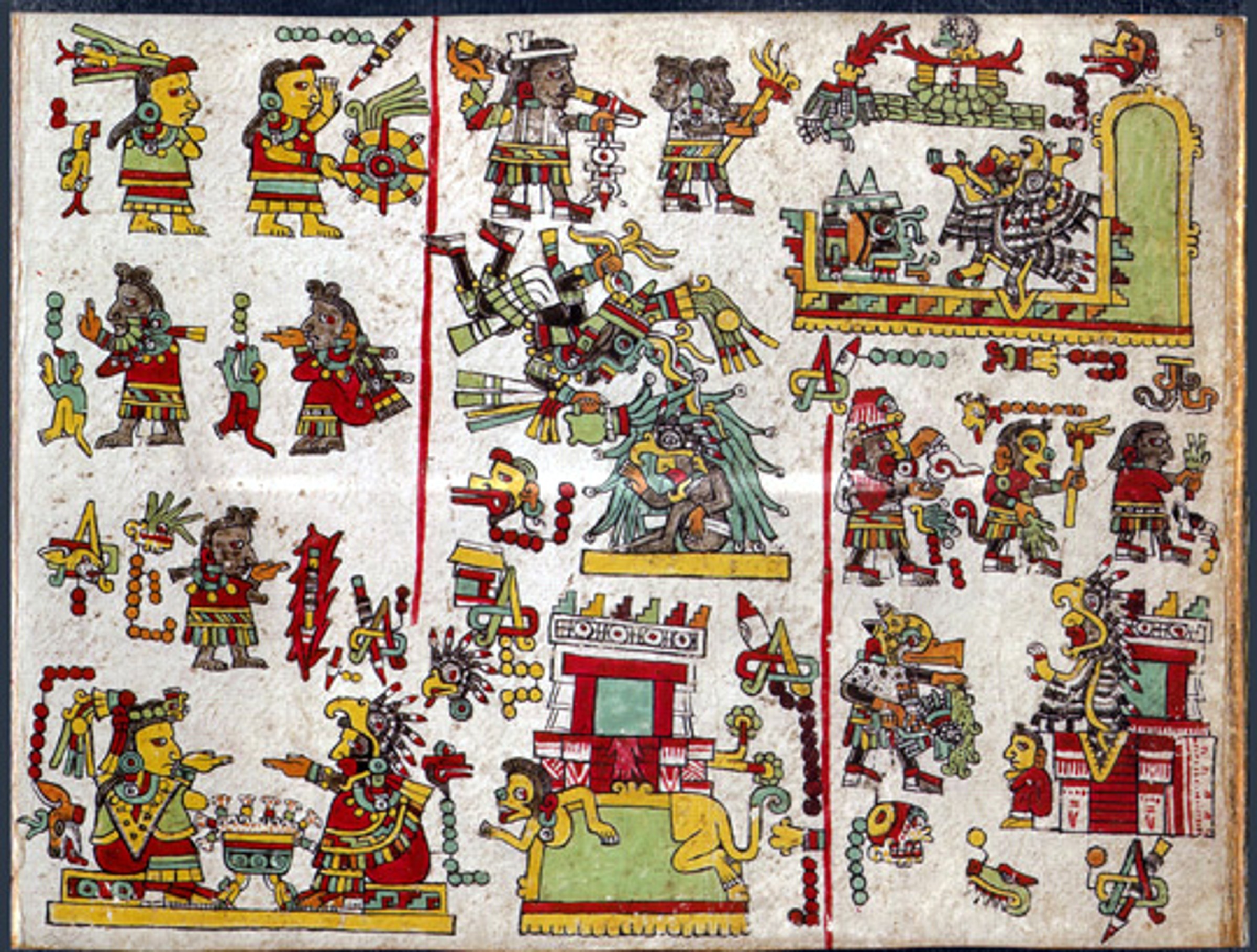
© Codex Zouche-Nuttall (Graz: Akademische Druck- u. Verlagsanstalt, 1987), S. 5.
- Language:
- Multiple
- Place of origin:
- Mexico, Oaxaca
- Time of origin:
- before 1519
- Transcription: & Translation:
- In the year 1 Reed (987 CE), Lord Eight Wind Eagle Flints emerges from a cave at a temple where other lords are also present. Seventeen years later he emerges from another cave and conducts a bird decapitation ceremony to the rain-god Dzaui, who then appears and showers Lord Eight Wind with water. Thereafter Lord Eight Wind founds his lineage at Monkey Hill by marrying Lady Ten Deer in 2 Rabbit 13 Grass (1014 CE), with their children portrayed above them. A further date sign with a red dart beside it suggests that Lord Eight Wind died in 2 Reed 2 Reed (1027 CE).
(Summary of the reading of these pictograms in Williams, Lord Eight Wind of Suchixtlan (Austin, TX: University of Texas Press, 2009), 115-118. - Contact person:
- Dr. Sam Kennerley
Additional Information:
The image is taken from a codex created in the Oaxaca region of what is now southern Mexico at some point prior to the Spanish conquest of Mesoamerica, and is one of the few from this time and place known to have survived to the present. It was written on deer-skin and folded in a concertina, which reaches almost 14 metres when fully extended. The pictograms written on this surface are not tied to a particular langauge, but instead form an ‘open’ system of communication would have been comprehensible to members of different linguistic groups in the region. This means of writing proved successful in Mesoamerica, at times even replacing other forms of writing such as the hieroglyphs used by the Maya.
In its original context, the codex is likely to have been displayed on a wall, with poets using the pictograms on its surface as aids to tell the epic of its protagonist, the Mixtec “culture hero” Lord Eight Wind Eagle Flint. Like other Mixtec codices, this one is read in a “boustrephon” pattern in which the eye moves horizontally or vertically in one direction, before proceeding back in the opposite direction like a plough tilling a field.
As was common, the Mixtec scribes have noted the direction of reading with red lines. We begin in the bottom-right corner, before moving to the top-right, to the centre, down, and then to the left and up. In this way we progress through Lord Eight Wind’s transition from his earlier life as a warrior-shaman to the foundation of his lineage, which still ruled the area at the time of the Spanish conquest.
Click here to get back to game!