
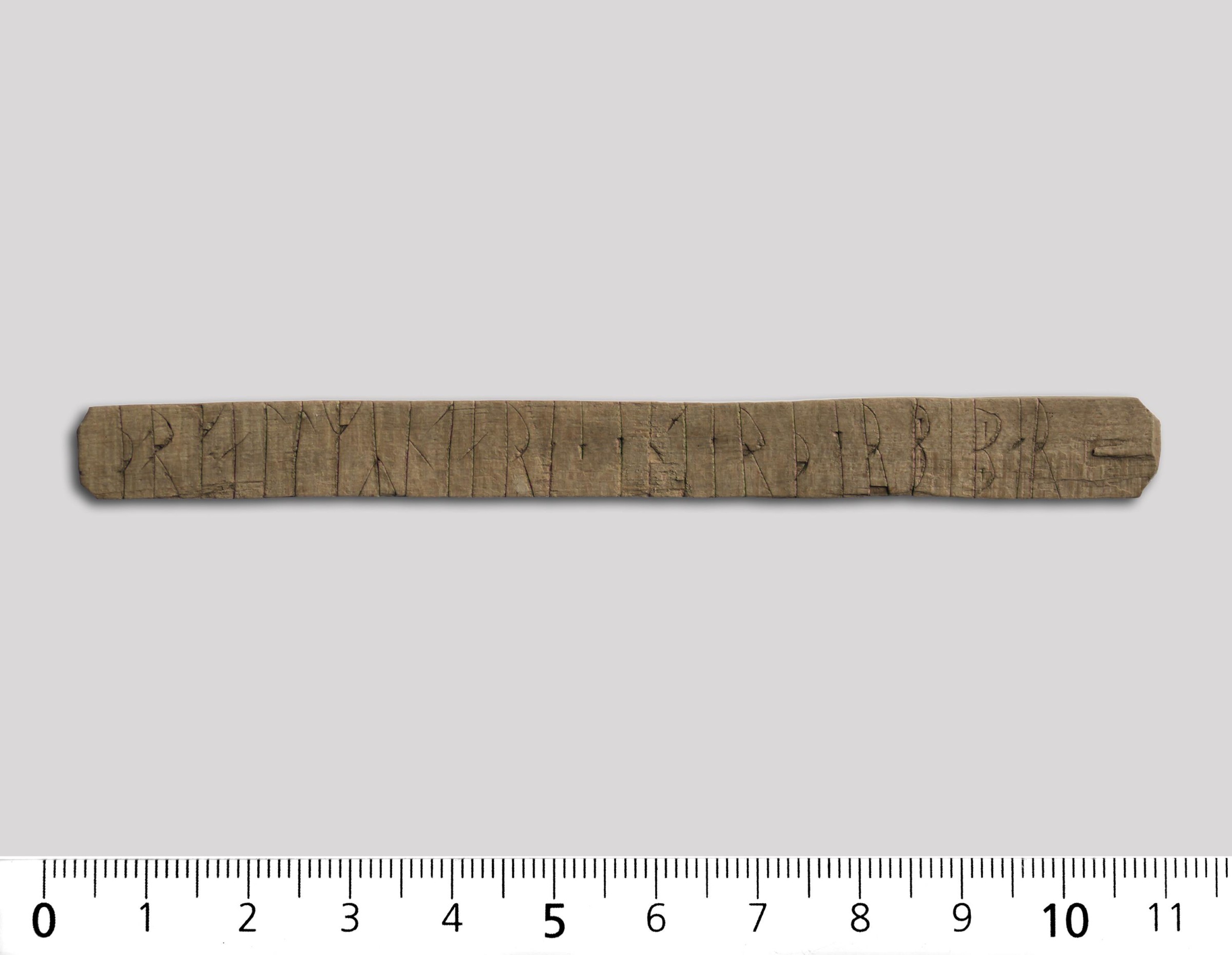
© Svein Skare, CC BY-NC-ND
- Language:
- Old Norse
- Place of origin:
- Norway (Bergen)
- Time of origin:
- Around 1200
- Transcription:
- Þorkell myntari sendir þer pipar
- Translation:
- Þorkell Moneyer sends you pepper
Additional Information:
The runic writing system is a phonographic means of writing which was used by the Germanic peoples from roughly the second to the fifteenth century CE. Runes were carved on portable objects made of metal, bone, and wood, as well as memorial inscriptions on stone. The earliest inscriptions use the so-called Older Futhark, a system of 24 runes that likely reflected the phoneme-grapheme relationship quite accurately in its early stages.
During the Viking Age (750–1050), probably due to sound changes, the Older Futhark was reduced to a shorter variant called the Younger Futhark, which comprised 16 runes. This development is unique in the history of writing systems, since the reduction of signs coincided with an increase of sounds, especially vowels. As a result, a smaller set of runes had to represent a larger range of sounds. Over time, additional runic signs and diacritical marks were introduced to better represent both Old Norse (the vernacular language) and Latin during the Scandinavian Middle Ages (1050–1500).
The object N 631 depicted here belongs to the corpus of inscriptions from medieval Bergen, discovered after the city’s trading quarter burned down. These inscriptions provide unique evidence of lay literacy and are mostly preserved on small wooden rune-sticks. Their contents range from owner tags containing mostly personal names, to Christian prayers, short messages, poems, and erotic texts. N 631 is a trading letter from a moneyer named Þorkell, who informs an anonymous recipient that he has sent pepper.
Click here to get back to game!