
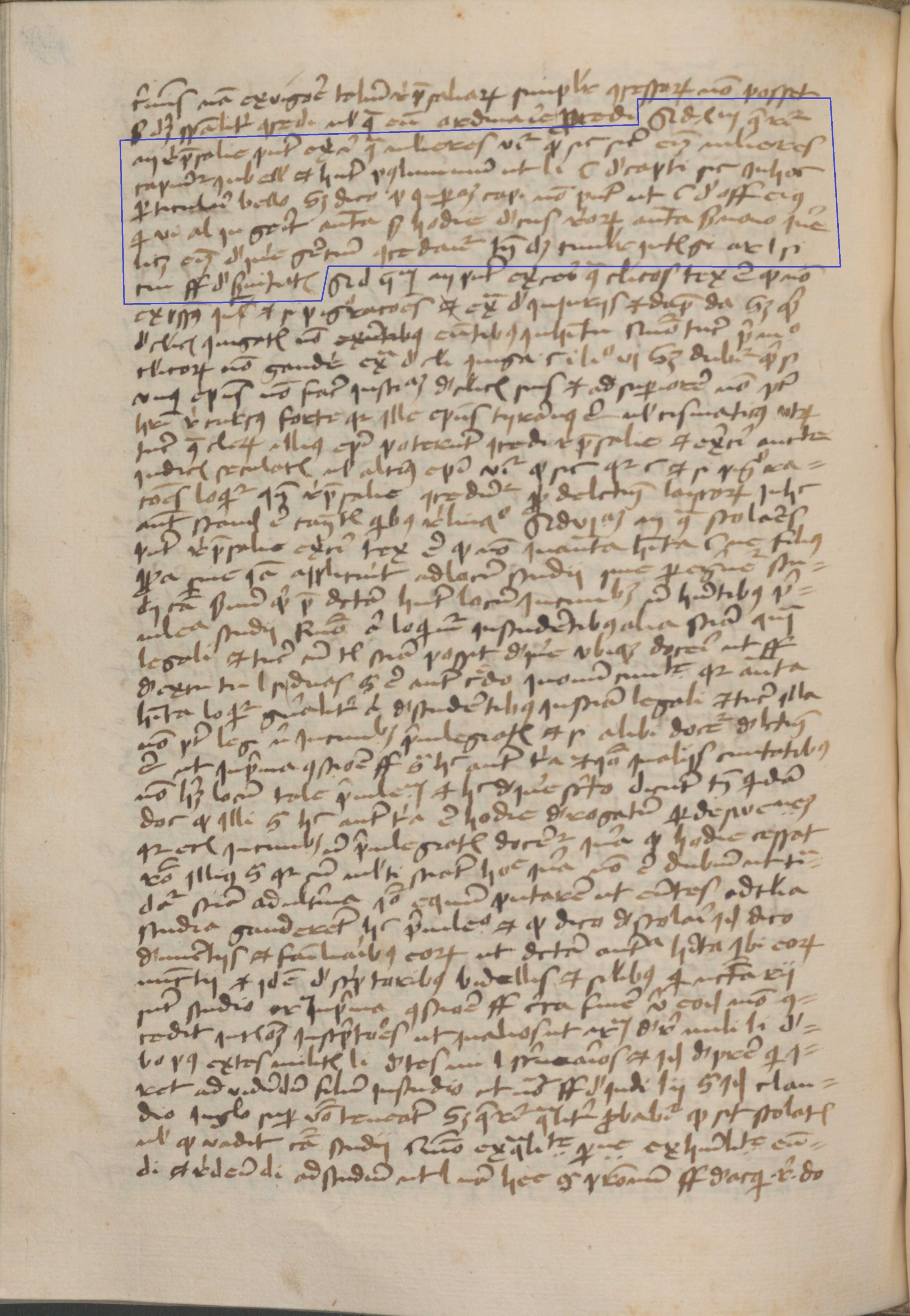
© Eichstätt, Universitätsbibliothek, Cod. st 186, f. 238v
- Language:
- Latin
- Place of origin:
- Italy (Padua)
- Time of origin:
- 1429–1439 (manuscript); 1354 (text)
- Transcription:
- [Quarta questio septime questionis principalis]
[A]d quartum queritur, an represalie possint exerceri contra mulieres. Videtur quod sic, sicut enim mulieres capiuntur in bello et habent postliminium ut l. i., C. de capti., sic in hoc particulari bello. Sed dico quod in personam capi non possunt ut C. de off. eius qui. vi al. iu. gerit, Autentica Sed hodie, de cus. reorum[MR1] [sic!], Autentica. Sed novo iure. Licet enim de iure gentium concedantur, tamen debet civiliter intelligi, ar. l. Si cui, ff. de servitute.
[MR1]Così nel ms. Legge corretta nella versione inglese/italiana - Translation:
- To the fourth it is asked whether reprisals can be exercised against women. It seems that they can, as in war women are captured and have postliminium: see l. i., C. de capti., so in this particular war. But I say the contrary, because they cannot be captured in person: see C. de off. eius qui. vi al. iu. gerit, Autentica Sed hodie, de cus. reorum[MR1] [sic!], Autentica. Sed novo iure . For although something may be granted by the law of nations, nevertheless it ought to be understood civilly [civiliter], ar. l. Si cui, ff. de servitute [MR1]Così nel ms. Legge corretta nella versione inglese/italiana
Additional Information:
The text above is taken from the Treatise on Reprisals (1354) by Bartolus de Saxoferrato,
as preserved in a legal-humanistic miscellany owned by Johannes von Heltpurg. Heltpurg’s manuscript was written between 1429 and 1439, mainly in Padua, and in a script that is described as Gothic cursive, with bastarda hands in some sections and later additions by other scribes. As can be seen in the image below, the main hand of the manuscript is a compact scholastic cursive typical of university and legal manuscripts. The letters are narrow, rapidly written, and heavily abbreviated. Many words are shortened with suspension marks, superscript letters, bars, and conventional legal Latin abbreviation signs, with the text written in a single column with long lines and little decoration. This hand can be located between late Gothic cursive and early humanistic habits: it is still very abbreviated and angular, but produced in an Italian humanist-legal environment connected to university culture in Padua. As a whole, the writing is dense and efficient, suitable for lecture notes and other working texts, rather than for luxury presentation copies.
Click here to get back to game!