
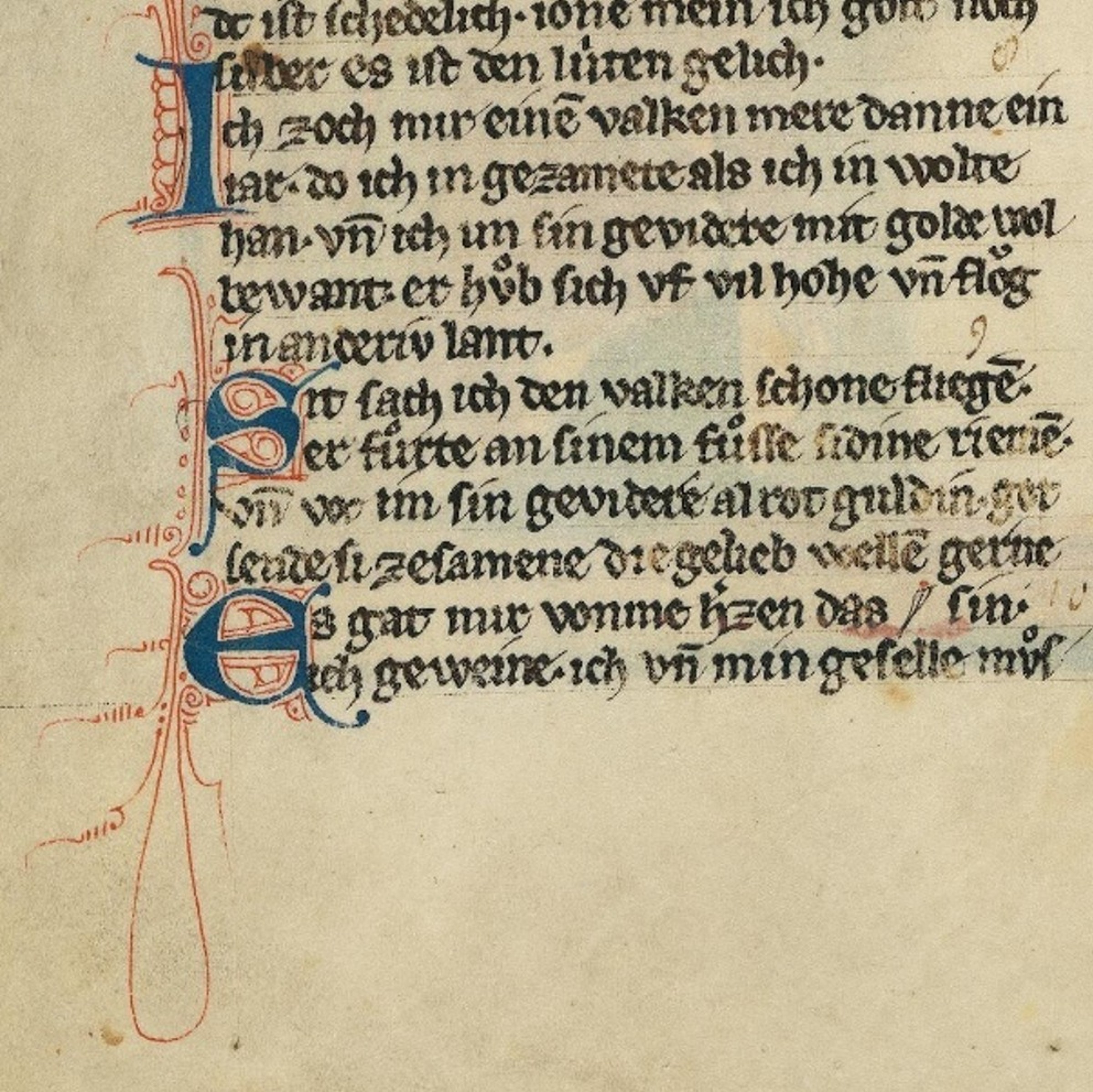
© Heidelberg, Universitätsbibliothek Heidelberg, Cod. Pal. germ. 848; 63v (Codex Manesse)
- Language:
- Middle High German
- Place of origin:
- Austria (Text composed in the German-speaking Austrian/Danubian Area; manuscript copied in Zürich)
- Time of origin:
- Composed around 1150/1160; manuscript copied between 1300–1340.
- Transcription:
- Ich zôch mir einen valken mêre danne ein jâr.
dô ich in gezamete, als ich in wolte hân,
und ich im sîn gevidere mit golde wol bewant,
er huop sich ûf vil hôhe und vlouc in anderiu lant.
Sît sach ich den valken schône vliegen,
er vuorte an sînem vuoze sîdîne riemen,
und was im sîn gevidere alrôt guldîn.
got sende sî zesamene, die gelieb wellen gerne sîn. - Translation:
- I trained a falcon for over a year.
Once I had tamed him just as I wanted him to be,
and had beautifully adorned his plumage with gold,
he soared high into the sky and flew to distant lands.
Since then, I have seen the falcon in proud flight.
He wore silk straps on his feet,
and his plumage was entirely reddish-gold.
May God bring together those who wish to love one another.
Additional Information:
Kürenberger’s so-called “Falkenlied” is generally regarded as one of the oldest surviving examples of Middle High German song. From a philological perspective, however, it is intriguing that this song – dated to around 1150 CE – does not appear in the extant tradition until around 1300, first in the Budapest Fragment and, somewhat later, in the Codex Manesse, which is the manuscript depicted here. Consequently, the song was written down at the same time as all the other texts in the Codex, which is included in the UNESCO Memory of the World register. However, that it was composed at the beginning of the productive tradition of “Minnesang” (medieval love poetry in the German language) can be substantiated by precise philological arguments from formal, linguistic, and thematic perspectives, regardless of the age of the manuscript witnesses. For instance, the stanzas of the poem are structured in the same manner as the Nibelungen stanza, that is, an older native stanza form that was primarily used in the Bavarian-speaking region during the second half of the 12th century.
Furthermore, the situation described – though already bound to courtly motifs in its imagery of adornment and falconry – shows no influence yet from the concept of “Hohe Minne” that came to dominate from the end of the 12th century onward. “Hohe Minne” was adopted from the model of French noble courts and, like the stanza forms influenced by Romance lyric (canzoni), became a defining characteristic of the Minnesang genre from 1200 onward.
Since the “Falkenlied” shows no thematic or formal influence from these adaptations, it can be concluded that it originates in an older tradition, and yet remained relevant to the tradition of Minnesang. For this reason, it can be found in the Codex Manesse alongside more recent “Minnelieder” that were influenced by adaptations from the Romance courtly traditions. Indeed, the Codex Manesse marks the end of Minnesang in the mid 14th century, and, in its magnificently decorated and illuminated folio format, aspired to present an as comprehensively compiled and complete example of the genre as possible.
As such, philological observations enable a comprehensive assessment of texts written at the same time based on various factors, thereby allowing us to trace cultural developments and their contexts.
Click here to get back to game!