
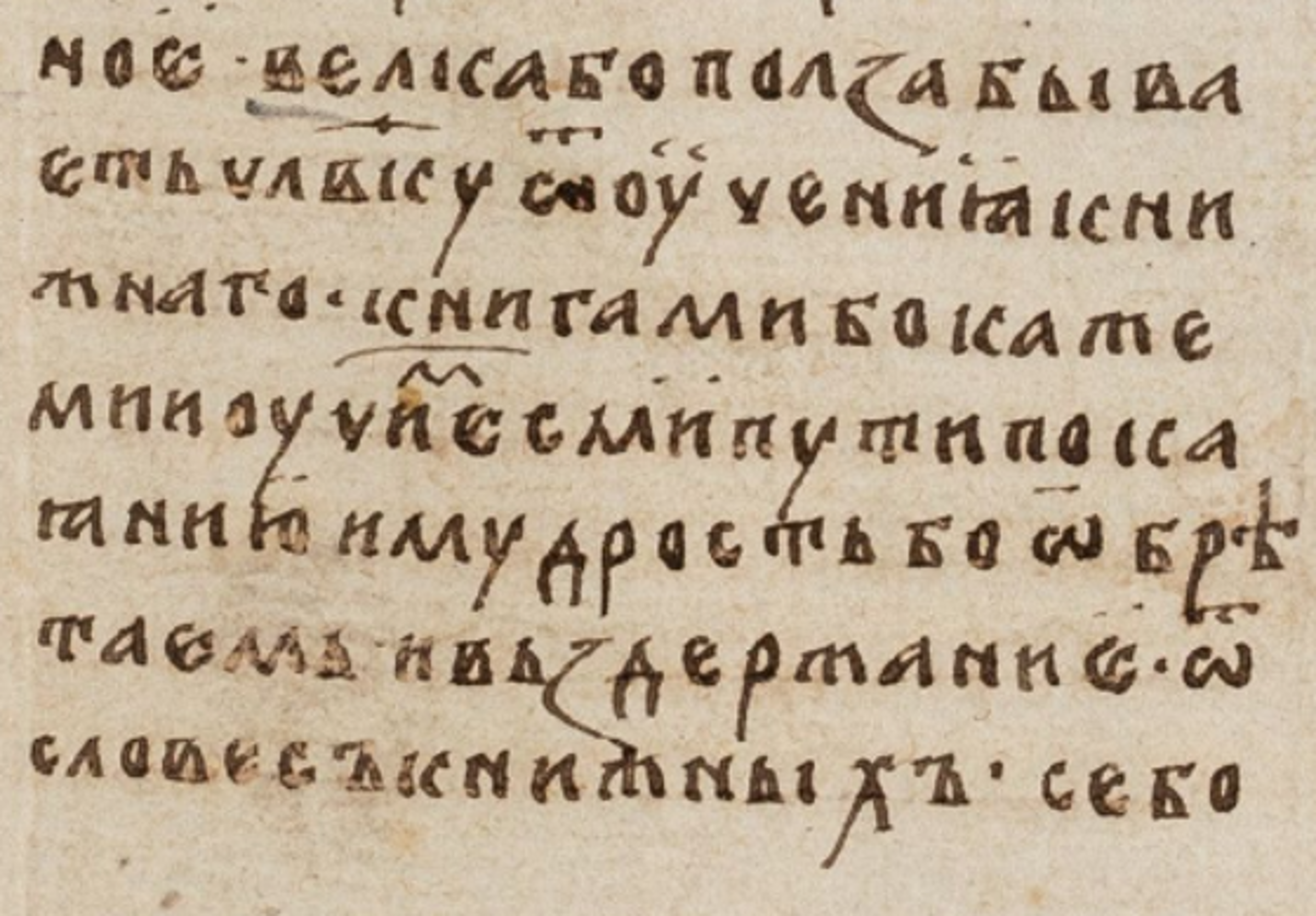
© St Petersburg, Library of the Russian Academy of Sciences, Manuscripts Department, NIOR 16.4.4.
- Language:
- Old East Slavic
- Place of origin:
- Ukraine (Kyiv)
- Time of origin:
- Early 12th century; the passage is placed in the chronicle under the year 6545 [1037 CE]
- Transcription:
- велка бо полза бываєть чл҃вку ѿ оучениꙗ книжнаго. книгами бо кажеми и оучим̑ єсми пути покаꙗнию и мудрость бо ѡбрѣтаємь. и вьздержаниє. ѿ словесъ книжныхъ. се бо суть рекы напаꙗющи вселеную всю се суть исходѧща мудрости.
- Translation:
- Great indeed is the benefit to a person from book learning: through books we are instructed and taught the path of repentance, and from the words of books we gain wisdom and self-restraint. For these are rivers watering the whole universe; these are sources of wisdom.
Additional Information:
The passage belongs to the Povist’ vremennykh lit (Primary Chronicle / Tale of Bygone Years), a key source for the early history of Kyivan Rus’, a medieval East Slavic polity centred on Kyiv. It is preserved in later manuscript witnesses, including this example, the “Ipatiev List” in the Hypatian Codex. The Codex is therefore not the “original” of the text, but one of the manuscripts through which the Primary Chronicle has come down to us. It also transmits the Kyiv Chronicle and the Galician-Volhynian Chronicle.
The manuscript is written in Cyrillic script, one of the main writing systems of the Slavic Christian world. The earliest Slavic literacy was connected to the mission of Constantine/Cyril and Methodius in the ninth century. This mission is usually associated with the creation of the Glagolitic alphabet, an early Slavic alphabet designed for writing and translating Christian texts in Slavic that was used before the wider spread of Cyrillic. Cyrillic emerged slightly later, most likely in the Bulgarian literary centers of the late ninth and early tenth centuries, and became closely associated with the transmission of Church Slavonic texts across the Orthodox Slavic world. Its letters are largely based on Greek uncial capitals, with additional signs created for specifically Slavic sounds. Here it appears in a medieval Cyrillic book hand known as semi-uncial / poluustav. Its older letter forms, abbreviations, and supralinear signs reflect the wider East Slavic and Ukrainian Cyrillic manuscript tradition.
Click here to get back to game!