
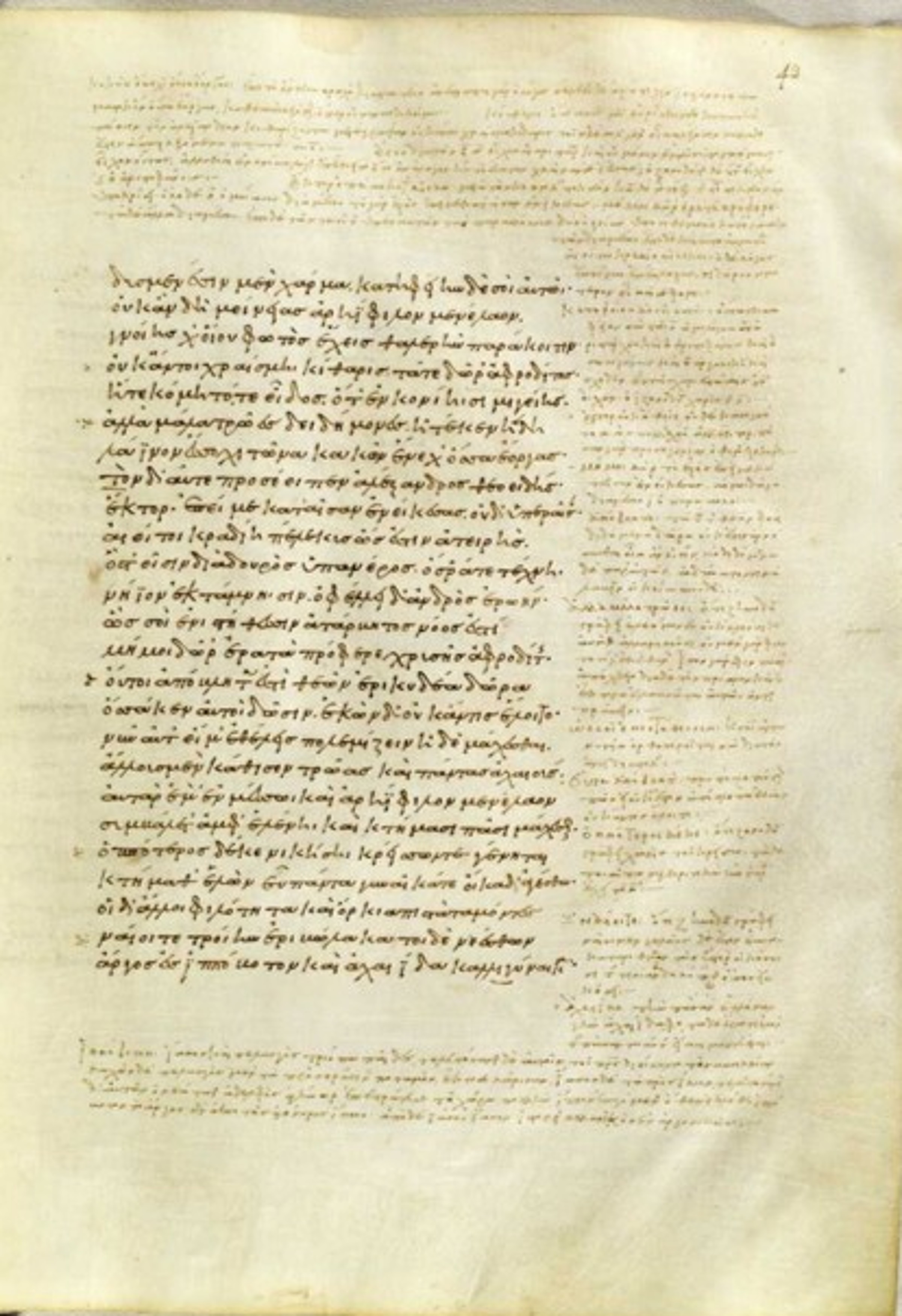
© Venice: Biblioteca Marciana, Marcianus Graecus 454 [=822]), 43r [Cod. Venetus A]
- Language:
- Ancient Greek
- Place of origin:
- Text: What is now Greece or Asia Minor (Turkey); Manuscript: Turkey (Constantinople = Istanbul)
- Time of origin:
- The quote is from Homer’s Iliad, 8th/7th century BCE (date disputed within scholarship).
The manuscript shown in the picture dates from the 9th century CE.
The marginal notes (known as scholia) were added in the 12th and 13th centuries. - Transcription:
- οὐκ ἄν τοι χραίσμῃ κίθαρις τά τε δῶρ’ Ἀφροδίτης
ἥ τε κόμη τό τε εἶδος ὅτ’ ἐν κονίῃσι μιγείης.
(Iliad 3.54–55)
- Translation:
- Then will thy lyre help thee not, neither the gifts of Aphrodite,
thy locks and thy comeliness, when thou shalt lie low in the dust.
(Iliad 3.54-55, transl. A.T. Murray)
Additional Information:
Codex Venetus A is a medieval manuscript containing the text of Homer’s Iliad on parchment pages. The Iliad is an epic poem and one of the earliest surviving works of European literature. What makes this 9th-century CE manuscript unique is that, in addition to the text of the Iliad, it also contains marginal notes (known as scholia) that trace back to the ancient philological practices in the famous library in Alexandria. The Codex Venetus shown here is then one of the few sources which allows us to reconstruct what was going on in the Library of Alexandria around 300 BCE, when scholars were already pondering how to understand the Homeric text and keep it free of transmission errors.
To give an example, at one point the Homeric text reads:
Then will thy lyre (kitharis) help thee not, neither the gifts of Aphrodite,
thy locks and thy comeliness, when thou shalt lie low in the dust. (Il. 3.54-55)
Even back then in Alexandria, people were puzzled by the Greek word for “lyre” (kitharis), because Paris (the character being referred to here) is never depicted with a “lyre” anywhere else in the Homeric text. There are, therefore, no parallel passages. This seems to have been the reason why someone suggested to replace the word kitharis with the word kidaris. A kidaris, as the commentary in the margins of the manuscript explain, is a kind of felt cap that a warrior wears under his helmet. Yet the commentator rejects this substitution with the words: “there are, after all, many things in Homer that occur only once”. Just because something is unique in the text does not mean it can simply be replaced with something more common. The unique also has its right to be in the text, and when in doubt, philologists might have to defend it.
Click here to get back to game!