
- Language:
- Ancient Egyptian
- Place of origin:
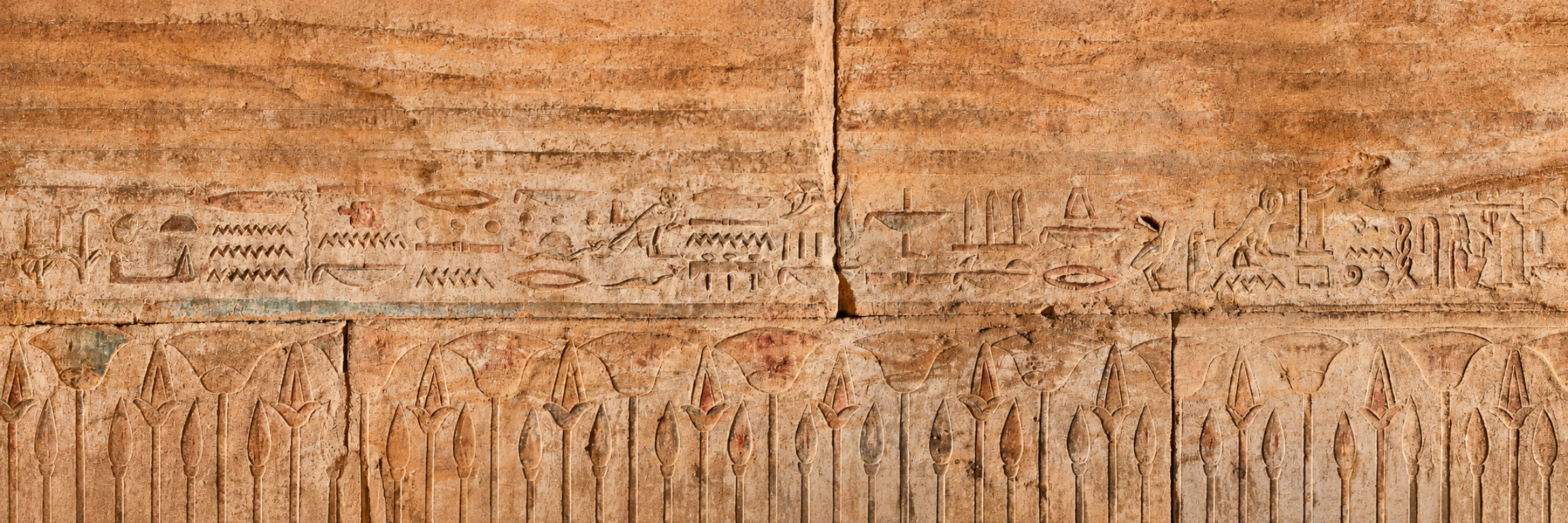
- Egypt (Assuan, Inscription in the so-called ‘Min Room’ in the Horus Temple in Edfu)
- Time of origin:
- The reference to King Ptolemy IV dates the placing of the inscription on the wall to between 221 BC and 204 BC. However, the text of the inscription is much older. It is an extract from saying 301 of the ‘pyramid texts’, and is transmitted over three thousand years in a variety of sources and contexts.
- Transcription:
- /
- Translation:
- Hail to you, Min-Amun, Lord of the sehenet-chapel! Come, so that you may pass through your fields and your trees of faience, turquoise, and lapis lazuli, and so that you may breathe in the fragrance of Neith. May you place the Ka of the king (Ptolemy (IV), who lives forever, the beloved of Isis at your side, and may the misut-crown rest upon your head.
Additional Information:
Egyptian is a part of the Afro-Asiatic language family. It is attested from shortly before 3200 BC and remained in use until about the eleventh century AD. The language underwent major changes in the long history of its development, which research divides into five primary phases: Ancient Egyptian, Middle Egyptian, New Egyptian, Demotic, and Coptic.
The key script of the ancient Egyptians were the ‘hieroglyphs’, a word that comes from the Greek for ‘sacred carvings’ and which itself represents the Egyptian expression ‘word of god’. About 500 hieroglyphs are typically recognised. The exact development of hieroglyphs is not yet clear, but it is notable that they appear around 3250 BC as an already well-developed system. Contrary to earlier views, hieroglyphs are not a purely symbolic secret language, but rather a normal script which represents speech. Here, the characters fulfil multiple purposes: as ideograms they directly reflect what they represent, and as phonograms they indicate sounds (this method of using pictures to indicate sounds is called the ‘rebus principle’). In addition there are determinants, which are not spoken, but which clarify the semantic structure of the word. One hieroglyph can serve many of these different purposes at the same time.
Hieroglyphs can also be read in different directions. They can be written from left to right, right to left, or vertically. Here the direction in which the accompanying figures face is decisive, as one always reads in the direction in which the animals or people portrayed are looking. Such flexibility allows for a balanced aesthetic and often a symmetrical arrangement of the text.
Another key characteristic of hieroglyphs is the grouping of characters. In contrast to alphabetical writing systems, characters are not arranged after one another in a line, but rather brought together in groups that appear balanced to the eye, and which are arranged according to the shape of each character. There are also no divisions between words, which can make the reading of hieroglyphs rather difficult.
Hieroglyphs have been written on different kinds of supports, for example on papyrus, pillars, or on everyday objects. They were written above all in monumental or religious settings, such as in temples, tombs, and statues, and are preserved both as short notes and as longer texts like reports about major events, autobiographical inscriptions, and religious hymns. Hieroglyphs were usually made by inscriptions into stone or by painting, and were often artistically depicted.
This system of writing underwent another change in the later phases of ancient Egypt, especially during the Ptolemaic and Roman periods (c. 1000 BC – 300 BC). The symbolic and visual potential of the characters was knowingly used to its fullest extent, especially in priestly circles. The script developed in this context is known as ‘Ptolemaic’, in which new styles of pronunciation and even so-called ‘cryptographic’ styles of writing were developed, which were incredibly complex and understood only by an educated minority. At the same time the number of hieroglyphs rose to several thousand, rendering the script much more difficult to use. Wordplay was characteristic of this phase: characters were combined so that they created vocal, visual, and semantic connections. The ‘consonant principle’ (namely the reduction to specific consonants of a sign) and the ‘acrophonic principle’ (the use of sounds at the start of a word) came into use at this time, for example. As a result, the writing system became more expressive but also much more complex, and remained primarily restricted to monumental and religious contexts.
Today, hieroglyphs can mostly be read without issue. They offer valuable insights into the history, religion, and culture of ancient Egypt, and demonstrate the close connection between language, writing, and cultural identity across many thousands of years.
Click here to get back to game!