
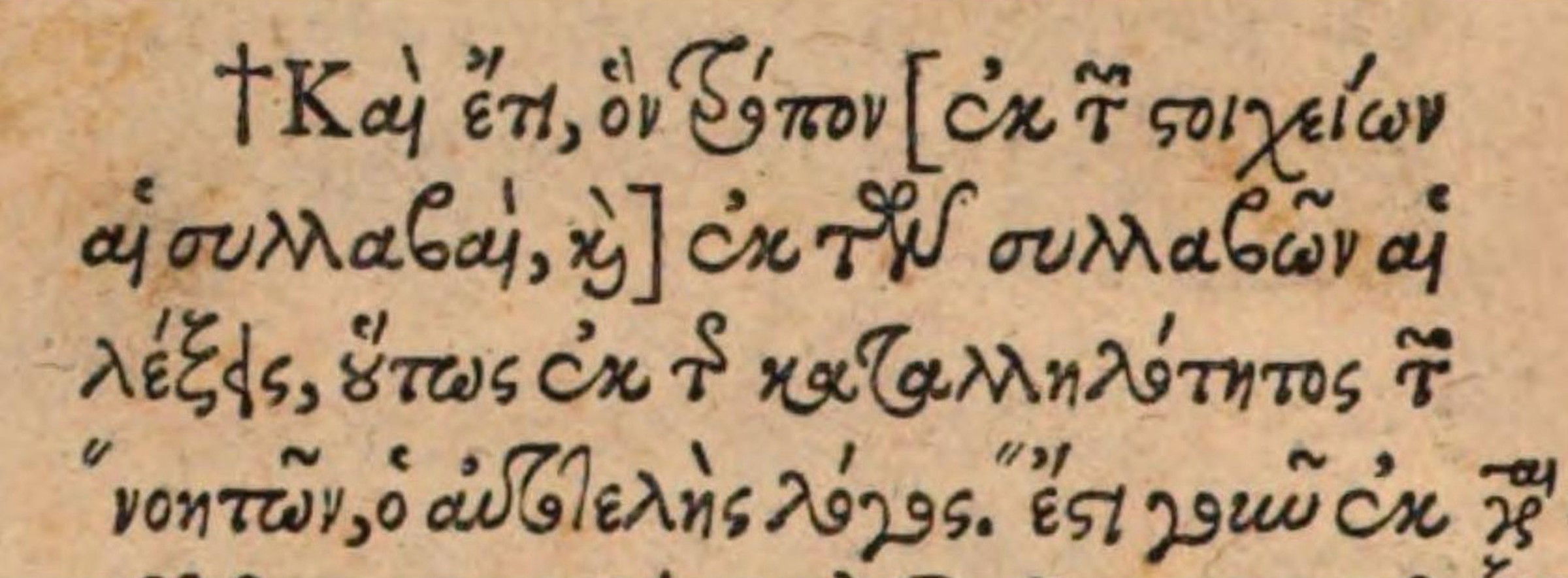
- Language:
- Ancient Greek
- Place of origin:
- Egypt (Alexandria)
- Time of origin:
- Apollonius Dyscolus was active in Alexandria c. 130–180 CE and is the most important systematic grammarian of Greek antiquity. Print from 1590.
- Transcription:
- Καὶ ἔτι, ὃν τρόπον [ἐκ τῶν στοιχείων αἰ συλλαβαὶ, καὶ] ἐκ τῶν συλλαβῶν αἱ λέξεις, οὕτως ἐκ τῆς καταλληλότητος τῶν νοητῶν ὁ αὐτοτελὴς λόγος.
- Translation:
- And furthermore, just as [syllables come from letters, and] words come from syllables, so the complete sentence comes from the congruence of the intelligibles.
Additional Information:
In this single sentence, Apollonius Dyscolus, the greatest Greek grammarian of antiquity, reveals that grammar is not merely about sounds and rules, but about the structure of thoughts or meanings. He draws a bold analogy: just as letters combine to form syllables, and syllables combine to form words, so the ‘intelligibles’ or ‘meanings’ [νοητά]—the mental contents associated with each word—must combine in the right way to produce a complete, well-formed sentence. The correctness of a sentence depends on the compatibility of the meanings it expresses. In other words, syntax is grounded in semantics.
The project ‘Philosophical Themes in Ancient Grammar (PTAG)’ recovers this dimension of ancient grammatical theory. Ancient grammarians—from the Alexandrian philologists of the 3rd century BCE to Priscian’s Latin synthesis in the 6th century CE—engaged directly with the great philosophical debates of their time: epistemology, semantics, ontology, and logic. PTAG produces the first comprehensive English-language sourcebook revealing this intersection and traces how Greek grammatical-philosophical ideas shaped intellectual traditions across Latin Europe, the Syriac world, and in Arabic grammatical scholarship.
Click here to get back to game!