
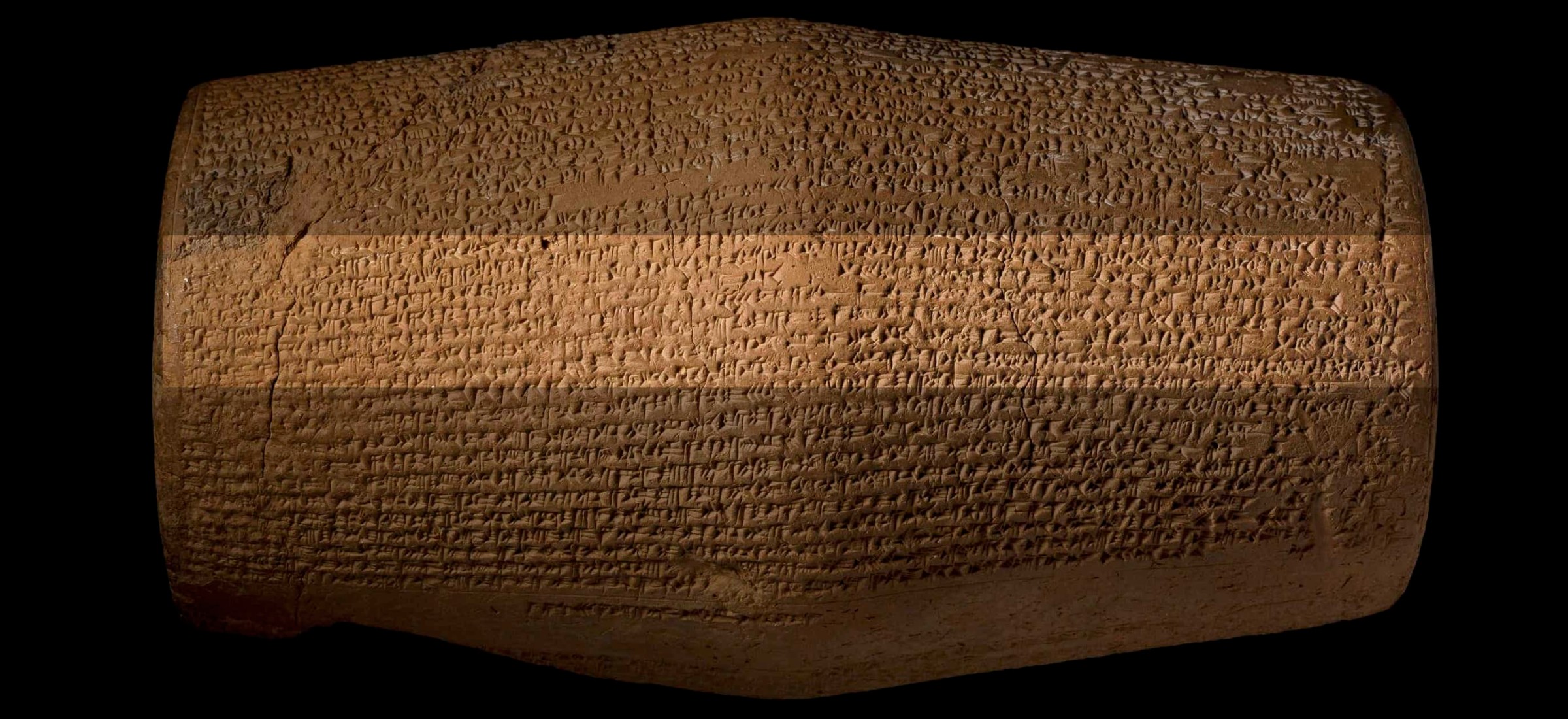
© The Trustees of the British Museum
- Language:
- Cuneiform
- Place of origin:
- Iraq (Northern Iraq: Nineveh or Aššur)
- Time of origin:
- 702 BCE
- Transcription:
- É.GAL ZÚ AM.SI GIŠ.ESI GIŠ.TÚG GIŠ.mu-suk-kan-⸢ni⸣ GIŠ.⸢EREN⸣ GIŠ.ŠUR.MÌN
GIŠ.ŠIM.LI ù GIŠ.bu-uṭ-ni é-gal-zag-du-nu-tuku-a a-na mu-šab LUGAL-ti-ia ú-še-pi-šá ⸢qé-reb⸣-šá
GIŠ.ÙR.MEŠ GIŠ.EREN tar-bit KUR.ḫa-ma-nim ša ul-tu ⸢ḫur-šá-a-ni ru-qu⸣-ú-tinam-ra-ṣi-iš ib-⸢bab⸣-lu-ni ú-šat-ri-ṣa ta-ra-an-ši-in
GIŠ.IG.ME GIŠ.ŠUR.MÌN ṣi-ra-a-ti ša i-na pe-te-e ⸢ù⸣ ta-a-ri e-re-sin ṭa-a-bu me-sér ZABAR nam-ri ú-rak*-kis-ma ú-rat-ta-a ba-bi-šin
É ap-pa-a-te tam-šil É.GAL KUR.ḫat-ti ša i-na li-šá-a-⸢ni⸣ KUR MAR.TU.KI É ḫi-la-a-ni i-šá-as-su-šú a-na mul-ta-ʾu-u-ti be-lu-ti-ia ú-še-pi-šá qé-reb-šin - Translation:
- I had a palace of elephant ivory, ebony, boxwood, musukkannu-wood, cedar, cypress, juniper, and terebinth, (a palace that I named) Egalzagdunutukua (“The Palace Without a Rival”), constructed thereon as my royal residence. I roofed them (the rooms of the palace) with beams of cedar grown on Mount Amanus, which were brought with difficulty from (that) distant mountain terrain. I fastened bands of shining bronze on magnificent doors of cypress, whose scent is sweet on opening and closing, and I installed them in their gates. For my lordly pleasure, I had a portico, a replica of a Hittite palace, which is called bīt-ḫilāni in the language of the land Amurru, constructed inside them.
Additional Information:
The extract is written in cuneiform script, a writing system invented in Mesopotamia (modern Iraq) around 3200 BCE, most likely for the Sumerian language. Over the following centuries, however, cuneiform was adapted to other languages, including Akkadian, the language of this excerpt. Cuneiform documents in the Akkadian language were composed for more than two thousand years, from the second half of the third millennium BCE until the first century AD.
The earliest documents written in cuneiform script were mainly administrative texts and, to a lesser extent, lexical lists. Over time, the writing system was used for other types of texts: inscriptions composed in the name of kings (royal inscriptions), such as the text above, were among the earliest and longest-attested genres. This extract belongs to one of the first royal inscriptions composed in the name of Sennacherib, king of Assyria from 704 to 681 BCE, and was written on several barrel-shaped clay cylinders buried as foundation documents. The whole text presents a lengthy account of the king’s first military campaign in Babylonia and a building report describing the construction of a royal palace, the “Palace Without a Rival,” and various other works at Nineveh.
This inscription, together with approximately 230 other texts known from the reign of Sennacherib and 130 from the reign of his father and predecessor, Sargon II (721-705 BCE), will be investigated within the project “(Dis)continuity and Innovation. Examining the Editorial and Scribal Practices of the Inscriptions of the Kings of Assyria.” This project aims to examine similarities and variations in the composition and production of the inscriptions of these two kings, as exemplified in this extract: a passage that, in content, almost duplicates previous inscriptions composed for the royal palace of Sargon II at Khorsabad, but that Sennacherib had his scribes inscribe on clay supports hidden in the foundations of the palace rather than on stone slabs decorating its walls, as was the case in his father’s time.
Click here to get back to game!