
© This image and its content are free of known copyright restrictions and in the public domain. See the Creative Commons Public Domain Mark page for usage details, http://creativecommons.org/publicdomain/mark/1.0/.
- Language:
- Persian
- Place of origin:
- Probably in Iran
- Time of origin:
- copied A.H. 815/A.D. 1412 (colophon on f. 38v)
- Transcription:
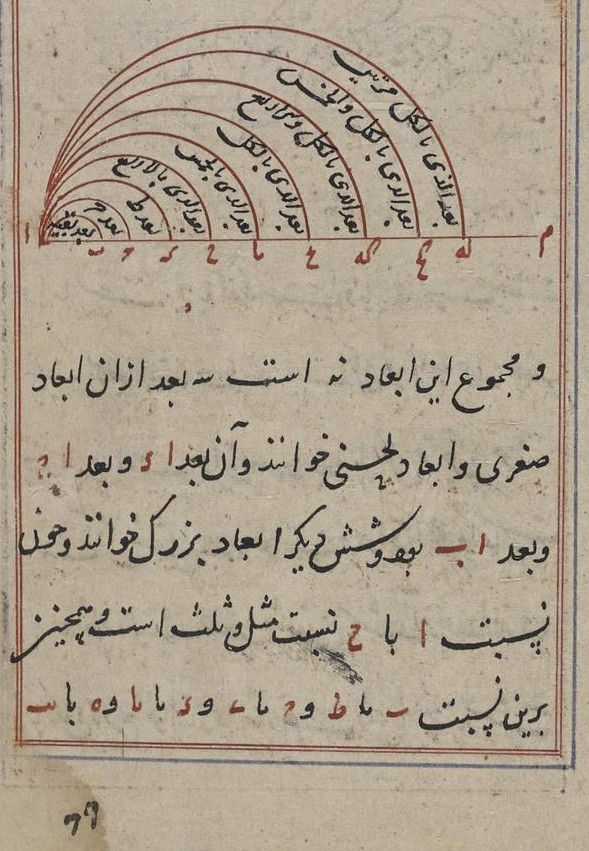
- va maǧmūʿ-i īn abʿād nuh ast, si buʿd az ān abʿād-i ṣuġrā va abʿād-i laḥnī ḫwānand, va ān buʿd-i AD va buʿd-i AǦ va buʿd-i AB buvad, va šiš dīgar abʿād-i buzurg ḫwānand čūn nisbat-i A bā Ḥ nisbat-i misl va suls ast va hamčunīn bar īn nisbat B bā Ṭ va Ǧ bā Y va D bā Yā va H bā Yb [...]
- Translation:
- Altogether, these intervals are nine. Three of them are called the ‘smaller intervals’ or the ‘melodic intervals.’ These are the intervals AD, AǦ, and AB. The remaining six are called the ‘greater intervals,’ since the ratio of A to Ḥ is that of four to three. Likewise, B to Ṭ, Ǧ to Y, D to Yā, H to Yb [...] stand in this same ratio.
Additional Information:
The project “Al-Urmawī’s Afterlife” aims to research the cross-cultural histories of the bilingual manuscript tradition of the two music treatises by Ṣafī ad-Dīn al-Urmawī (d. 1394). These tracts were directly influential in the field of music theory for the next two hundred years via Arabic copies, Persian translations, and commentaries in both languages, and were retextualized in other original music theoretic works by Ibn Ġaybī (d. 1453) and aš-Širāzī (d. 1311).
The primary research question of this project concerns philological practices: where, how, when, by whom, and in which language were al-Urmawī’s two works received, adapted, and transformed, and then in which social contexts? Other crucial aspects relate to bilingualism: are there differences in the dissemination and reception of the manuscripts in Arabic as opposed to Persian? Are there textual amendments or omissions? And how do these aspects correlate with their material counterparts?
An example of this approach is presented here, taken from a Persian version of the Kitāb al-Adwār. The diagram shows musical intervals that can be found in a system of a double octave. The notes are numbered by means of abǧad numerals (letters used as numerals), whereas the names of the intervals are written in Arabic between the connecting bows. The text describing the intervals is in Persian using Arabic terminology (buʿd, “interval”), but also Persian calques (abʿād-i buzurg, “greater intervals”). It seems that the translation process helped (trans-?)forming a musical terminology in the Persian language. – A good working hypothesis.
Click here to get back to game!