
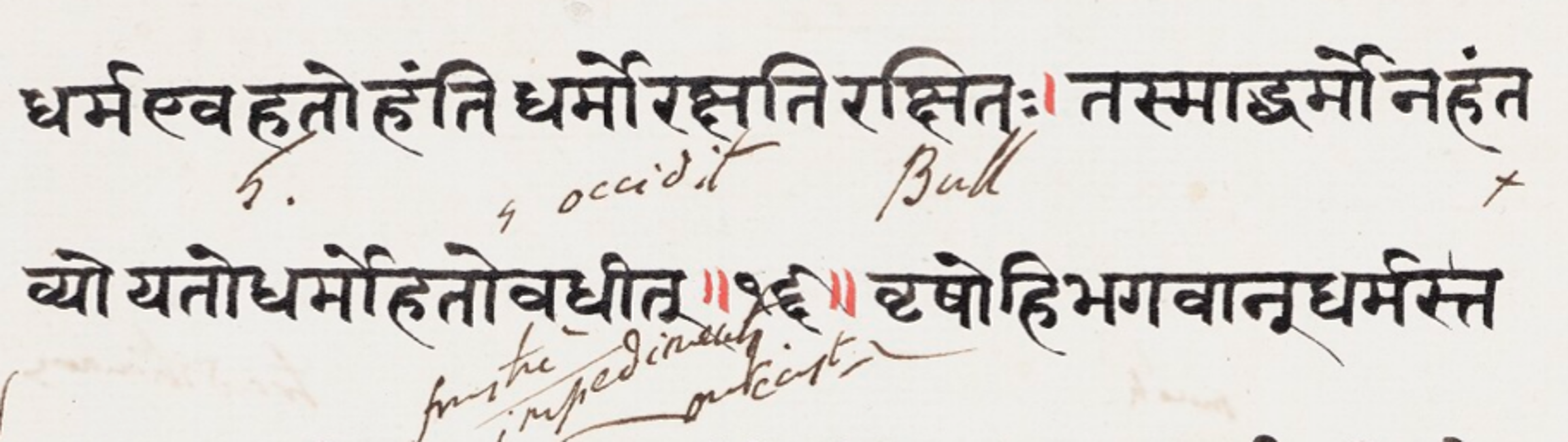
© Oxford, Bodleian Library MS. Sansk. c. 32 (f. 74v, ll. 4-5)
- Language:
- Sanskrit
- Place of origin:
- India (Northern India)
- Time of origin:
- Middle of the second century CE
- Transcription:
- धर्म एव हतो हन्ति धर्मो रक्षति रक्षितः ।
तस्माद्धर्मो न हन्तव्यो मा नो धर्मो हतो वधीत् ॥
dharma eva hato hanti dharmo rakṣati rakṣitaḥ |
tasmād dharmo na hantavyo mā no dharmo hato vadhīt ||
(Quotation from the Mānavadharmaśāstra (MDh 8.15)) - Translation:
- Justice, when struck, strikes back; when protected, it protects. Therefore, one must not strike against Justice. For Justice, once struck, destroys us.
Additional Information:
The Mānavadharmaśāstra (“Manu’s Code of Law”) is the earliest legal code in verse in Sanskrit, composed in northern India by a learned Brahmin, or by a group of learned Brahmins, in the middle of the second century CE.
The writing traditions of South Asia have never been reducible to a single script. The earliest securely datable documents are the edicts of Aśoka, from the mid third century BCE, written in Kharoṣṭhī in the northwestern region of South Asia, namely the historical region of Gandhāra, and in Brāhmī elsewhere. While Kharoṣṭhī remained regional, Brāhmī became widespread across South Asia and developed into the ancestor of the major South Asian scripts. The structural principle common to both Kharoṣṭhī and Brāhmī, and to the later Brāhmī-derived scripts, is the so-called akṣara, which makes these systems alphasyllabic, or abugidas: a consonant sign normally includes an inherent vowel (short a), while other vowels are marked by diacritics and consonant clusters by conjuncts or related devices. Over time, Brāhmī diversified into regional scripts, shaped by material, language, and writing practice. One of these scripts is Modern Nāgarī, or Devanāgarī (from Sanskrit, “[script] of the heavenly city”), which had acquired a distinct identity by the eleventh century and later came to be used throughout northern South Asia, not only for Sanskrit but also for New Indo-Aryan languages (such as Hindī, Nepālī and Marāṭhī) and even non-Indo-Aryan languages such as Gōṇḍī (a Dravidian language). Modern Devanāgarī is visually characterised by a horizontal headline (called śirorekhā in Sanskrit), relatively angular letter forms, and the aforementioned akṣara principle.
Click here to get back to game!