
© privat
- Language:
- Classical Chinese
- Place of origin:
- China (Near Changsha)
- Time of origin:
- The tomb was sealed in 168 BCE; the chapter itself, however, is generally believed to be at least a century older.
- Transcription:
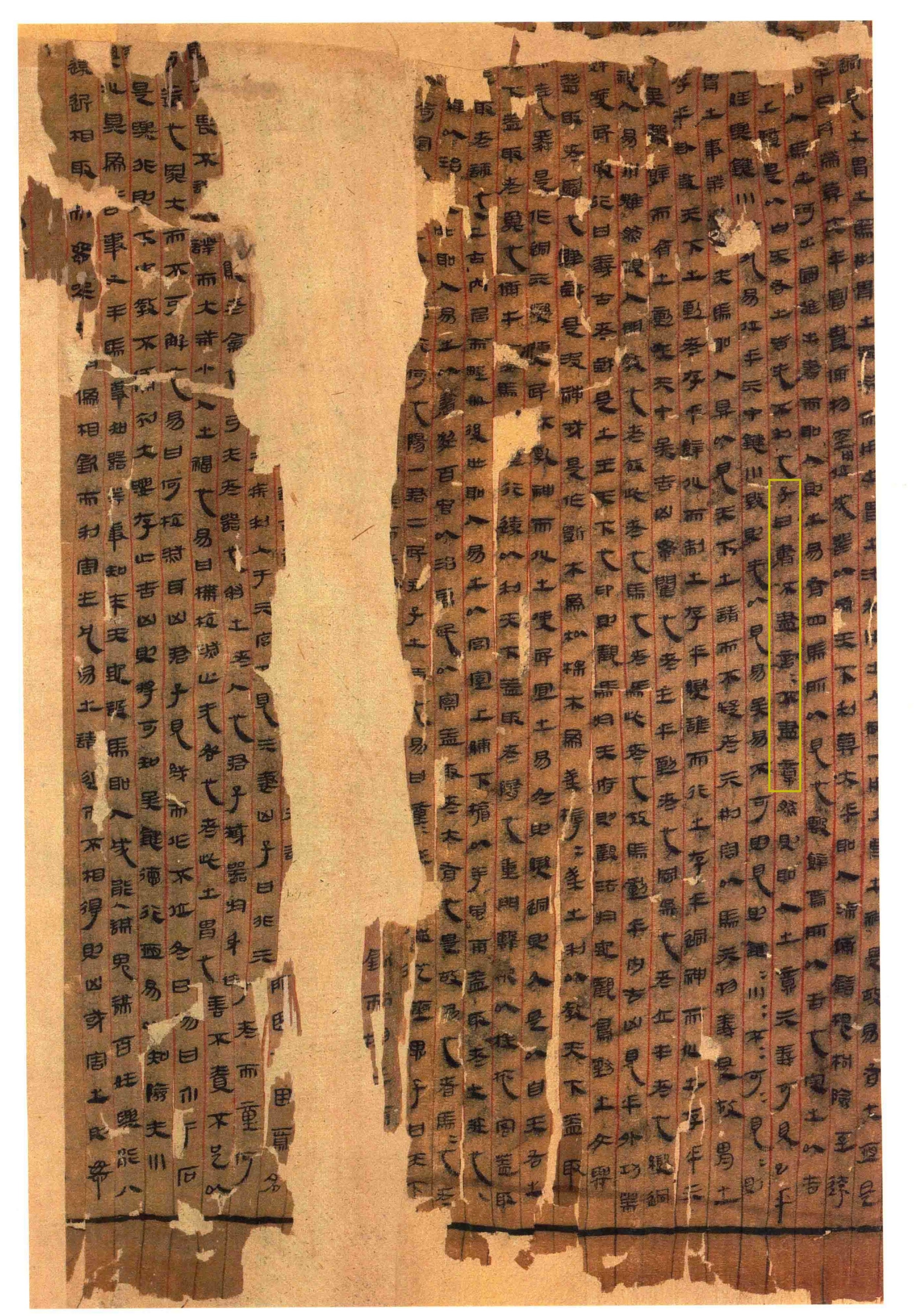
- 書不盡言,言不盡意。Punctuated transcription
Shū bù jìn yán, yán bù jìn yì. Modern Pronunciation (Pinyin) - Translation:
- “Writings do not exhaust words; words do not exhaust meaning.”
Additional Information:
The saying is attributed to Confucius (ca. 551–479 BCE) and is found in a chapter of the Yìjīng 易經 (Classic of Changes) which reflects on the origins of the work and elaborates its broader significance for understanding and anticipating the ever-changing nature of the world. The image is taken from the earliest reliable witness to this chapter, a silk manuscript unearthed from a tomb near Changsha. The tomb was sealed in 168 BCE; the chapter itself, however, is generally believed to be at least a century older. Whether the attribution to Confucius is reliable cannot be determined, and modern scholarship tends to treat it with skepticism.
Chinese writing emerged as a logographic script that originally included many pictographic elements depicting concrete objects and actions. Over time, these forms became increasingly abstract as the script developed, and many characters were borrowed to write homophonous words. By the time that the manuscript was produced, the writing system had assumed a form similar to that used today, and many of its pictographic origins had become difficult to discern. The character for the first word, “writing” (shū 書), for example, originally depicted a hand holding a brush. This origin remains faintly visible, though perhaps only to those familiar with earlier forms of the character (e.g., ) and with the fact that writing with brush and ink was the standard practice in early China.
Like many other ancient languages, Chinese was written in scriptio continua, without punctuation or clear markers separating individual words (indeed, the very concept of the “word” was largely overshadowed by that of the “character”). That said, occasional textual markers do appear. One such device, visible in the example above, is the iteration sign consisting of two short vertical strokes placed after the fourth character yán 言 (“word”), indicating the repetition of the preceding character.
Click here to get back to game!