Vikings in the fog of history
How clichés about Vikings arose and why they remain powerful to this day – Professor of Old Norse Verena Höfig unpacks the truth behind the myth.

How clichés about Vikings arose and why they remain powerful to this day – Professor of Old Norse Verena Höfig unpacks the truth behind the myth.
In all likelihood, the morning of 8 June 793 began like any other for the monks of Lindisfarne. The monastery grounds would have been a hive of activity, and seagulls would have circled over the island. And then unfamiliar sails appeared on the horizon. Soon thereafter, the monastery’s wooden buildings were on fire, relics were being stolen, and monks were being kidnapped or killed. News of the raid spread quickly – and with it the image of the Vikings as merciless plunderers from the north.
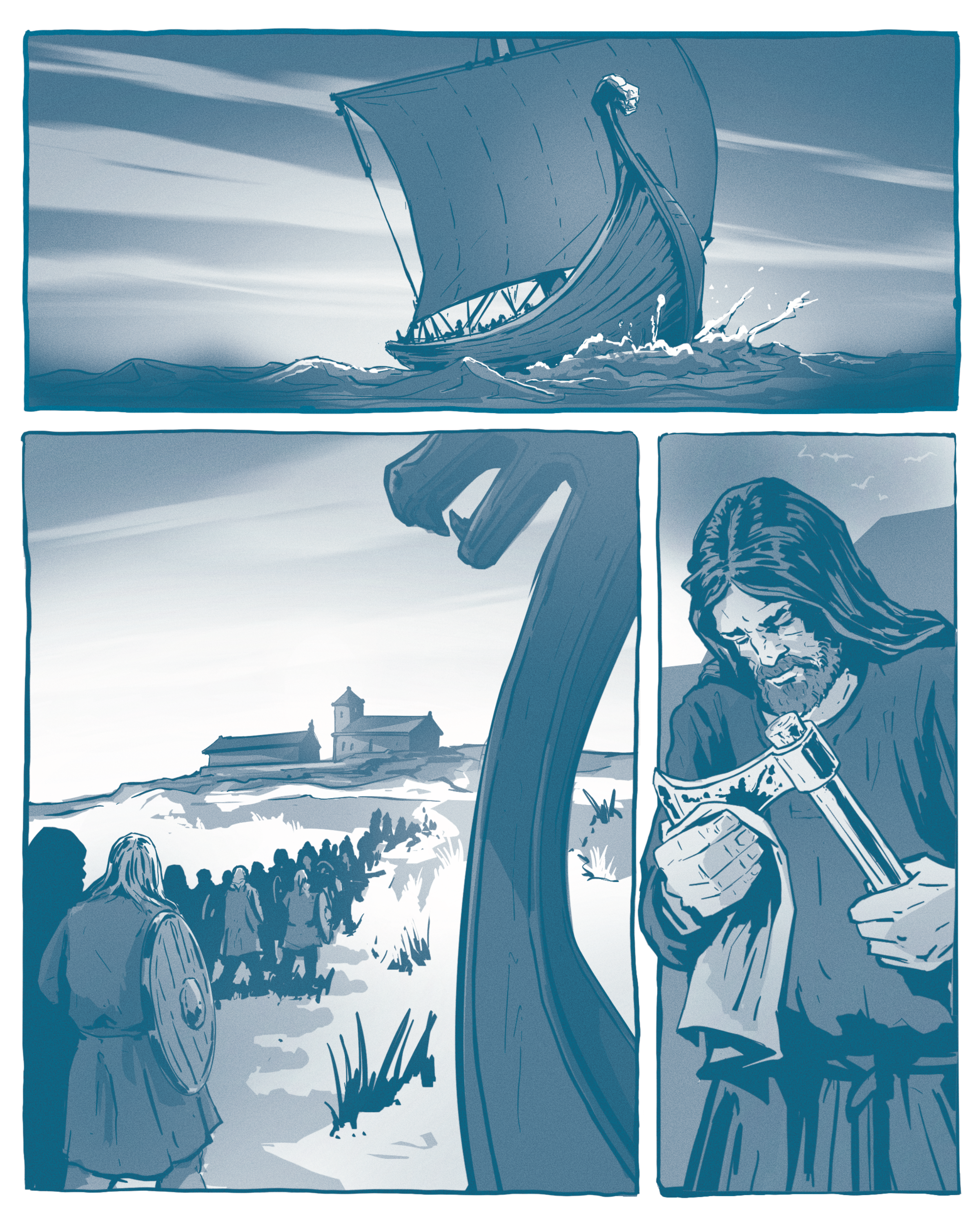
As the first recorded Viking raid, legends still surround the attack on the monastery today. It is the starting point for many films and series about Vikings.
© LMU / Jörn Jakob PeperMore than twelve centuries later, these images continue to resonate. But what we know as ‘the Vikings’ today has got more to do with cultural projection than historical reality. “Our vision of the past often says more about us than about the Early Middle Ages,” observes Verena Höfig. The Professor of Old Norse Studies at LMU studies who the Vikings really were and why they lend themselves so readily to reinterpretations.

Horned helmets are part of the pop culture image of Vikings. However, this depiction was only popularized in the 19th century by the stage design in Wagner's opera “Der Ring des Nibelungen” (The Ring of the Nibelung). | © LMU / Jörn Jakob Peper
In today’s popular culture, Vikings are invariably portrayed as wild warriors with weathered faces, fur coats, and huge axes. Productions like Vikings and The Northman paint a picture of archaic masculinity and freedom. In video games, the Viking becomes a character to battle your way through a world “in which rules do not apply,” as Höfig describes it. “Vikings often embody a departure from societal norms, a counterpoint to a present which many people perceive as overregulated.”
In the world of marketing, too, Norsemen have become trademarks: beard care products, fitness programs, and nutrition guides all sport the name “modern Viking” in an attempt to attract customers. “Vikings stand for strength, authenticity, and rebellion,” says Höfig. “This esthetic sells well, but it’s got little to do with historical reality.”
After all, Scandinavian society in the Early Middle Ages was largely agricultural in nature. People lived as farmers, fishermen, or craftsmen. Only a small proportion actually went on raids. These seafarers called themselves víkingr. This describes an occupation, Höfig emphasizes: “Viking is never an ethnonym – it is a condition, not a people.” She notes that contemporary sources generally referred to Norsemen or Danes when talking about the Scandinavian population of the Early Middle Ages.
Verena Höfig
The image of the blonde giant is also a simplification. Finds from Viking trading sites showed a mixed population. Rune stones, imported goods, and coins point to contacts with eastern Europe, Byzantium, and the Arab world. In Scandinavian graves, archeologists have found silk fabrics and other exotic objects. “The Viking period was a time of movement and exchange,” says Höfig. “Ethnically and culturally, it was significantly more diverse than today’s clichés would have you think.”
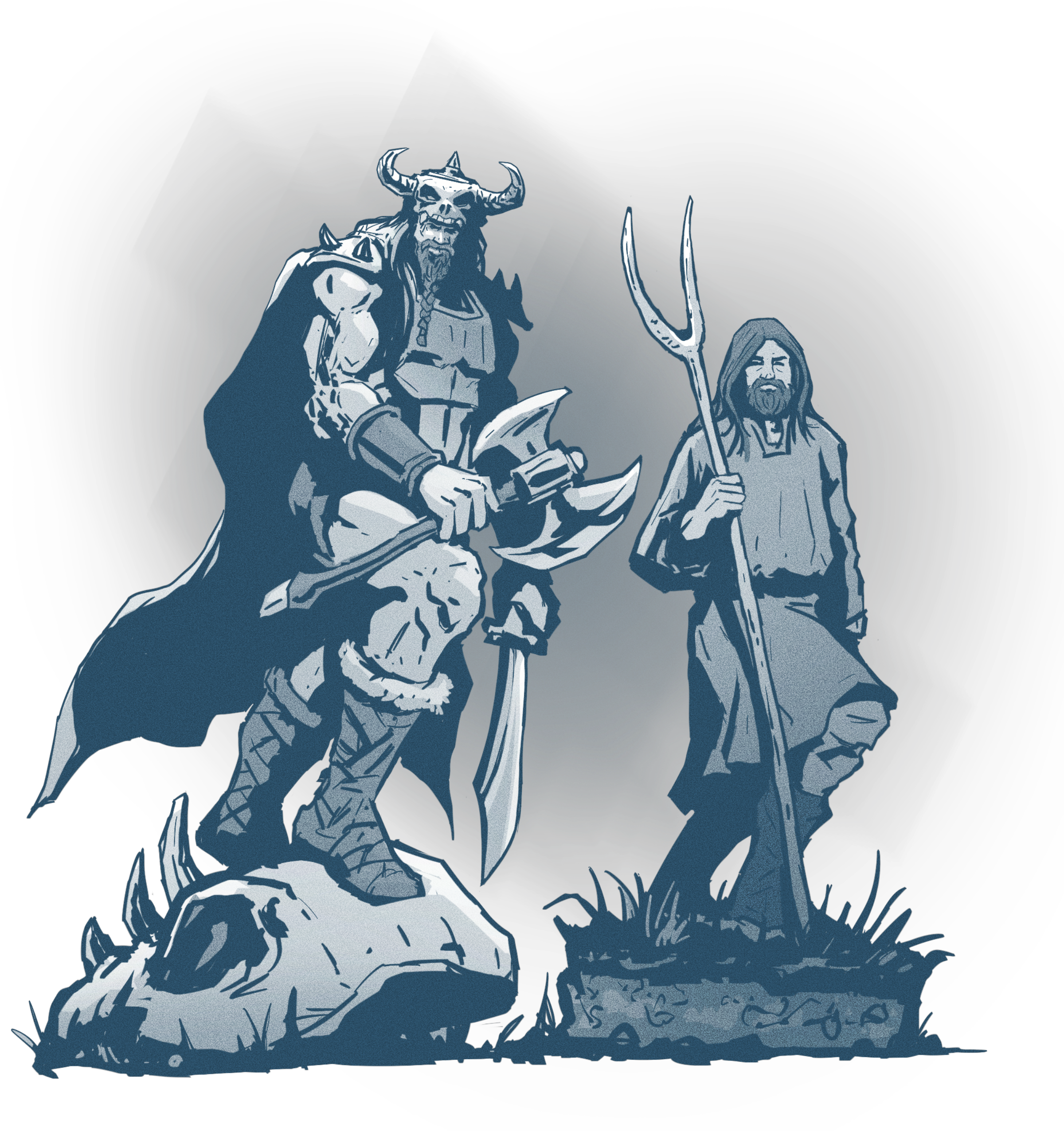
Pitchfork instead of battle axe: the media's zeitgeist is dominated by images of muscle-bound robbers, but in reality, the Northmen were more concerned with field work than raiding.
© LMU / Jörn Jakob PeperBeyond the historical reality, each era has formed its own image of the Vikings. Directly after the plundering of Lindisfarne, it was chiefly the victims who shaped this image. The Anglo-Saxon Chronicle and authors like the scholar Alcuin of York crafted a highly tendentious image: “barbarian heathens from the north,” a “terrible portent” and harbinger of doom. “Others could have reported that there had long been trade with Scandinavians,” says Höfig, “but what has survived for the most part are reports that enshrine a historical picture of the Norsemen as an apocalyptic threat.”
Centuries later, these ‘barbarians’ were recast in a new light. In the late 18th and above all in the 19th century, German Romantic nationalists rediscovered the north as the source of their own culture. After the social upheavals following the Napoleonic wars, a powerful need for national self-reassurance arose in large parts of this intellectual milieu.
“People were searching for an alternative to the Western Christian cultural model,” explains Höfig. “Scandinavia offered a canvas for projection that was supposedly closer to their own origins.” In this intellectual milieu, the Norsemen were stylized as the heroic ancestors of a strong people who were closely connected to nature. This Norseland infatuation, as Höfig dubs it, carried on into the early 20th century and found its extreme in Nazi Germany.
Verena Höfig
What started out as a Romantic harking back to the past became a political weapon in the 20th century. During the Nazi era, Viking motifs were exploited for propaganda purposes. Runes and symbols from Nordic tradition were particularly popular in the SS. Two Sig runes were adopted as the emblem of the organization, while the Othala rune stood for “blood and soil” and the Tyr rune was used as a symbol of military valor.
“The Nazis were very selective in their use of Nordic motifs,” says Höfig. In school materials, illustrated books, and SS publications, Vikings were portrayed as tough, warlike Arian ancestors – a deliberately idealized image that was designed above all to convey a martial spirit of self-sacrifice.

Mjölnir, the hammer of Thor, god of thunder, is a popular symbol and is usually worn without any political connotations - but right-wing extremist groups have claimed the symbol for themselves. | © LMU / Jörn Jakob Peper
These interpretive patterns did not fully disappear after 1945. Sections of the New Right draw on the same imagery to this day to give a spurious veneer of historical legitimacy to their ideologies. Hammers of Thor, runes, and images of Nordic gods crop up in far-right milieus and subcultures steeped in conspiracy theories. Höfig emphasizes: “This is not people engaging with history, but looking for a mythical origin to prop up their own ideology.”
Springing up alongside the New Right but coming from a very different place, neopagan movements such as Asatru (“belief in the Æsir”) have been trying to reanimate pre-Christian Scandinavian beliefs since the 1970s. “More and more people are turning away from the established churches and are searching for a spiritual alternative,” explains Höfig. Many followers of Asatru practice a spiritual paganism replete with seasonal festivals, worship of gods, and rune symbolism. Often a strong emphasis on closeness to nature and environmental protection also play a role.
But the scene is heterogenous. A small, radical subset reinterprets these symbols in ethnic terms and connects them to blood-and-soil narratives. In these milieus, ideas of cultural purity combine with an ecologically charged ideology. “The large majority of people carry Thor hammers and have rune tattoos out of entirely harmless enthusiasm for Scandinavian culture. However, these overlaps make the symbolism highly ambivalent,” notes Höfig, “because from the outside you can hardly tell if they represent spirituality or political ideology.”

Women played important roles in the early Middle Ages in Scandinavia, particularly in the area of worship. Today, neo-pagan movements are reviving some of these traditions. | © LMU / Jörn Jakob Peper
The fantasies of neo-Nazis or extremist neopagans do not end with origins. Gender images also become a site of projection in our time of gender-political upheaval. In groups that appeal to Nordic masculinity, the Viking is stylized as the epitome of the sturdy man who is ready for battle – as a counterfigure to a supposedly soft or decadent female-dominated society. In portions of the so-called manosphere and the alt-right, handbooks circulate with titles like “How to be a modern Viking,” supplemented by training plans, diets, and haircuts.
Although Höfig cautions against idealizing the Viking period as feminist – “This was a patriarchal society” – there were spaces nevertheless in which women could exercise great power – in the sphere of religious worship, for example, or as wealthy widows with their own property. In addition, women were allowed to divorce their husbands and have influence over male representatives at political assemblies. In the Icelandic sagas, moreover, we encounter exceptional women who fought or ruled. Höfig points out that older Nordic categories did not distinguish so much between man and woman as between strong/active and weak/passive – roles which could include people of all forms of gender expression.
Verena Höfig
The question remains: Why are so many groups today appropriating the Vikings – and not the Celts, say, or the Trojans, or the samurai? Höfig identifies several reasons for this: From the western and central European perspective, the Nordic world is situated in an intermediate zone: geographically far enough away to seem exotic, but culturally close enough to count as its own past. “Vikings stand apart from the Western Christian ideal, but are not as foreign as samurai or Mongols,” observes Höfig. “It’s a counterculture within their own cultural sphere.”
On top of this, there is a pragmatic element: The historical Viking culture is small, straightforward, and can be appropriated with relatively little in the way of resistance. “Hardly anyone protests when you caricature Vikings – as sport mascots, brand logos, or characters to advertise packet soup,” says Höfig. It is precisely this lack of resistance that makes Vikings so flexible: a blank screen for projecting rebellion, a symbol of strength, and a suite of identities to be claimed by pop culture, the alt-right, and ecofascists as needed.
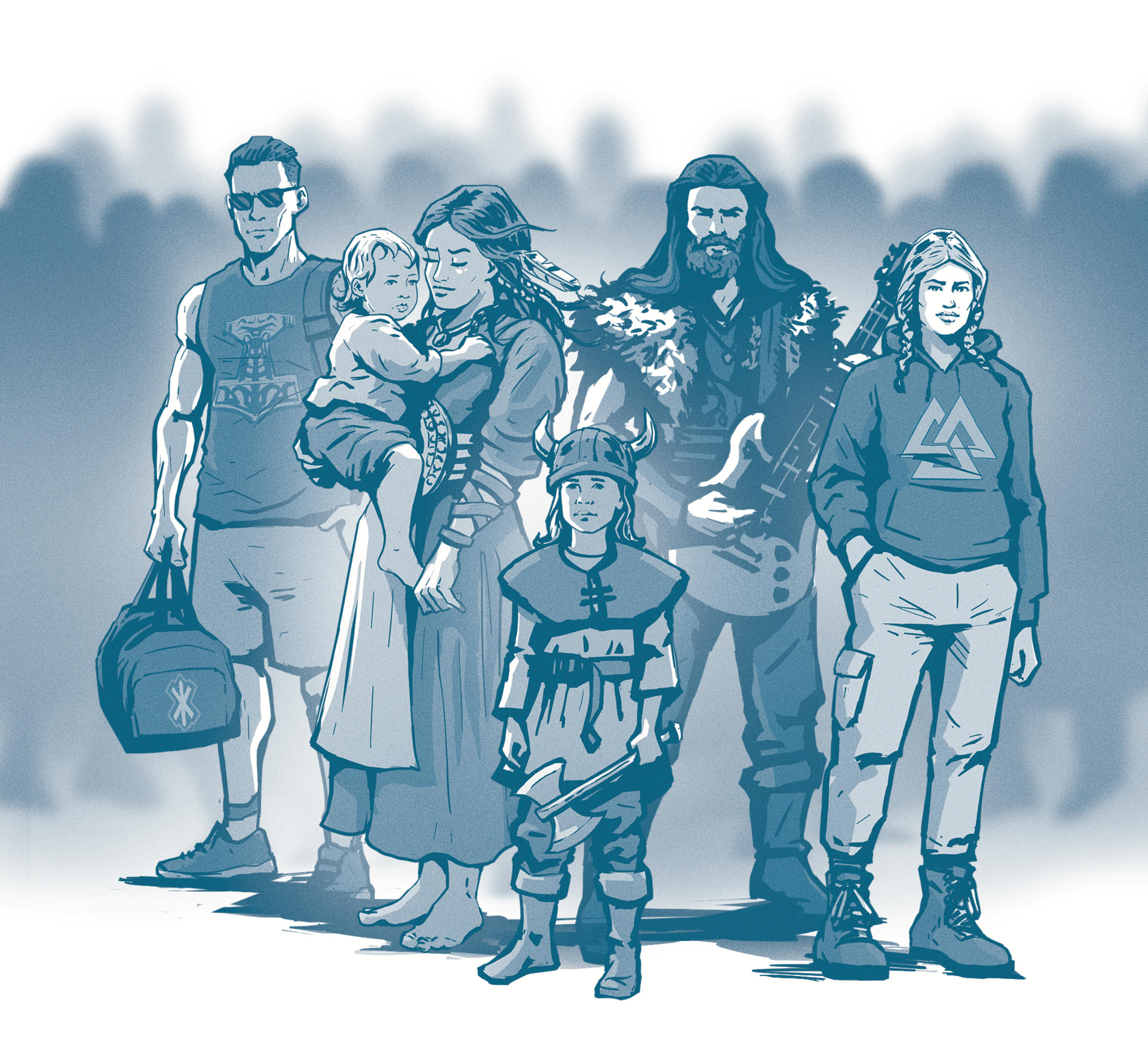
Whether on clothing, in children's TV series, at heavy metal concerts, or in spiritual practices. Borrowings from the world of the Vikings can be found in many areas of everyday life.
© LMU / Jörn Jakob PeperAnd finally, notes Höfig, current notions continue to be influenced by the earliest descriptions of the Vikings, where a deliberately exaggerated image was created of wild, capricious heathens. And so it all comes back to Lindisfarne: The martial exaggeration of the chroniclers proved productive. “It lends itself excellently, then as now, to attempts to draw a contrast to a present day perceived as decadent,” says Höfig. The common image of the Vikings thus derives its strength less from their putative wildness or masculinity, but because it has always embodied a contrast to the status quo which replaces the complexity of the present with an idealized past.
Verena Höfig is Professor of Old Scandinavian Studies at the Institute of Nordic Philology at LMU.
Read more articles from LMU's research magazine in the online section and never miss an issue by activating the magazine alert!