News
A wall full of sea creatures: Art meets science
13 May 2026
The artist Javier Espinosa has created an underwater mural at the Biocenter. Researchers and students from LMU contributed their ideas.

13 May 2026
The artist Javier Espinosa has created an underwater mural at the Biocenter. Researchers and students from LMU contributed their ideas.
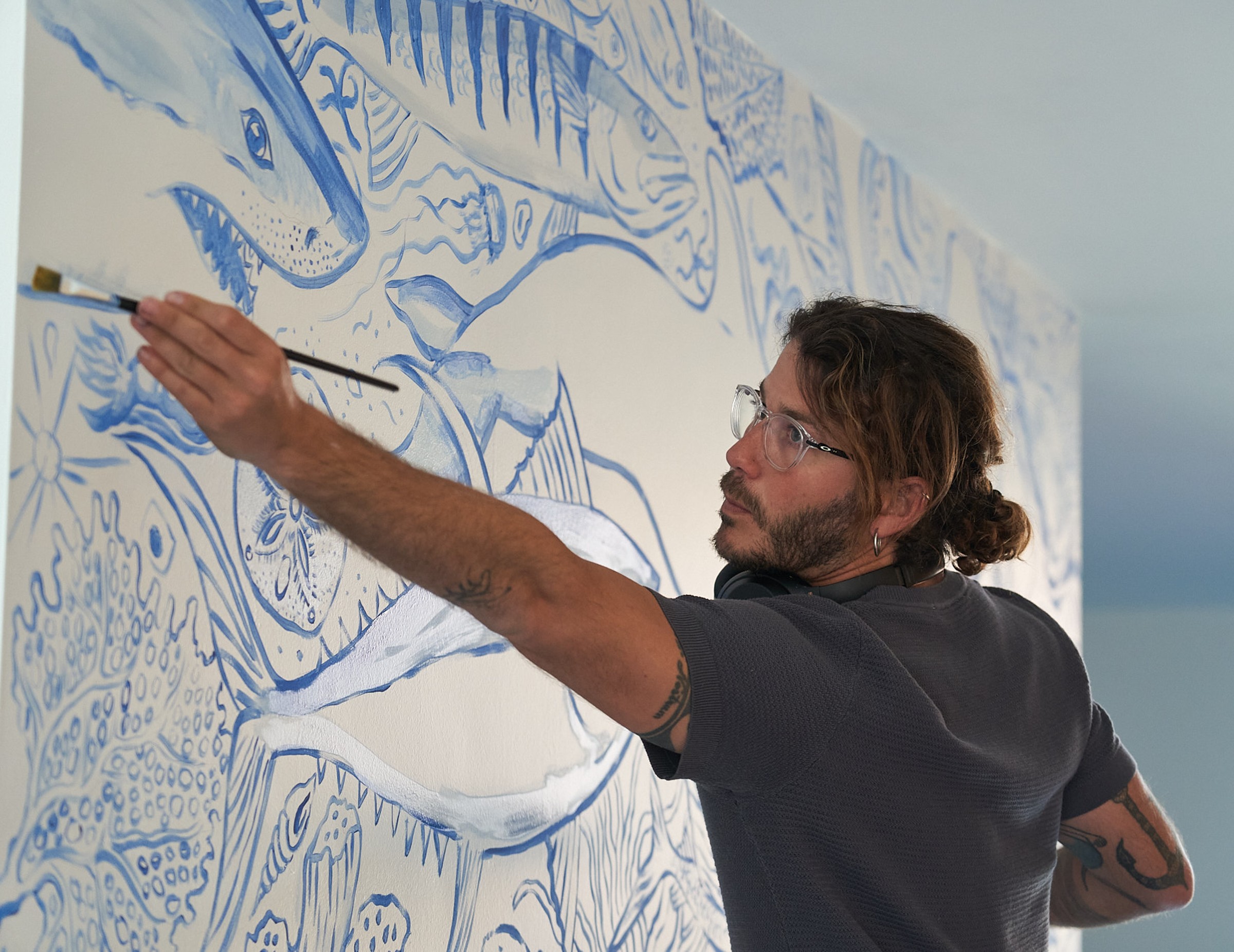
Javier Espinosa has painted the walls in LMU’s Biocenter with motifs that he is familiar with from his experience of working as a diving instructor. In the artistic process, he expanded these motifs to include other marine organisms that biologists are researching in the surrounding laboratories. “I found the experience of engaging with the researchers very enriching and just a great deal of fun,” says Espinosa.
© Carolin BleeseFish, corals and underwater landscapes: The Spanish artist Javier Espinosa usually paints motifs that he is familiar with from his experience of working as a diving instructor and underwater guide. To create a mural at LMU’s Biocenter, he has now expanded his range of motifs to include organisms that are the focus of research taking place in the surrounding laboratories. For example, there are now also sponges and bacteria in a bold blue color and clear shapes lining the corridor.
Creating this mural at the Biocenter is one of the nicest assignments I’ve had in my career as an artist.Javier Espinosa
“Protecting the underwater world is a subject very close to my heart,” explains Espinosa. “I’ve now expressed this passion at the Biocenter in a work that combines art and science.” The artist, who in the past has depicted sea creatures on whole ship hulls and facades of buildings, spent three days painting the walls of the building complex in Martinsried. On the second floor, he has created around 150 different species of animals and organisms between lockers and glass doors.
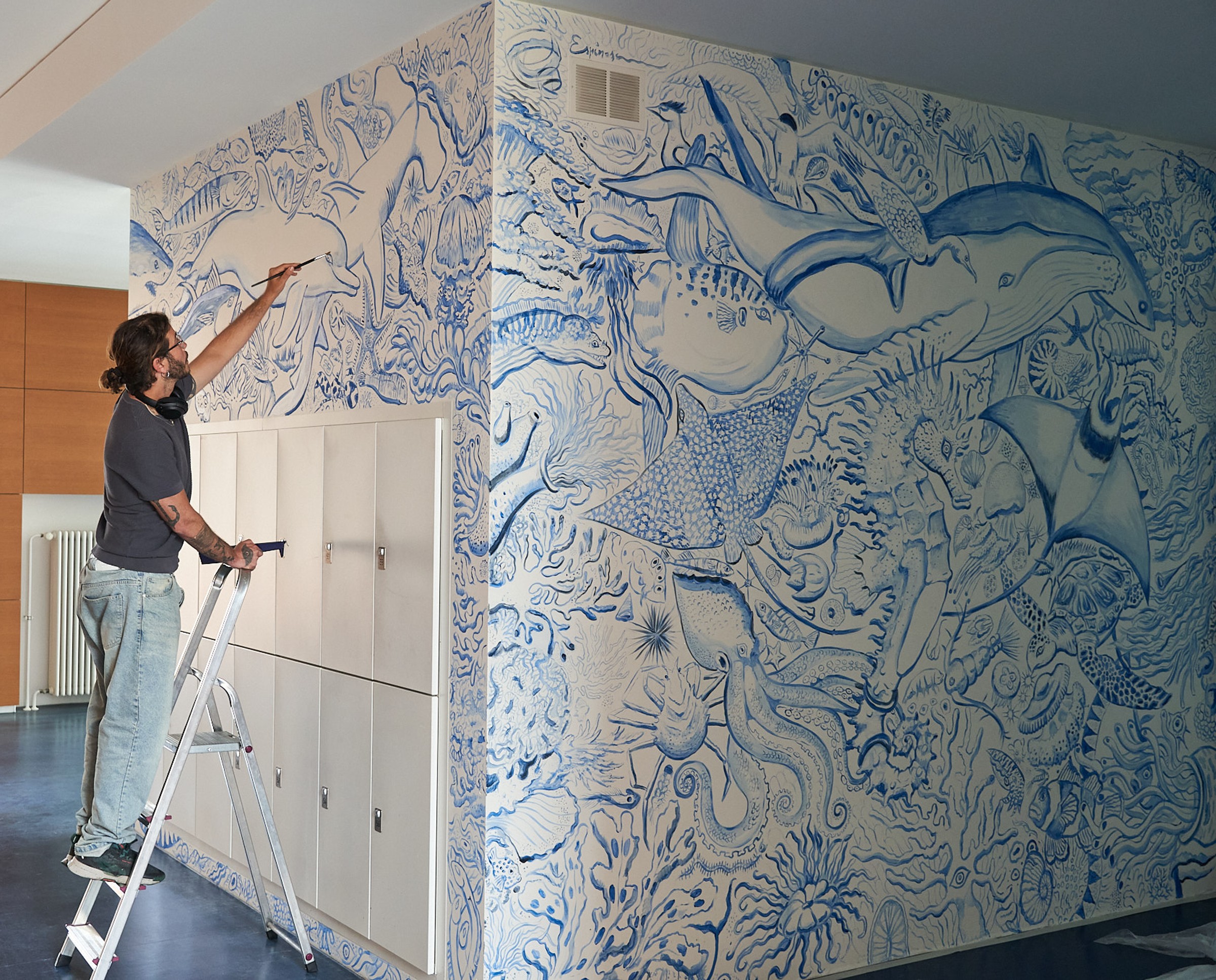
“As a child, all I wanted to do was explore and observe animals underwater and by the time I was eleven I’d already completed more than 100 dives,” says Javier Espinosa. One example of Espinosa’s largest works on public display is the facade of the Colegio Mediterráneo in Águilas, which includes a giant “unicorn seahorse”. He is also a member of the international project ¡vamos, simbiosis!, which was co-initiated by Annika Guse.
© Carolin Bleese“I wanted to create a composition of creatures and organisms that will accompany both students and teaching staff and researchers as they go about their daily lives at the Biocenter,” says the artist. While he was painting the mural, he asked the staff working in the surrounding laboratories to contribute their own ideas and suggestions to the artistic process. “Many of them suggested their current research objects as motifs.”
Spaß, Enthusiasmus und wissenschaftliche Kreativität entstehen in einem anregenden Umfeld. Deshalb setze ich mich dafür ein, unsere Forschungsumgebung schöner, einladender und spielerischer zu gestalten.Annika Guse

Biologist Herwig Stibor (left) with the artist Javier Espinosa and the biologist Annika Guse in front of one of the newly decorated walls at LMU’s Biocenter. | © Carolin Bleese
Using a brush and blue emulsion paint, Espinosa painted the ideas he collected directly onto the wall. Alongside rays and turtles, you can now also see organisms that scientists working at the Biocenter are studying. These include jellyfish, microscopic plankton or the nematode C. elegans, which is used as a model organism in research.
“Science should be fun,” believes LMU molecular biologist, Professor Annika Guse, who initiated the project. “And fun, enthusiasm and scientific creativity all emerge in a stimulating environment.” Laboratories and scientific institutions can often seem like rather sterile places. “That’s why I’m committed to making our research environment more attractive, more inviting and more fun,” says Guse, whose own research focuses on the symbiosis between corals and algae. “Because I believe that this will also benefit science in the long run.”
Herwig Stibor, Professor of Aquatic Ecology and Dean of the Faculty of Biology, also sees benefits in combining art and science. “Particularly for a faculty whose work is primarily analytical, art is about much more than just decoration,” he explains. “That’s because it also gives researchers the opportunity to expand their own ways of thinking.” This may also lead to better communication and critical reflection on one’s own research.
To make it easier for colleagues to pause and reflect in front of the mural in future, Annika Guse also wants to place a small bench in the corridor and install warm lighting. “My aim is to enable the researchers working there to identify more strongly with the Biocenter and celebrate the diversity of life and not least of our research.”