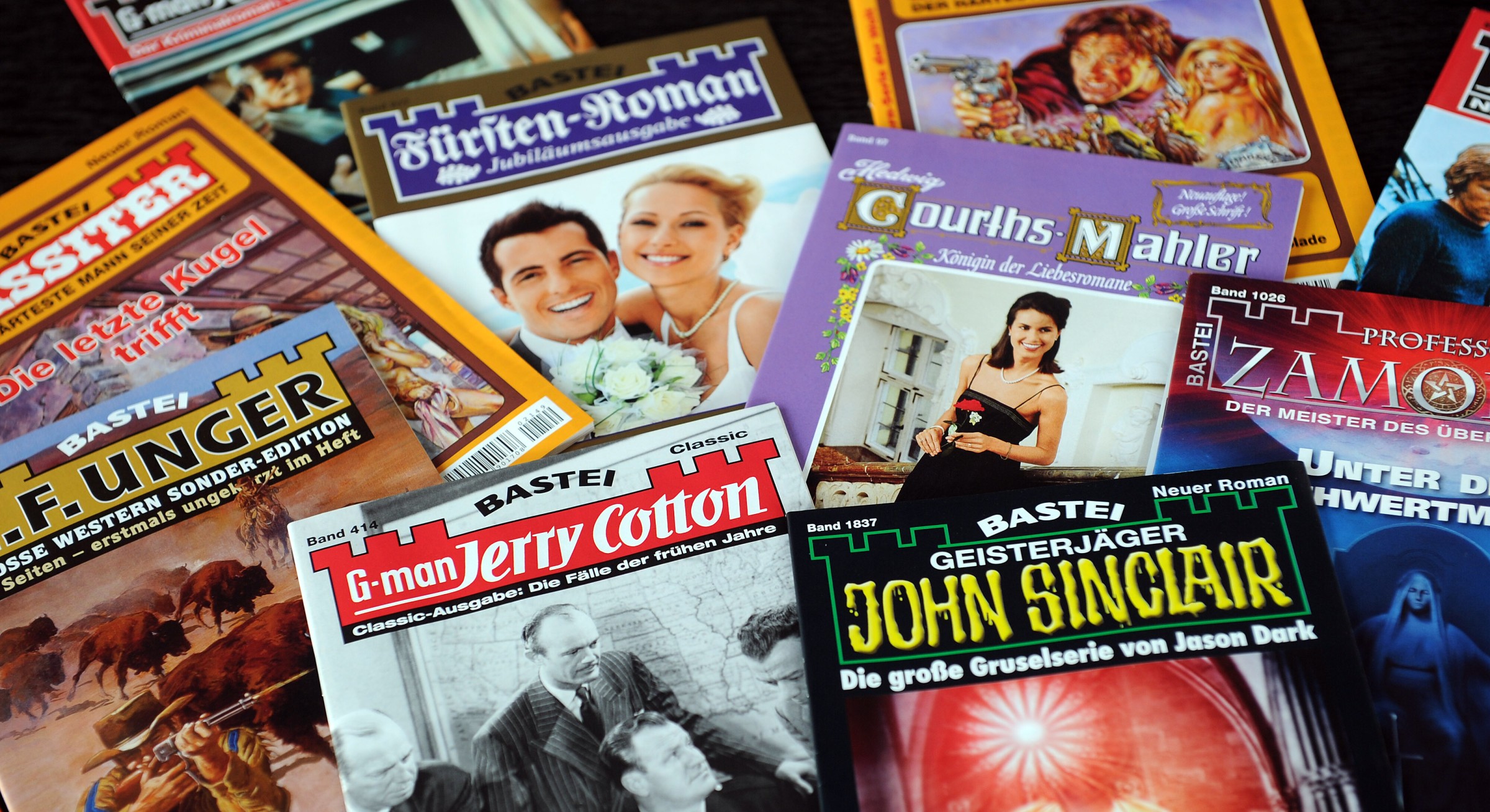
Lovers, scoundrels, immortals, infallible heroines: with dense plots, dramatic conflicts, and vivid settings, the dime novel has been highly popular in Germany for over a hundred years. Whether readers prefer romances, crime thrillers, or science fiction, they love to immerse themselves in gripping stories in a handy format that traditionally spans 64 pages.
Despite its long tradition and its massive success, the dime novel has received scant academic attention. Yet the texts, which are simple and deliberately so, develop their own forms of complexity, not least through their abundance and serialized form. The new German Research Foundation (DFG) research group Medium – Commodity – Work: The German Dime Novel from 1913 to the Present will be analyzing this special market.
Prof. Dr. Carola Metzner-Nebelsick, LMU Vice President for Humanities: “This funding award demonstrates the strength of LMU in the humanities, which are not a fringe pursuit at our university, but a cornerstone of our academic identity. They shape our image through methodological diversity, historical depth, and the powerful mirror they hold up to society. The research group is mining hitherto unexploited resources in their project, especially through the use of AI for language pattern recognition. The dime novel – produced in huge print runs for more than a century and spanning significant historical and social upheavals – offers a vast untapped source of knowledge and insights from the sphere of popular culture. At the same time, the researchers are addressing current topics and trends such as self-publishing, BookTok, and enthusiasm for elaborate cover design. In the process, they are analyzing economic phenomena like market concentration in the publishing industry.”
“Previous research, which is scattered across multiple disciplines and has its origins in the start of the twentieth century, has done justice to the fullness and individuality of the dime novel – as a phenomenon of literature that is actually read – only to a rather selective extent,” says Christine Haug, Professor at the Centre for Book Studies at LMU and spokesperson for the new research group.
Texts that reach their readers
The project scholars are interested in the production conditions and distribution channels of the dime novel as well as in the development of concentration processes, monopolization tendencies, and market trends. In addition, the researchers plan to investigate the special role of the authors in contrast to conventional publishing arrangements, and to analyze innovations such as the emergence of new genres and new trends in book cover design.
In close consultation with each other, the subprojects will look at the romance dime novel, which is still pretty much terra incognita in research, from a variety of disciplinary perspectives. They will explore the progressive loss of series diversity in crime novels and analyze plot and character constellations in science fiction and other genres. In addition, the project will undertake a bibliography of the German dime novel from its beginnings to the present day. This bibliography will include so-called paratextual elements – authors and illustrators, publishers and advertisements – for the first time.
Using a range of methodological approaches and involving participants from various disciplines, from computational philology and art history to book studies and literary studies, the interdisciplinary project will systematically map a research field about which we still know astonishingly little despite – or perhaps because of? – its popularity, and which has received sporadic scholarly attention to date.
Access to huge, digitized archive
An indispensable cooperation partner of the new research consortium is the German National Library. “The Leipzig branch has been collecting dime novels since 1913, building up a particularly large stock,” says Christine Haug. Under the leadership of Dr. Stephanie Jacobs, director of the German Museum of Books and Writing in the German National Library and active member of the Centre for Book Studies for many years, the librarians have already digitized these holdings in advance and made them accessible to the researchers in the consortium.
AI and literature: Prose ex machina
Read more
The new research group is comprised of several subprojects. As well as spokesperson Christine Haug, the LMU project contingent includes Johannes Frimmel from the Centre for Book Studies and Julian Schröter, Professor of Digital Literary Studies. In addition, Weißensee School of Art and Design, the University of Würzburg (JMU), HU Berlin, and the University of Potsdam are members of the consortium. Taking part in German Research Foundation (DFG) research groups allows scholars to devote themselves to current and pressing issues in their fields of expertise and establish innovative research directions. The groups are funded for a period of up to eight years.