A new Argonne- und LMU led analysis based on five years of South Pole Telescope data detects tiny shadows imprinted on the afterglow of the Big Bang: more than 7,000 galaxy clusters found
Around 1,800 galaxy clusters in the new catalog are so distant that their light has traveled for more than 8 billion years to reach us. A research team led by Argonne and LMU Munich has now published one of the deepest censuses of massive, distant galaxy clusters to date.
The catalog is based on five years of observations from the SPT-3G experiment at the Amundsen–Scott South Pole Station in Antarctica. Using highly sensitive measurements of the cosmic microwave background—the faint afterglow of the Big Bang—the international team identified 8,892 galaxy cluster candidates and confirmed 7,190 of them using optical and infrared data. Researchers from institutions around the world contributed to the project, including LMU Munich.
Counting galaxies clusters from the south pole
Data from the South Pole Telescope (pictured) help to map the large-scale distribution of galaxies clusters in the universe.
The catalog's reach into the distant universe is particularly striking: the SPT-3G catalog contains about 1,800 confirmed galaxy clusters at redshifts greater than 1. Redshift is a measure of cosmic distance and lookback time: the higher the redshift, the earlier in the history of the universe we observe an object. The new SPT-3G catalog contains about 50% more such distant systems than in the largest previous SZ-selected catalog, even though SPT-3G surveyed a region of sky roughly ten times smaller.
Roughly one in five confirmed galaxy clusters does not appear in any previous catalog. For about two-thirds of the sample—4,824 systems—this also represents the first detection of the hot gas that fills the space between the galaxies within these clusters.
“Our analysis draws on the SPT-3G’s phenomenally deep CMB data to open a new window onto the ancient universe,” said Lindsey Bleem, a physicist at Argonne National Laboratory and lead author of the study. “It's a new milestone for cluster cosmology to have this catalog as a resource. It will be the core of many, many studies over the years to come.”
It is really exciting to see this latest, spectacular cluster catalog from SPT and DES.
Joe Mohr, Professor of physics at LMU and co-founder of the SPT and of the Dark Energy Survey (DES)
SPT-3G is the camera mounted on the South Pole Telescope. It was upgraded in 2017 with 16,000 detectors built at Argonne. "It is really exciting to see this latest, spectacular cluster catalog from SPT and DES," said Joe Mohr, professor of physics at LMU Munich and co-founder of the SPT and of the Dark Energy Survey (DES), which is the source of most of the optical follow-up data used to confirm the cluster sample. "We continue to harvest new discoveries from these two survey projects more than a decade after their first light!”
Galaxy clusters are the largest gravitationally collapsed systems in the universe. They contain hundreds to thousands of galaxies, hot gas, and large amounts of dark matter. Their abundance and distribution reveal how cosmic structures grow, providing important clues about the nature of dark matter and dark energy.
The new galaxy clusters were not discovered through their starlight, but through tiny shadows cast on the cosmic microwave background. As this ancient light passes through the hot gas in a galaxy cluster, part of it is shifted to higher energies. In the lower-frequency SPT-3G maps, the clusters therefore appear as faint dark spots. This signature is known as the Sunyaev–Zeldovich (SZ) effect.
This detection technique is precisely what makes SPT-3G especially powerful for finding distant galaxy clusters. While previous surveys covered much larger areas of the sky, SPT-3G probes much deeper within a smaller region. It detects fainter signals, lower-mass systems, and more distant clusters, creating an exceptionally rich SZ catalog.
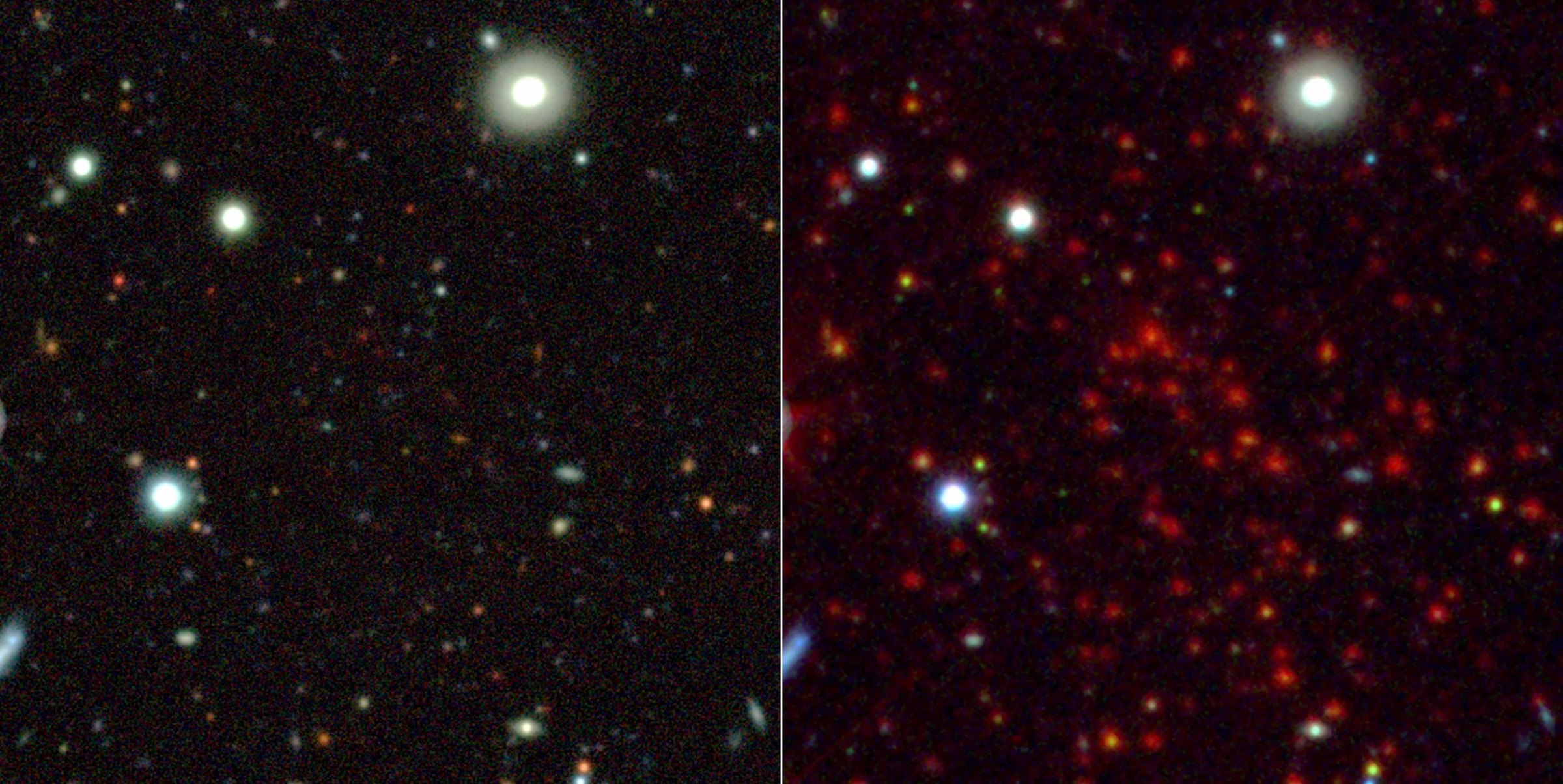
Extremely distant galaxy cluster
One of the key challenges of this project is identifying extremely distant galaxy clusters like SPT-CL J0313.9-5334.6 . They are so highly redshifted (1.474) and so far away that they are barely visible in optical observations (left). Only infrared observations (right) clearly reveal the galaxies that make up the cluster.
With the SPT-3G galaxy cluster sample, we will investigate the evolution of cosmic structure formation over the past 10 billion years.
Sebastian Bocquet
"Working with our automated pipeline for confirming SPT-3G candidates and measuring their redshifts, I inspected many of these systems in optical and infrared imaging data as part of the quality-control process," said Matthias Klein, scientist at the LMU Observatory. "Seeing the galaxy clusters behind the microwave signals with my own eyes makes me even more excited about the science this sample will enable."
“Building a catalog like this takes a lot of careful checking behind the scenes,” said Kayla Kornoelje, a University of Chicago graduate student. “A big part of our work was making sure the detections are reliable so that this sample can be used with confidence in future cosmological studies.”
The catalog also provides new insights into the evolution of galaxy clusters themselves. Because SPT-3G observes at multiple microwave frequencies, the team was able to study additional emission from material within and around the clusters. They found significantly stronger dust emission in galaxy clusters observed at earlier epochs of the universe, pointing to enhanced star formation in these environments.
Seeing the galaxy clusters behind the microwave signals with my own eyes makes me even more excited about the science this sample will enable.
Matthias Klein
"With the SPT-3G galaxy cluster sample, we will investigate the evolution of cosmic structure formation over the past 10 billion years," said Sebastian Bocquet, scientist at LMU Munich. He is leading the cosmological analysis of the new galaxy cluster sample.
The next step is to turn this cosmic census into precision cosmology. With refined mass measurements, the team will use the catalog to test how quickly cosmic structure grew over time — a key prediction of models involving dark matter and dark energy. Upcoming surveys, including the European Space Agency’s Euclid mission and LSST at the Vera C. Rubin Observatory, are expected to help confirm even more distant clusters in the SPT-3G data sample.