News
Cosmology: detailed survey of the southern sky
26 Nov 2026
It takes millions of galaxies to understand a universe – the 4MOST collaboration, which includes LMU, is undertaking an ambitious observational program.

26 Nov 2026
It takes millions of galaxies to understand a universe – the 4MOST collaboration, which includes LMU, is undertaking an ambitious observational program.
After years of planning and development, the new 4MOST instrument on the VISTA telescope in Chile is beginning operations, and with it a large-scale scientific program. Over the next five years, researchers, including numerous astrophysicists from LMU, will obtain more than 50 million spectra of celestial objects in a comprehensive observational campaign. Thirty institutes from all over Europe and Australia are taking part in 4MOST. With the active involvement of some 800 scientists, it is one of the largest collaborations in modern astronomical spectroscopy. The 4MOST consortium, which also works with the European Southern Observatory (ESO) in Garching, is led by the Leibniz Institute for Astrophysics Potsdam (AIP).
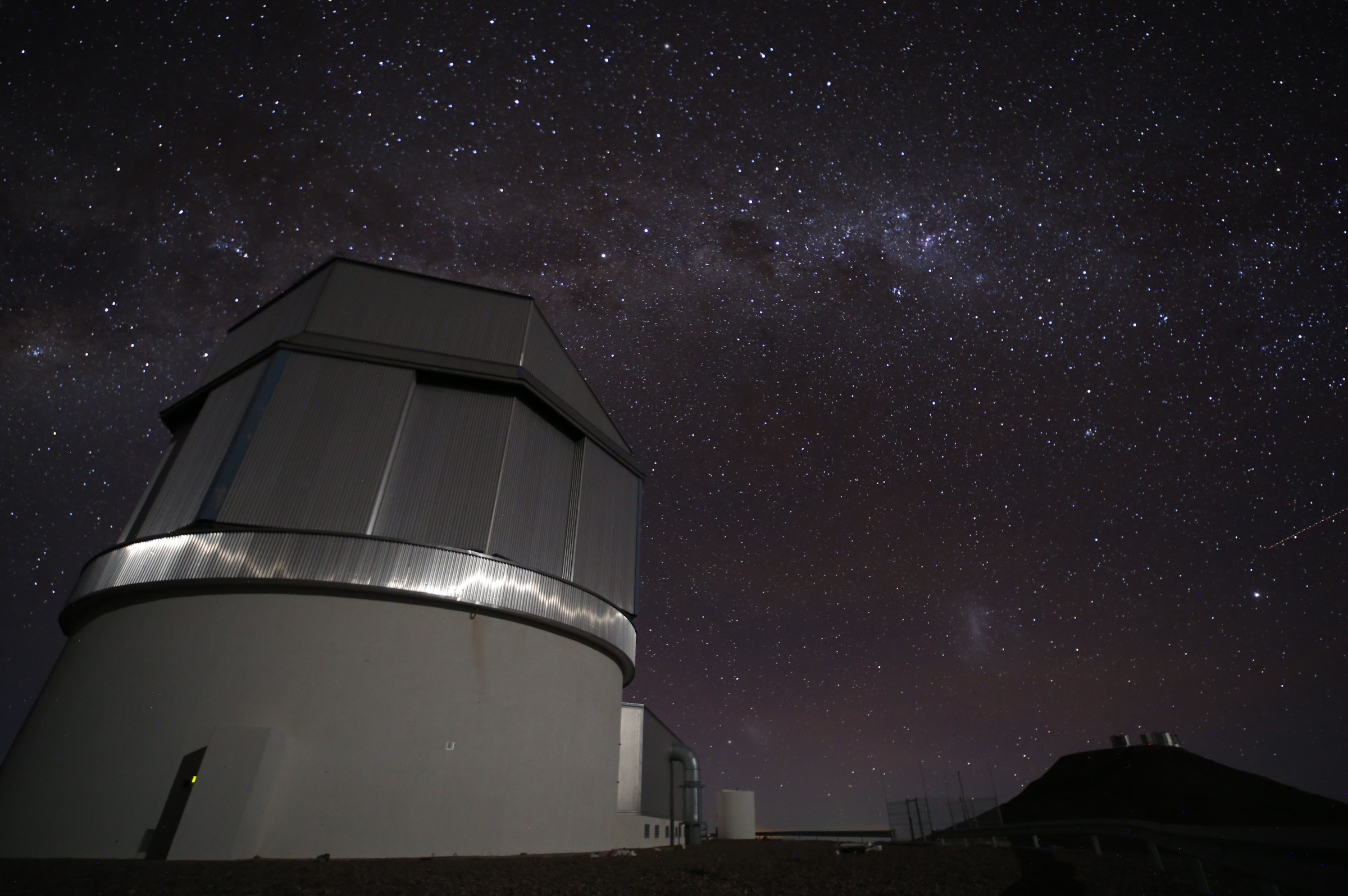
The VISTA telescope (left), in the background the Very Large Telescope (4 domes, right). The Milky Way and the Magellanic Clouds are visible in the sky.
© AIP/A. SaviaukDaniel Grün, Professor of Astrophysics, Cosmology, and Artificial Intelligence at LMU Munich, leads one of the observational programs that 4MOST is now implementing. Together with former LMU doctoral student Dr. Jamie McCullough (Princeton) and LMU astrophysicist Dr. Luca Tortorelli, Grün is measuring the relationship between the apparent color and the distance of galaxies in the 4C3R2 (4MOST Complete Calibration of the Colour-Redshift Relation) project. “When we observe a distant galaxy, its light must have been traveling for billions of years to reach our eyes,” explains Grün. “Because the Universe is expanding in all directions, the light appears redder than it actually is. This effect, known as redshift, is like the change in pitch of an ambulance siren as it moves away from us.” Due to this change in color of the light from galaxies, we can determine the three-dimensional positions of galaxies from multi-color images of the sky.
However, redshift is often difficult to measure, and the results can be ambiguous. To reliably estimate the distances of galaxies from their apparent colors – as we must if we want to use imaging data to understand the physics of the universe – we need more precise distance measurements for some galaxies. To obtain these, we split the light from a galaxy into a spectrum. In this spectrum we can measure the spectral lines of chemical elements, for example, which are also shifted toward the red end of the spectrum.
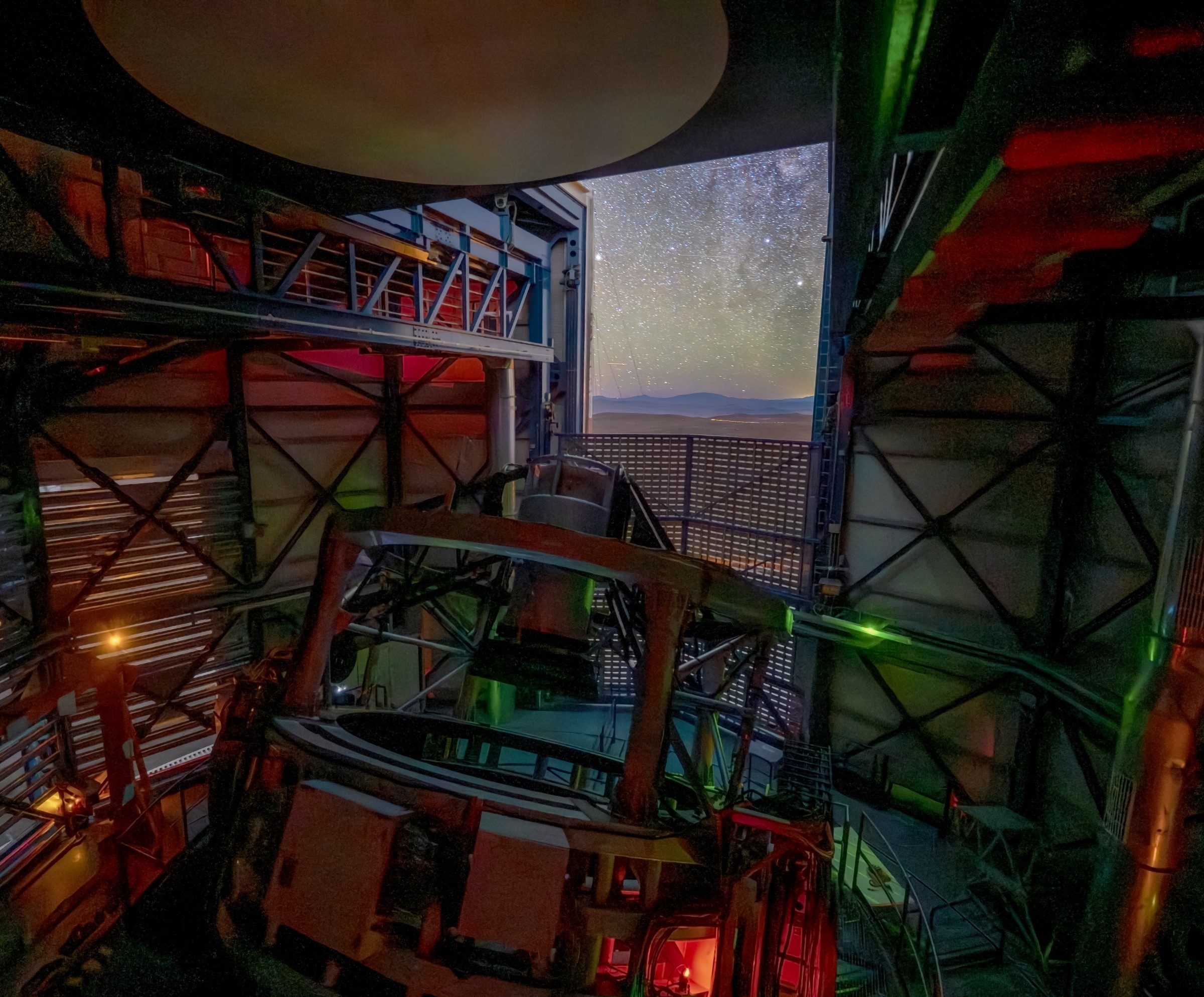
4MOST uses its 2,400 optical fibers to simultaneously analyze the light from various celestial objects.
© 4MOST / Romain Lucchesi“4MOST is a very efficient spectrograph – it collects light from galaxies using a telescope with a mirror diameter of four meters. The telescope is installed on Cerro Paranal mountain in Chile, an optimal location for astronomical observations,” explains Luca Tortorelli, scientific lead of 4C3R2. Moreover, 4MOST is able to do this for 2,400 celestial objects simultaneously, with a device that collects the light of each object with a dedicated glass fiber. “In this way, we will measure the redshifts of almost half a million galaxies over the next five years. With a conventional spectrograph, this would take a million hours.” In collaboration with the WAVES observational program, which measures the redshifts of a large number of nearby galaxies in the same region of the sky, 4C3R2 will determine the distance distribution of galaxies of virtually all existing colors.

Both low-resolution spectrographs were installed successfully at the VISTA telescope in September 2025. | © AIP/A. Saviauk
4MOST is pursuing a novel scientific strategy that makes optimal use of the spectrograph’s capabilities. It is not just implementing one scientific program such as 4C3R2, but 25 different programs at the same time, each with its own celestial objects and scientific goals. “Each 4MOST observation simultaneously contains spectra from old stars, young stars, galaxies, and active galactic nuclei powered by supermassive black holes. So we had to develop a system that enables us to plan, implement, and analyze the data, while also preserving all the information that allows us to create clearly defined samples of the various objects from this wealth of data. This is the result of international cooperation between numerous astronomers from all over the world. To be able to say with confidence: We’re ready – that’s an amazing feeling,” adds Dr. Jakob Walcher from AIP in Potsdam, who is responsible for coordinating the development of the scientific software system that enables the scientific work with 4MOST.
“This is the moment when all the development work of the past 16 years comes together. Astronomers will have access to a genuine treasure trove of data that will help them find answers to longstanding open questions,” says Dr. Roelof de Jong, who has guided the project at AIP from its inception to this important milestone.

4C3R2 uses 4MOST to measure the distances to faint galaxies of all colors. Some of these galaxies are indicated by circles in this sky image, approximately the size of half the moon in the sky.
© Daniel Gruen / JWST / HST / COSMOSOver many nights, we observed some faint galaxies for up to 30 hours in order to test whether we can measure their redshift in this way. These are the longest observations accomplished with 4MOST to date; they test the limits both of the instrument and of the data processing.Dr. Luca Tortorelli, LMU Observatory
The start of the main survey was preceded by a comprehensive phase of testing and scientific verification. Over the past year, several observation campaigns were carried out with 4MOST on the VISTA telescope to ensure that both the instrument and the scientific infrastructure are ready for the full observational program.
“Our team carried out a particularly challenging test. Over many nights, we observed some faint galaxies for up to 30 hours in order to test whether we can measure their redshift in this way,” says LMU physicist Luca Tortorelli. “These are the longest observations accomplished with 4MOST to date; they test the limits both of the instrument and of the data processing. The analysis of these data is still ongoing, but initial results indicate that 4MOST is indeed able to measure the redshift of even faint and distant galaxies.”
With the start of the five-year survey, 4MOST is entering its scientific phase, where the instrument is expected to furnish new insights into the Milky Way, its neighboring galaxies, and the evolution of galaxies throughout the universe.