News
Detecting pneumonia with quantum AI
14 Jul 2026
LMU researchers have developed an AI-assisted image analysis model that can increase the speed and accuracy of diagnosis – such as when detecting pneumonia on X-rays.

14 Jul 2026
LMU researchers have developed an AI-assisted image analysis model that can increase the speed and accuracy of diagnosis – such as when detecting pneumonia on X-rays.
Pneumonia is one of the leading causes of death worldwide among infants and the elderly. It is often difficult to recognize on X-rays, especially in the early stages. Automated image classification systems that are trained to distinguish between healthy and diseased lungs can improve diagnostic accuracy. However, the medical image datasets on which these models are trained are often small and unbalanced in their ratio of healthy to diseased cases. This limits the development of robust, high-accuracy classifiers.
A new model developed at LMU’s Chair of Mobile and Distributed Systems can help physicians diagnose diseases faster and more precisely – for example, by detecting pneumonia on X-rays. In the future, this quantum-based system could match the performance of comparable classical models while using only a fraction of the parameters.

X-rays of healthy lungs alongside images of diseased lungs | © QuCUN / LMU
For the most part, the classification of medical image data is currently performed using neural networks, particularly convolutional neural networks (CNNs). Although these models achieve high accuracy, they are prone to overfitting on small datasets due to the large number of parameters to be optimized. This often means that additional techniques like transfer learning and regularization have to be employed.
In a foundational study published last year, the LMU researchers investigated the potential of quantum-based techniques. The model they developed is based on so-called Quantum Boltzmann Machines (QBMs) – probabilistic models that learn probability distributions from data. The sampling process required for training and inference uses quantum annealing, an optimization technique that exploits quantum mechanical effects such as quantum tunneling.
The researchers have now applied the technique in a real-world use case on the QuCUN quantum network platform. QuCUN is a joint project by LMU, Aqarios, BASF, and SAP, which is sponsored by the German Ministry of Research, Technology and Space. Using classified image data – in the current use case, chest X-rays of children from the MedMNIST dataset – the model learns the probability distribution from the training data, where relevant structural features such as characteristic shadowing and consolidations appear with higher likelihood in patients with pneumonia than in healthy individuals. The model can then evaluate new, unseen images based on these learned features and assign them to the categories “healthy” or “diseased” along with a confidence probability.
The results showed that the QBM model achieves an accuracy of around 84-86 percent using fewer than 9,000 trainable parameters. While this lags behind established image classification models, which obtain around 94 percent on the same dataset, it does so with only a fraction of the parameters. For comparison, a popular classical CNN architecture such as ResNet-18 has over 11 million trainable parameters.
Our research shows that quantum machine learning algorithms can offer specific advantages over comparable classical approaches – for example, when data availability is limited.Tobias Rohe, doctoral student at the Chair of Mobile and Distributed Systems
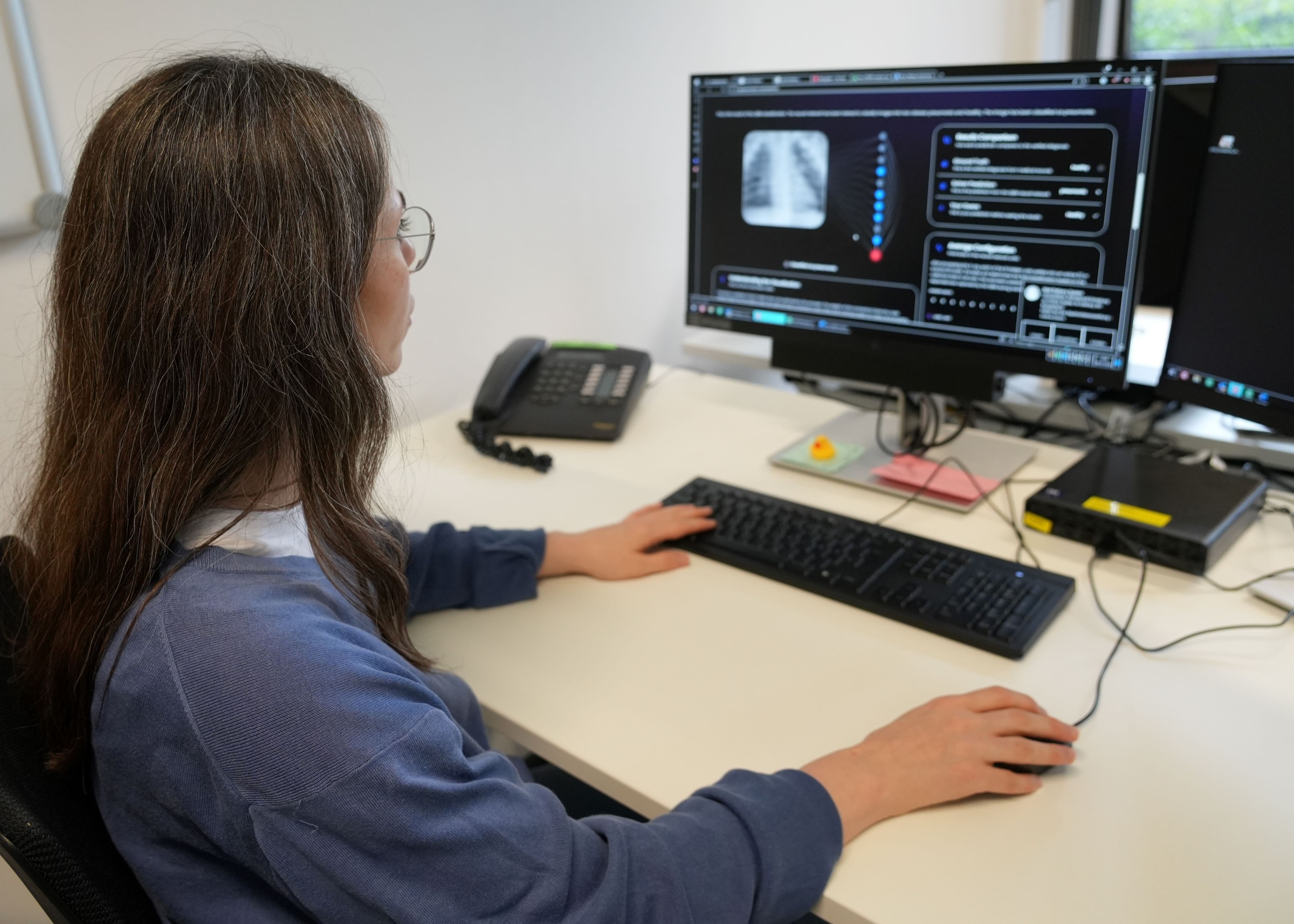
The quantum algorithm has been made publicly available on the QuCUN quantum project platform. Users can register free of charge under https://app.qucun.de/use-cases/medmnist and classify X-ray images themselves. Then they can run the quantum application, view both the results and the actual clinical diagnosis, and see which one was correct.
© LMUAs the study demonstrated, quantum machine learning models such as Quantum Boltzmann Machines based on quantum annealing can substantially reduce training times for image classification tasks in certain cases – and can identify complex feature correlations even with small datasets.
“Our research shows that quantum machine learning algorithms can offer specific advantages over comparable classical approaches – for example, when data availability is limited,” says Tobias Rohe, doctoral student at the Chair of Mobile and Distributed Systems and member of the study team. “Now it’s a matter of further investigating these strengths, identifying suitable use cases, and gradually translating the technology from research into clinical practice as quantum hardware matures. We must acknowledge, however, that there’s still a long road ahead on this exciting journey.”
Follow-up studies are needed to evaluate performance on more clinically realistic datasets. Moreover, both the underlying quantum hardware and its practical implementation remain at an early stage of development.
Daniëlle Schumann, Mark V. Seebode, Tobias Rohe, Maximilian Balthasar Mansky, Michael Schroedl-Baumann, Jonas Stein, Claudia Linnhoff-Popien, Florian Krellner: Quantum Boltzmann Machines Using Parallel Annealing for Medical Image Classification. IEEE Xplore 2025.
About QuCUN: QuCUN is short for Quantum Computing User Network, a German project involving LMU, Aqarios, BASF, and SAP. It is funded by the German Ministry of Research, Technology and Space. As part of its mission, QuCUN helps industrial partners prepare for the age of quantum computing – without high upfront investment.