News
Learning for the future in the forest
13 Jul 2026
In LMU’s university forest, students and scientists are investigating together how climate-resilient forests develop – and how to protect them.

13 Jul 2026
In LMU’s university forest, students and scientists are investigating together how climate-resilient forests develop – and how to protect them.
With summers getting hotter, severe weather and drought are affecting not just big cities, but forests too. Average annual temperatures in Bavaria have increased by over two degrees since 1950. Many tree species respond sensitively to this change.
To preserve our forests, utmost importance must be placed on climate resilience during regeneration. LMU is researching how to do this in the university’s own forest near Landshut. Spanning 470 hectares, the forest is roughly the size of 650 soccer pitches. It is managed according to close-to-nature principles, but is it resilient as well? Which trees thrive best where? And how can we increase their adaptability?
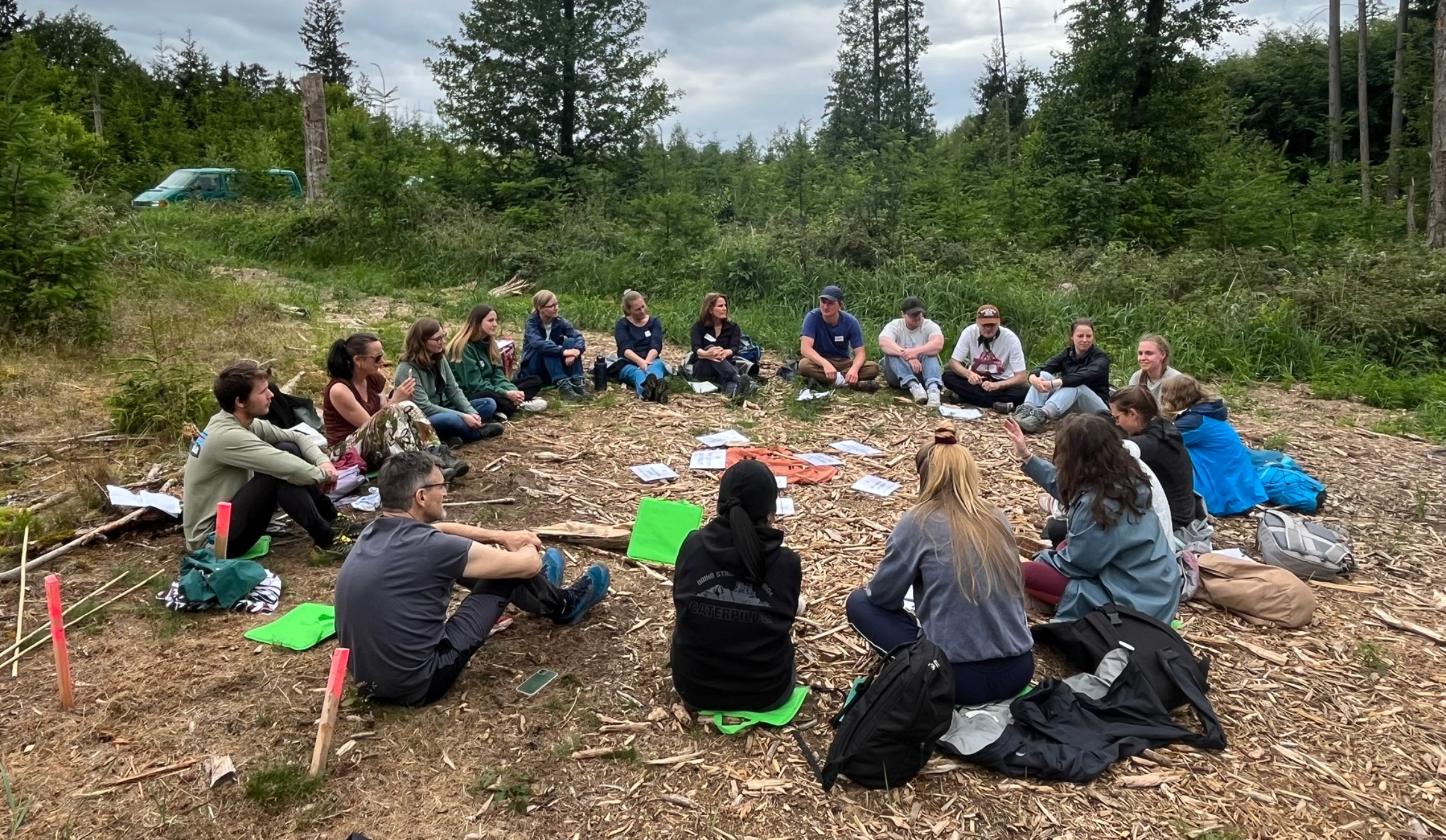
At KLICKS, students learn from other students in person at LMU’s University Forest.
© elmundoWhat matters is diversity of species and of tree ages, explains Professor Ralf Ludwig, Chief Sustainability Officer at LMU. We need to regenerate the forest with species that cope better with heat and drought – even if not all of them are currently native to the university forest.
In several large-scale field projects on site, the Department of Geography at LMU is collaborating with its partners to research the ideal conditions for a climate-resilient forest. And because the forest is “an excellent tool for sustainability education,” it has been transformed since April into an innovative real-world teaching and learning laboratory.
This new two-year project is called KLICKS (Climate Change and Sustainability in Forest Ecosystems). Funded by the Stiftung Innovation in der Hochschullehre (Foundation for Innovation in Higher Education), it brings students and researchers on excursions into nature.
The concept of ‘place-based learning’ in the university forest is being developed and tested within the framework of el mundo, the interdisciplinary educational program at LMU for sustainability in studying and teaching. “We’re learning in the forest, from the forest, and for the forest,” explains Dr. Katrin Geneuss, the project’s educational director.
Here, in the heart of the forest, far from the traditional lecture hall, teaching begins to work differently. It is not just the learning environment that is special, but above all the underlying learning structures, where subject expertise and pedagogy intertwine and create a self-propagating multiplier system.
The so-called Forest Experts get the ball rolling, as they introduce teaching degree students and master’s students to the topic and accompany them on their path to becoming Forest Trainers. These trainers then pass on the subject-matter knowledge to bachelor’s students in a wide variety of learning formats. Over time, the participants thus become Forest Literates – students with a deeper understanding of the forest and the ability to impart this knowledge to others.
The model is built on a hybrid qualification format. A digital, interactive course conveys the theoretical foundations, supplemented by several days in the forest, where the course contents become tangible. In this way, the Forest Trainers acquire not only knowledge about the forest, but also the skills to translate this knowledge into engaging and effective teaching formats.
The el mundo program not only trains and qualifies students of all disciplines in sustainable development, but also facilitates practical teaching formats. “Learning with all your senses forms lasting memories,” says Melitta Amend, teacher at a high school in Aschheim. Amend enrolled in the el mundo certificate program so that she could teach sustainability more effectively. Like many people, she laments the so-called extinction of experience: the loss of the immediate experience of nature, which particularly affects children and adolescents – and not just since the Covid-19 crisis.
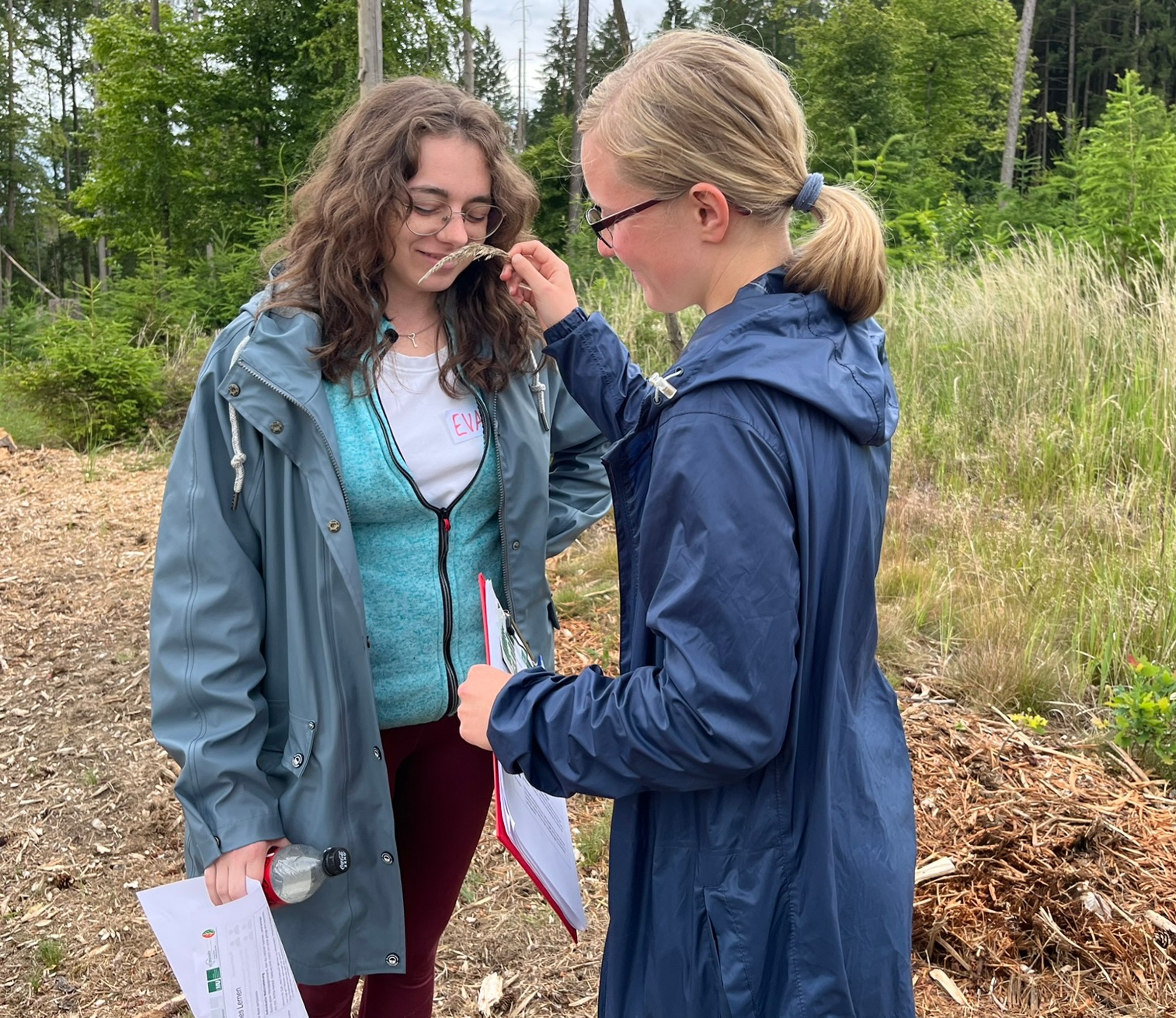
It’s a whole different experience to explore the forest up close and in person.
© elmundoTo set the mood on the way to the forest, the assorted group listens to a podcast on the topic produced by team member and forest expert Dr. Simon Kloos. Many of the participants are studying to become teachers, including Vivian Huber, who would like to teach her future students outdoors as often as possible. Others, like Konstantin Piller, are students in the Environmental Systems and Sustainability master’s program. What Piller values most about KLICKS is how the project “brings people closer to the forest and raises awareness.”
He is one of the five participants who are qualifying to become Forest Trainers in the university forest. This will certify them to train even younger students, using a brand new teaching-learning format, to become Forest Literates, who “read” the forest and are able to pass on their knowledge.

© elmundo
The excursion begins with safety advice about the abundant ticks and an introduction to the dangerous poisonous plants that can be encountered in the forest, such as poison hemlock and blue monkshood.
Then small groups set off – peer-to-peer learning in action – to identify trees. European beech, spruce, oak: they’re all here. Even a black alder is spotted with the help of a plant app.
The participants discover that there truly is a diverse mix of tree species of all ages in the university forest – ideal conditions for climate resilience. However, the heat- and drought-sensitive spruce still dominates.
The more robust Douglas fir, by contrast, which is non-native but finds outstanding growth conditions here, only towers above the other treetops in isolated instances.
At the next station, Kloos discusses one of the major enemies of the forest: the bark beetle, particularly the European spruce bark beetle. Climate change helps this creature to thrive. One way of preventing possible spread of the bark beetle to the regeneration areas of the ongoing research projects is to slot trees that have been cut down.
This exposes the bark under which the beetles, eggs, and larvae hide. The dead wood, which continues to store carbon, is deliberately left in the forest in some places, providing valuable habitats to fungi, insects, mosses, and birds. The labor-intensive splitting is generally done where it would be too difficult to remove the wood.

The KLICKS team at the kickoff event in summer 2026 | © Monika Goetsch
A short walk away, the group is engaged in research-based learning. Equipped with infrared thermometers, the forest visitors measure the surface temperature of soils, leaves, and trees. This process confirms the hypothesis that temperature differences could be related to the material investigated, the humidity, and the albedo effect, which describes how strongly a bright or dark surface reflects sunlight.
Following the concept of “sensory learning”, the participants also gather blossoms, buds, wood, berries, and other objects from the forest in order to describe their scent. Resinous, perhaps, or tangy? Does it trigger emotions and associations? And if so, which ones?
In the “Expert’s Puzzle” segment, team member Marianne Pfaffinger guides the group in finding explanations for curious phenomena. For example, why do spruce cones close their scales in humid weather? The answer is so that the wet, heavy seeds do not fall down and end up in the shade of the tree itself, but fly off to a sunnier location.
If spruces break out in an unusually large profusion of cones, the participants learn, this can be stress-induced flowering caused by drought or lack of nutrients – this too is pronounced due to climate change, which leaves such a lasting impression on this day.
Towards the end of the multi-hour excursion, team member Lea Antony discusses with the group a rather more philosophical question: Who does the forest actually belong to? Everyone? Noone? Itself? Or perhaps those who take responsibility for the forest? For Ralf Ludwig, it is clearly the latter. “Ownership means stewardship,” he says. Another five forest days are already planned. After all, we are best able to protect what we know and understand.