News
LMU Newsroom – The year in review
29 Dec 2025
A quick look back at topics that captivated LMU Newsroom readers in the course of 2025.

29 Dec 2025
A quick look back at topics that captivated LMU Newsroom readers in the course of 2025.
The LMU Newsroom provides a constant stream of fresh insights into research and study at LMU. The following review rounds up those issues that have especially touched and fascinated our readers over the past twelve months.

Öykü Camligüney, Maria Valcárcel Jiménez and Tina Schiele (from left)
At the beginning of the year, LMU psychologist Frank Niklas presented the findings of his ERC project. He and his team had investigated how children can train their mathematical and written language skills even before reaching school age. To do so, Niklas and his team initially tested a raft of learning apps – some of which were more likely to hinder learning than encourage it.
For their project, the LMU psychologists therefore developed their own apps. “We will never completely eliminate the fact that children arrive at school from different starting points,” Niklas says. “Our workgroup’s strategy is to keep those differences as small as possible, and to get children to a similar level even before they start school.”
Many Newsroom readers showed a keen interest in how the team successfully helped children to better prepare for school with the aid of apps.
Go to the interview: Improving educational opportunities with learning apps

Looking out on the Salinenhof courtyard: the Historicum Library | © LMU
Learning was heavily on the agenda again in February, especially for students. Fortunately, there are any number of places at LMU that are good for studying. In a Newsroom article – and also on LMU’s Instagram channel – students at the university talked about their favorite study spots and why they like them.
A multimedia story about the history of LMU’s University Library (in German only) is linked to the article. This fascinating dig into the past traces how the role of and expectations placed on libraries have changed over time. “Today, the University Library is a social meeting place, a place to talk and exchange views, to learn together and immerse yourself in culture,” says Sven Kuttner, Deputy Director of the library. That, he adds, is what students nowadays expect of a library. And the LMU library takes them seriously: In 2025, for example, a new UniLounge was inaugurated on Geschwister-Scholl-Platz – a barrier-free learning center with about 100 workplaces in the hallowed historical halls.
Go to the article:
The best places to knuckle down
Go to the Instagram story: Wo Studierende gerne lernen (German with English subtitles)
Go to the multimedia story: History of the University Library – from manuscripts to e-books

Quantum simulation in a laboratory at LMU in Munich | © MCQST / Jan Greune
“LMU and the Munich region as a whole are considered one of the main centers of modern quantum physics,” said Professor Ulrich Schollwöck, Dean of LMU’s Faculty of Physics and a member of the Cluster of Excellence MCQST, in a March interview that captured the imagination of many readers.
In the interview, the professor explained the concept of quantum mechanics and the historical and contemporary contribution LMU has made to quantum theory. To mark the International Year of Quantum Science and Technology, the faculty organized a series of events that attracted a broad audience. One example was the Day of Quantum Physics in early November, which was attended by more than 1,500 people.
Go to the interview:
How quantum mechanics revolutionized thought 100 years ago.
Go to the interview:
Day of Quantum Physics: Discovering the future

In several rounds of questions, users say how they would pronounce certain words.
A team working with LMU linguist Lars Bülow has developed the first Bavarian dialect app, eliciting a tremendous echo from the media – and from Newsroom readers, too. The researchers are using the app to explore which dialects are spoken where and in what variants in modern-day Bavaria. To attract as many dialect speakers as possible, the app trumps up with a quiz and a ranking table.
On social media, too, Bülow has bagged plenty of likes: In one Instagram reel, he explains (in German with English subtitles) why young people use certain colloquial expressions.
Go to the article: Bavarian dialect app: DaBay goes with you everywhere
Go to the Instagram story: Jugendsprache: Rede, checkst du, lowkey (German with English subtitles)

View of the fountain at Geschwister-Scholl-Platz in front of the main building of LMU | © LMU
In May, LMU’s successful involvement in the German government’s Excellence Strategy generated numerous clicks in the LMU Newsroom. All seven proposed Clusters of Excellence successfully passed the review process – an achievement that made this the most-read report in the LMU Newsletter, too.
The main focus of the clusters ranges from systems neurology and nucleic acid research to questions of energy conversion, bioengineering and the development of the universe, through to quantum science and cross-cultural philology. Clearly, our readers were fascinated by these research areas, with many clicking through the text links to the projects slated for the individual clusters.
Go to the article:
Major achievement for LMU: Seven Clusters of Excellence approved
Go to the newsletter: LMU aktuell (in German only)

The newly opened ICON research center is based at LMU’s Grosshadern/Martinsried campus.
The Interfaculty Center for Endocrine and Cardiovascular Disease Network Modeling and Clinical Transfer – or ICON for short – was opened in June at LMU’s Grosshadern/Martinsried campus. The new interdisciplinary center pools research around cardiovascular diseases, the most common cause of death in Germany. It also transfers innovative therapeutic approaches from the research lab to medical applications.
On LinkedIn, too, the opening of this research center prompted a huge echo, especially in the international community.
Go to the article:
Opening of ICON research center at LMU
Go to LinkedIn: New ICON research center opened

It marks the entrance to the archaeological site of Babylon. They are holding a tablet with excerpts from the discovered text. | © Junko Taniguchi
An expert in ancient Near Eastern literature, LMU’s Enrique Jiménez used artificial intelligence to bring a text that had been lost for a millennium back to life. Rediscovery of the hymn to Babylon kindled the enthusiasm not only of Newsroom readers, but also among both the German and international press.
The hymn of praise describes Babylon in all its majesty and gives insights into the lives of inhabitants of both sexes. The article and the video interview in which Enrique Jiménez and his colleague Anmar Fadhil of the University of Baghdad discuss their research and what it means to the people of Iraq continue to be frequently accessed to this day. Media reports have also appeared.
Go to the article:
Hymn to Babylon discovered
Go to the video:
Hymn to Babylon: Readable again thanks to AI

LMU’s main building on Geschwister-Scholl-Platz | © LMU
What most captured Newsroom readers’ attention in August was LMU’s position in the latest Academic Ranking of World Universities. On social media in general and LinkedIn in particular, the report likewise generated considerable interest, drawing messages of congratulation from Germany and abroad. Comments sections were filled with readers fondly recalling their own student days at LMU.
In what is known as the ShanghaiRanking, LMU ranked 43rd, giving it a coveted position among the top 50 universities in the world. It was also the highest-ranked German university
Go to the article:
Shanghai Ranking: LMU remains the best German university
Go to LinkedIn

The President of the Jewish Congregation of Munich and Upper Bavaria, Charlotte Knobloch, and Ronny Vollandt with the restituted book. | © LC Production/LMU
In September, Professor Ronny Vollandt presented a small book to Charlotte Knobloch – a book that deeply moved the serving President of the Jewish Congregation of Munich. The Hebrew textbook once belonged to the Jewish Elementary School in Munich, which Knobloch herself attended as a pupil in 1938.
Stolen by the National Socialists, the book ended up in what, at the time, was the Reich Institute for the History of the New Germany. “The institute was an attempt by the National Socialists to scientifically underpin their antisemitic propaganda,” Vollandt says. “It was for this purpose that they established a library with books from Jewish cultural contexts.” The goal of the institute, the professor explains, was to provide legitimation for discrimination, expropriation, expulsion and extermination.
Together with his colleague Sarah Lemaire, Vollandt has materially advanced the systematic recording of looted books, alongside research into their former owners and the latter’s descendants. Up to now, the diminutive Hebrew textbook is one of the few books from the library that it has been possible to return to its rightful owner. Charlotte Knobloch nevertheless welcomes the initiative of the Jewish Studies department to return books. Together with Vollandt, she has already sounded out possibilities for exhibiting them – so that the books and the people who once owned them are not forgotten.
Go to the article: Jewish Studies library: restitution of loot

“Our mission is to create knowledge — but also to carry responsibility. For the future of science. For the future of the young people who come here to learn. And for the future of a society that is looking — for progress, for meaning, for trust”, says Matthias Tschöp at the start of his presidency at LMU.
Professor Matthias Tschöp took office as President of LMU Munich in October. His video message drew very significant interest from Newsroom readers, while also garnering a positive reaction on social media (including LinkedIn) in Germany and abroad.
Go to the video:
"A university that is open, ambitious, excellent — and human"
Go to LinkedIn
In the Newsroom and on social media, a welcome video – in which business student Fiona offered new students a brief insight into LMU – was also very well received.
Go to the video: Welcomte to the winter semester
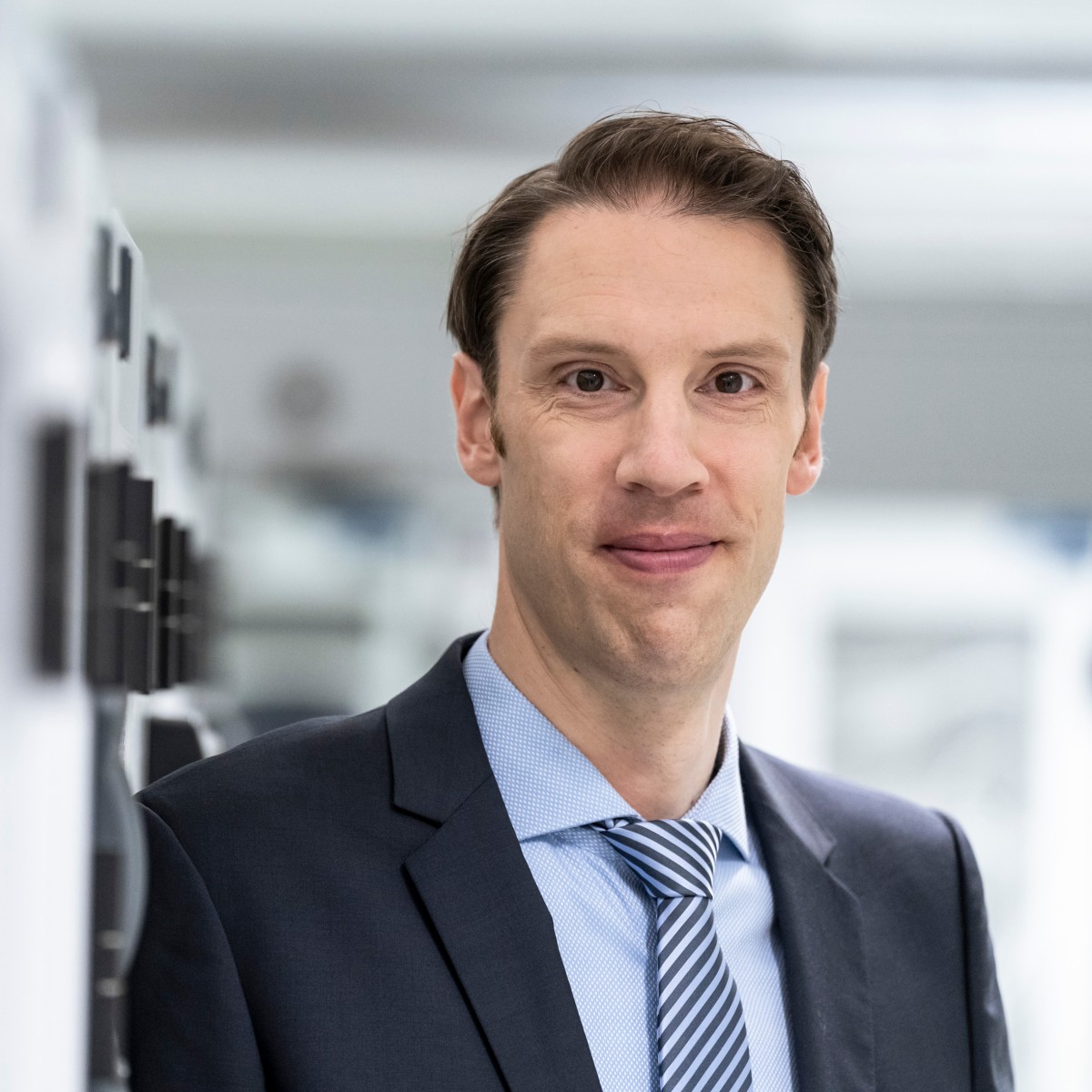
Björn Ommer is himself an AI researcher and co-developed the Stable Diffusion AI image generator. “It’s exciting to see how widely this technology is already in use, although naturally it’s not finished yet.” | © Ansgar Pudenz
Artificial intelligence has been a hot topic in many Newsroom research reports and interviews over the past year. In November, one interview – with LMU’s Chief AI Officer Björn Ommer, – attracted a great deal of attention. “The vast majority of people have no idea how large the development really is,” Ommer said in the run-up to the AI symposium at LMU.
The many changes taking place also concern research done by the university itself. In a separate Newsroom article, LMU scientists from various disciplines shared insights into how AI is shaping their everyday research work.
Go to the interview with Björn Ommer:
Doing new things that used to be impossible
Go the article about AI in research:
AI has become transformative

“A nineteen-year-old medical student with leukemia was our first patient. I’ll never forget him.” With these words, Subklewe recalls the moment she sees as a milestone in cancer therapy. | © BERLI BERLINSKI
The second issue of LMU’s digital magazine “Research and Innovation” came out in early December. Its focus? “Rethinking”: How is AI changing literature? What new realities do we face as the climate tips? Could the universe itself be working quite differently than we thought? And what innovative approaches are there to the treatment of cancer?
The article on “Made-to-measure cancer therapy” discusses the research done by Marion Subklewe, Senior Physician at LMU University Hospital and head of the Translational Cancer Immunology workgroup, and Sebastian Kobold, head of the Immunopharmacology workgroup and Deputy Director of the Division of Clinical Pharmacology at the same hospital. The two researchers are getting the immune system to target tumors, which opens up new perspectives for patient-specific treatments.
Go to the article: Made-to-measure cancer therapy
Go to the digital magazine “LMU Research and Innovation“: Rethink