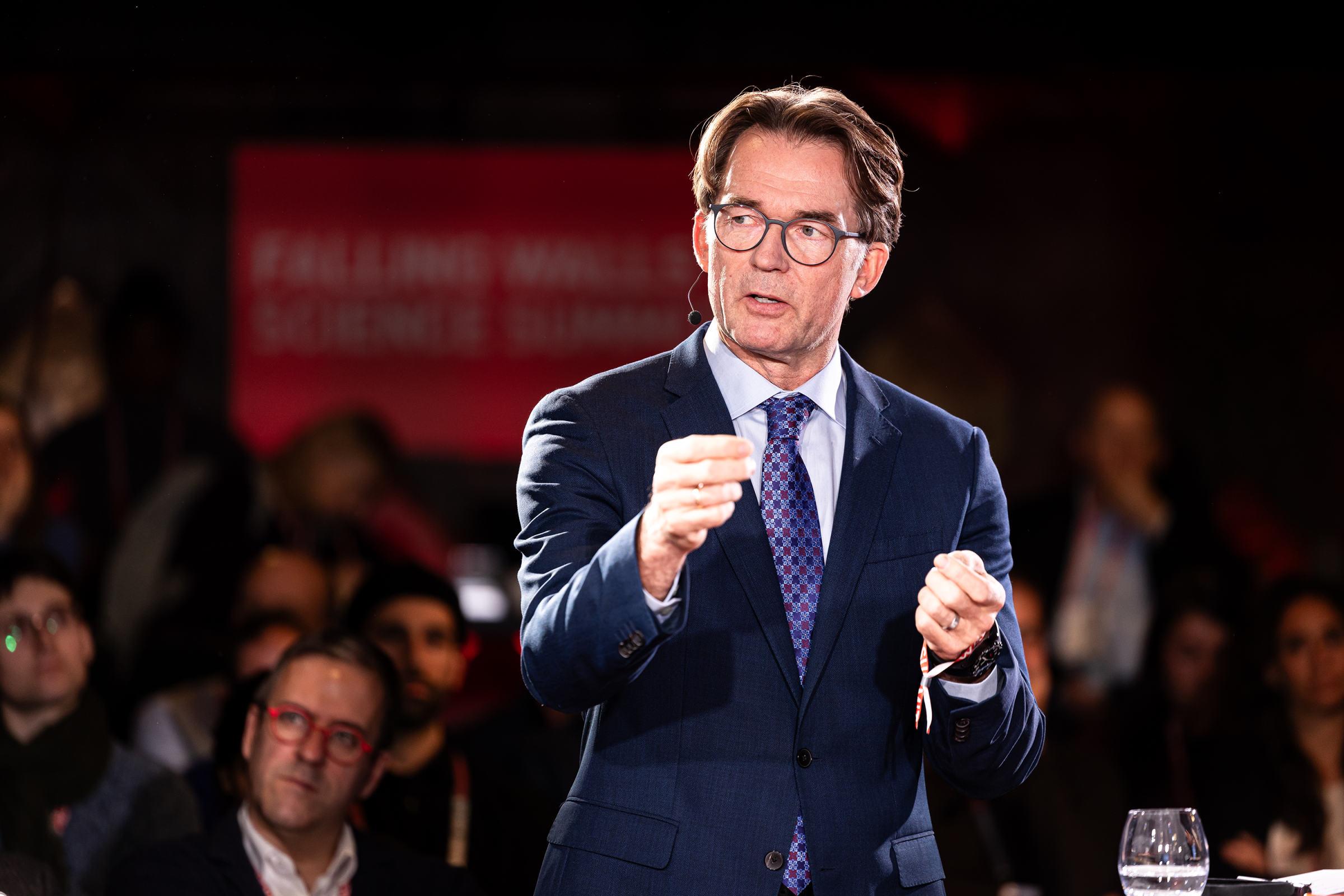
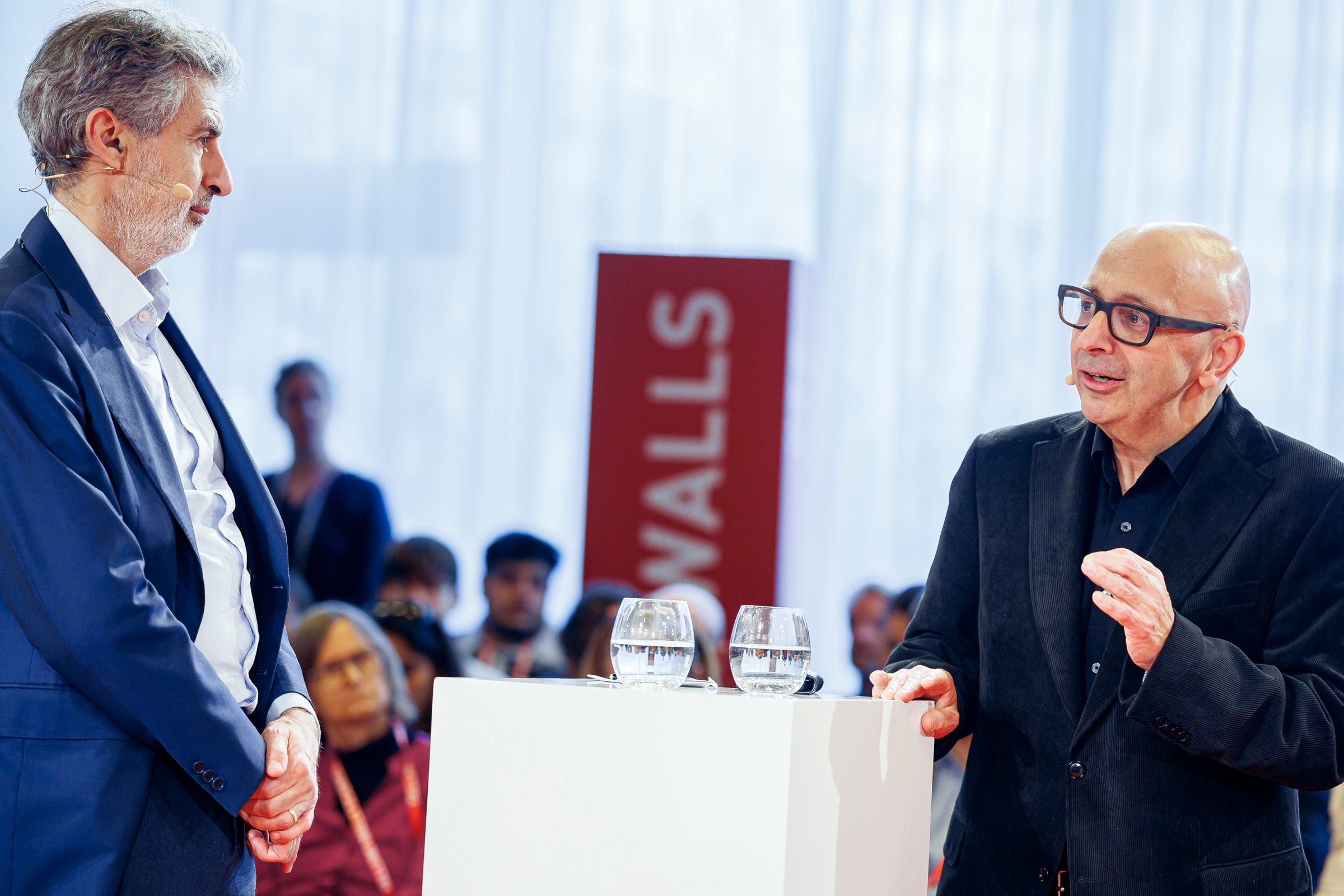
Discussing scientific breakthroughs and tackling societal challenges: under the motto “Free Science for Humanity,” the Falling Walls Science Summit brought together international researchers and decision-makers to explore academic freedom and science’s contribution to humanity. The focus was on sustaining open exchange and international collaboration amid growing geopolitical tensions. LMU made key contributions to this debate.
Mobility without borders: What makes a country attractive to researchers?
Research excellence alone is not enough. Researchers choosing where to work also ask: What opportunities will I have? How secure will my position be? Who can I collaborate with—and what will life there be like?
These questions were at the heart of “The Talent Race: Why Researchers Choose Countries,” a discussion hosted by the Alexander von Humboldt Foundation. LMU President Matthias Tschöp joined Foundation President Robert Schlögl, political scientist Katrin Kinzelbach of FAU Erlangen-Nürnberg, DLR researcher Cassandra Seltzer, and Vicki Thomson, Chief Executive of Australia’s Group of Eight university alliance.
The discussion made clear that funding and infrastructure remain decisive factors, particularly for early-career researchers. Personal connections, institutional culture, and the prospect of feeling at home also matter. Attracting international talent is only the first step. Long-term career security and robust protection for academic freedom help persuade researchers to stay.
Tschöp also emphasized the reality facing leading universities: competition for the best researchers is global. Germany has strong foundations but must hold its own in an increasingly competitive international environment.
Free societies under pressure: Does AI threaten democracy?
Democracy distributes power. Artificial intelligence concentrates it. LMU Vice President Armin Nassehi highlighted this tension at the LMU roundtable “Democracy Under Pressure: Building Resilient Societies.” The central question: Can democratic societies still steer the technologies transforming their future?
Nassehi was joined by Turing Award winner Yoshua Bengio, Scientific Director of LawZero; Portugal’s former science minister Manuel Heitor; former European Research Council President Helga Nowotny; and Nobel laureate in physics Brian P. Schmidt.
Schmidt illustrated the need for accountability through a comparison with medicine: pharmaceutical companies must demonstrate the efficacy and safety of their products before widespread use. Why are AI systems with potentially far-reaching societal consequences released before their risks are sufficiently understood? Bengio argued that AI companies should be held to the same standards of responsibility as other businesses.
Meaningful participation requires informed citizens
Taking up a suggestion from the audience, the panel discussed representative citizens’ assemblies, potentially at an international level. These could give people a meaningful voice in decisions about AI. Armin Nassehi identified a crucial obstacle: decision-makers would have to be willing to share power and revise decisions already taken.
Nassehi also raised a more fundamental issue. Citizens’ assemblies and elections depend on informed citizens. Yet AI is fundamentally changing how information is produced, shared, and perceived—and therefore the conditions under which democratic decisions are made.
The discussion thus raised a fundamental question: Does society set the framework for technological development? Or does it allow technology to dictate the pace? Democratic oversight, public participation, and clear accountability emerged as central requirements for the responsible use of AI.
Falling Walls Summit 2026
The Falling Walls Science Summit brings leading figures from science, business, and politics together in Berlin. Inspired by the fall of the Berlin Wall, they meet each year around November 9 to discuss scientific breakthroughs and ask which barriers in science and society can be overcome next.