News
Semiconductor physics: polaron formation observed for first time
11 Feb 2026
LMU researchers have directly measured a physical phenomenon that was theoretically described all the way back in 1933 – the polaron.

11 Feb 2026
LMU researchers have directly measured a physical phenomenon that was theoretically described all the way back in 1933 – the polaron.
When an electron travels through a polar crystalline solid, its negative charge attracts the positively charged atomic cores, causing the surrounding crystal lattice to deform. The electron and lattice distortion then move together through the material – like a single object. Physicists call these quasiparticles polarons. A team led by Professor Jochen Feldmann from LMU has succeeded in tracking the extremely brief formation process of this object for the first time, using an ultrafast imaging method. The physicists demonstrated experimentally that the electron loses energy and gains mass – just as the theory predicted. In addition, they determined the formation time and spatial extent of the polaron. “Our findings confirm a concept in solid-state physics which has been around for a long time,” says LMU physicist Feldmann.

LMU physicist Jochen Feldmann (right) and his doctoral student Matthias Kestler in the laser labs for ultrashort spectroscopy at the Nano-Institute Munich
© Jan Greune / LMUFor the electron, this must feel a bit like it has left a paved road and is wading through mud.Jochen Feldmann
Soviet physicist Lev Landau was the first to publish the idea of the polaron in 1933. In the 1950s, Herbert Fröhlich formally described the process. As the name polaron indicates, the displacement of the atomic cores alters the local polarization of the crystal – that is to say, its local charge distribution. Fröhlich predicted that the electron would lose energy and gain mass as a result of the process. The reason for this is a cloud of phonons – the technical term for lattice vibrations – that surround the electron and travel with it. “For the electron, this must feel a bit like it has left a paved road and is wading through mud,” says Feldmann.
The measurements were carried out in a joint project with Professor Zhi-Heng Loh from Nanyang Technological University (NTU) in Singapore. Kestler, Feldmann’s PhD student, employed an extremely demanding state-of-the-art technique at NTU for the time-resolved determination of the energy and effective mass of an optically excited electron – time-resolved photoemission electron microscopy. To follow, typically on the order of femtoseconds, the energy and momentum of electrons in crystals, the researchers combine ultrafast laser spectroscopy with photoelectron microscopy.
The method works as follows: An initial laser pulse excites an electron in a semiconductor into the conduction band, where it interacts with the lattice vibrations of the atomic cores and forms a polaron. A second laser pulse then fully releases the electron from the semiconductor, before it flies through a vacuum to the detector. “We measure the time that the electron is traveling, and the angle at which it exits the semiconductor material,” explains Kestler, lead author and doctoral candidate under Feldmann. From these variables, we can calculate the effective mass and the energy of the electron. To make reliable statistical statements, however, one needs over a million such events,” says Kestler. “And that is very time-consuming.”
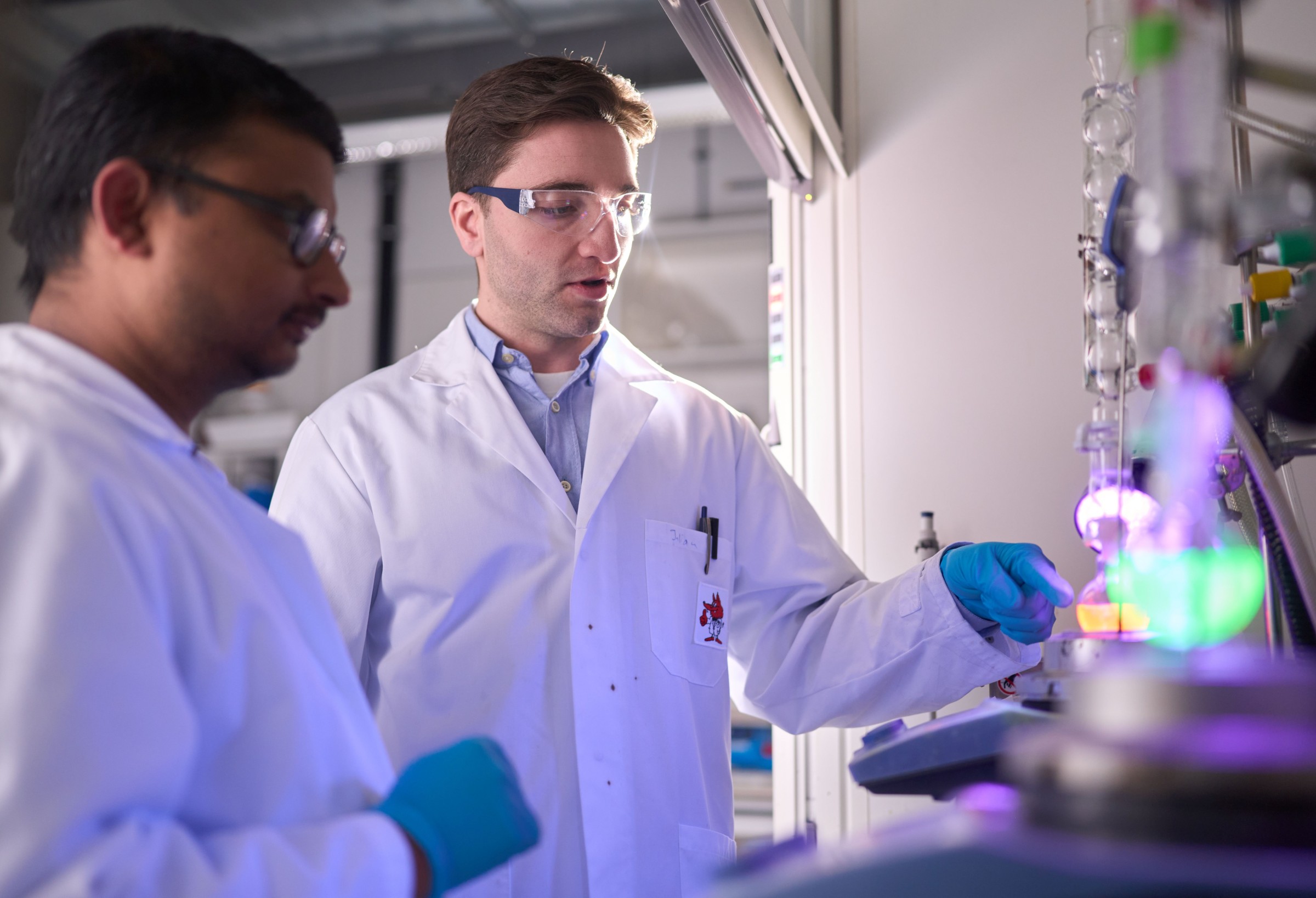
Nanocrystals made of semiconducting oxides are synthesized in the chemistry labs of the Nano-Institute.
© Jan Greune / LMUA two-month measuring campaign in Singapore was followed by rather intensive computer-assisted data analysis at LMU. “During the formation period of the polaron of 160 femtoseconds, the detected electrons exhibited a doubling of effective mass, accompanied by a fall in energy,” says Kestler. “Our findings show that the formulas derived by Fröhlich describe the experimentally observed polaron formation very well,” continues Feldmann. On this basis, we can now better understand how electrons move around in the crystal lattice of a solid – in particular in polar semiconductor materials.
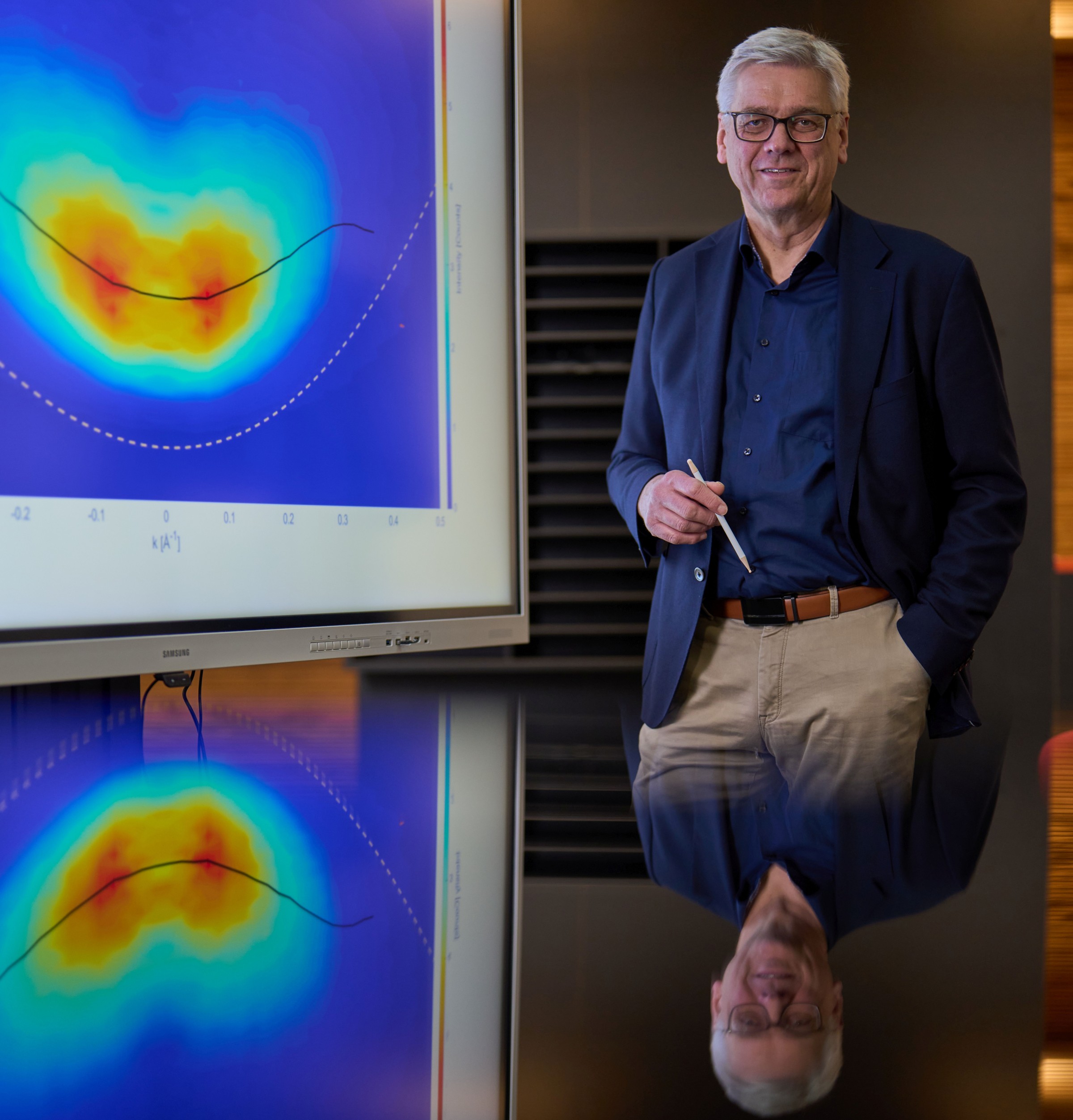
Their study is “of great value for the scientific community and will help both in the planning of further experiments and in the development of various devices.”, says LMU-physicist Jochen Feldmann. The measured distribution of electrons at time zero can be seen on the screen.
© Jan Greune / LMUThe two physicists affirm that their study is “of great value for the scientific community and will help both in the planning of further experiments and in the development of various devices.” Feldmann already has an idea: “I can imagine using the mechanical distortions to initiate catalytic processes thus enabling photochemical reactions,” says the physicist. For instance, his research group at LMU’s Nano-Institute is developing nanostructures that can split water molecules with the help of light in order to generate hydrogen. “Such reactions normally require quite high activation energies,” explains Feldmann. “If it were possible to excite mechanical motions on the surface, this could reduce these activation energies and substantially increase efficiencies.”
Matthias F. Kestler, Kyung Chul Woo, Justin W. X. Lim, Lucas M. Prins, Jochen Feldmann und Zhi-Heng Loh. Direct observation of Fröhlich polaron formation in BiOI nanoplatelets. Physical Review Materials, 2026.