News
Space telescope Euclid: Foundation for the Best-Ever 3D Map of the Universe published
12 Nov 2026
LMU and several Max Planck Institutes provided key optical components and data processing, crucial for the mission’s success.

12 Nov 2026
LMU and several Max Planck Institutes provided key optical components and data processing, crucial for the mission’s success.
The Euclid Consortium and the European Space Agency have released its first major batch of data from the Euclid space telescope, capturing light from over a billion objects to create the largest 3D map of the universe, focusing on dark energy, dark matter, and cosmic structures. German research centres, including LMU in Munich and several Max Planck Institutes, provided key optical components and data processing, crucial for the mission’s success.
The data release, named DR1 Foundation, covers 13 months of observations, includes over 900 million galaxies, 15,000 strong gravitational lensing candidates, and 60 million quasar candidates, enabling unprecedented cosmic studies. Euclid’s space-based observations deliver the largest catalogue of strong gravitational lenses and extensive galaxy cluster data.
For the first time, it provides scientists with the puzzle pieces needed to begin constructing a detailed 3D map of the cosmos – crucial for solving the many mysteries of the dark universe.
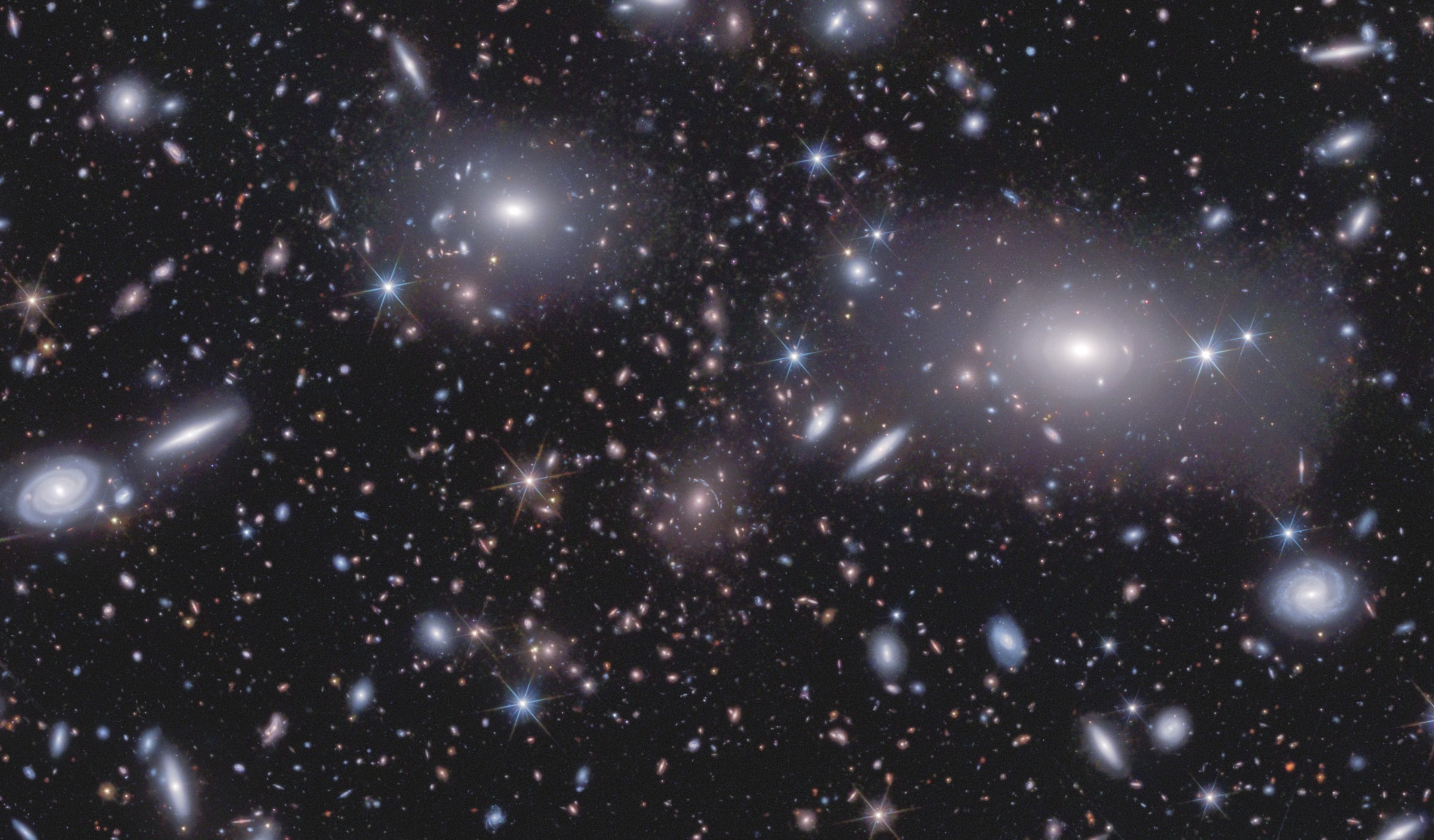
As part of its DR1 Foundation data release, Euclid observed Abell 3128, a cluster of hundreds of galaxies located about 800 million light-years away from us. Abell 3128 is one of the richest members of the Horologium supercluster of galaxies, which comprises more than 30 smaller galaxy clusters. Abell 3128 is home to a great many galactic residents, as captured here, including whirling spirals and fuzzy ellipticals. A wonderful celestial object sits at the image’s centre: a strong gravitational lens, in which light from a more distant galaxy has been warped by a massive foreground object, creating beautiful blue arcs and stretched-out shapes across the sky.
© ESA/Euclid/Euclid Consortium/NASA; Bildbearbeitung: J.-C. Cuillandre und E. BertinToday’s release is the first to demonstrate Euclid’s capabilities as a sky surveyor. Its breadth, panoramic mosaics, and wide sky coverage in visible and near-infrared light support a wide range of new science. After analysing about 10,000 science images, the DR1 Foundation reveals unprecedented numbers of cosmic objects, a total of 1.7 million GB of data.
“This is a change in scale from Euclid’s previous releases, which included a few days of observations over around 60 deg² of sky,” says Valeria Pettorino, Euclid project scientist at ESA. “We’re now releasing more than a year of data covering a significantly larger area.”
More than 15 years of preparatory work prior to launch, and over three years in orbit, are now rewarding us with results that are groundbreaking.Dr. Frank Grupp (LMU/MPE), German Euclid Project Manager and optical architect of the mission
The images were obtained with Euclid’s VIS (the 600-megapixel camera for visible light) and NISP (Near-Infrared Spectrometer and Photometer) instruments, for which the Max Planck Institute for Astronomy (MPIA) in Heidelberg and the Max Planck Institute for Extraterrestrial Physics (MPE) in Garching near Munich contributed critical optical components. The data are being processed into scientifically usable data at various locations, including the German Science Data Centre (SDC-DE), operated by MPE. Scientists at more than 300 research institutions in Germany and abroad, including LMU and Max Planck Institutes, analyse them, and over 2,500 researchers use the data.
“This is also possible because the optics built here in Munich using the most innovative methods allow images of outstanding quality to be transmitted to the ground station. More than 15 years of preparatory work prior to launch, and over three years in orbit, are now rewarding us with results that are groundbreaking,” says Dr. Frank Grupp (LMU/MPE), German Euclid Project Manager and optical architect of the mission.
I am excited that we can now take another step towards understanding why the expansion of the universe is accelerating – a mystery that has challenged physics for nearly thirty years.Prof. Jochen Weller, Professor at the Faculty of Physics / Universitäts-Sternwarte München, Head of Physical Cosmology Group
However, those data have to be corrected for instrumental effects and translated into physical quantities. MPIA scientists, mainly Dr. Mischa Schirmer and Dr. Kerry Paterson, coordinate and organise this process, known as calibration. “This task ranges from designing and planning the required calibration observations, to characterising the properties of the telescope and its instruments, and analysing whether these properties change over time,” says Mischa Schirmer.
“I am delighted and excited that we can now take another step towards understanding why the expansion of the universe is accelerating – a mystery that has challenged physics for nearly thirty years,” says Professor Jochen Weller (LMU). “After so many years of preparation, it is a real joy to see the data becoming available and this next stage of our journey beginning.”
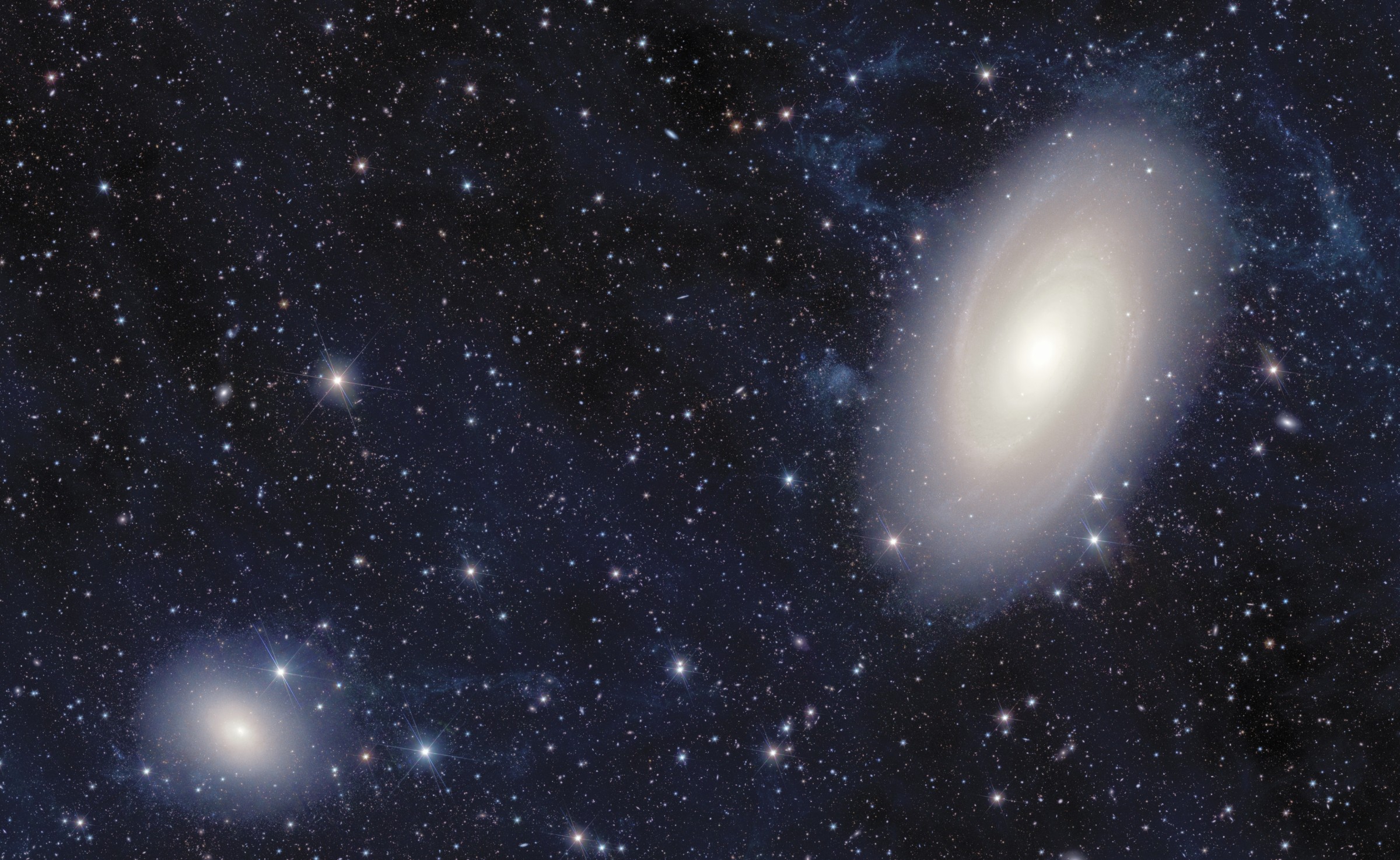
As part of its DR1 Foundation data release, Euclid observed the beautiful core of the Messier 81 galaxy group, part of which is shown here. The group’s largest galaxy, Messier 81, lies to the right, with the smaller NGC 3077 to the left, and other smaller members scattered across the frame. Wispy blue-hued clouds can also be seen – these filaments of foreground cloud are known as ‘galactic cirrus’, and are part of our own home galaxy. Messier 81 is a ‘grand design’ spiral galaxy, meaning that it has a bright centre and well-defined spiral arms rich in gas and dust. Its immense gravity influences nearby galaxies, including NGC 3077. It triggers bursts of active star formation within these galactic neighbours and alters their shape over time. The Messier 81 galaxy group lies about 12 million light-years away. This image covers an area of sky five times the size of the full Moon and took Euclid just over an hour to capture.
© ESA/Euclid/Euclid Consortium/NASA; Bildbearbeitung: J.-C. Cuillandre und E. BertinOverall, the DR1 Foundation release marks the first major milestone of the Euclid mission, many years after its conception. From Germany, Professor Ralf Bender (LMU/MPE), Professor Hans-Walter Rix (MPIA), and Professor Peter Schneider (University of Bonn) are founding members of the Euclid project and were instrumental in its inception. Ralf Bender and Hans-Walter Rix also represent Germany on the Euclid Consortium Board, while Peter Schneider chairs the Editorial Board and plays a key role in organising the peer review of all publications across the Euclid Consortium.
Already with this data release, Euclid provides the largest space-based image dataset available to astronomy to date and for the foreseeable future. Processing these vast amounts of data poses immense challenges for the participating computing centres, further aggravated by the current tight availability of new hardware. Added to this are the exceptionally high requirements for photometric precision – that is, the accuracy with which the brightness of astronomical objects is determined.
“It is all the more exciting to see how the data processing pipelines developed by our team over the years are now coming together and delivering scientific results,” says Dr. Maximilian Fabricius (MPE/LMU), head of the German Euclid Data Centre. Astronomers use the term ‘pipelines’ to describe the scientific software that produces progressively refined results step by step from raw data. These pipelines are based in a large part on software and algorithms prepared at LMU and now run across computing centres throughout Europe and in the USA.
In space, above Earth’s image-blurring and light-dimming atmosphere, Euclid can complete deep and wide surveys of the sky in a way that ground-based telescopes cannot. As a result, this data release delivers vastly more cosmic objects than any preceding survey, pushing the boundaries of detection for rare and distant objects. These include strong gravitational lenses and galaxy clusters.
The strong gravitational lenses sought by Euclid form when the light travelling to us from distant galaxies is significantly distorted by a foreground galaxy. The DR1 Foundation release contains the largest catalogue of strong lenses ever – larger than all previous catalogues combined. These phenomena allow scientists to ‘weigh’ individual galaxies, including their invisible dark matter, and to explore how the universe is expanding.
Galaxy clusters reveal how matter clumps together and how cosmic structure grows across the universe. “Euclid doesn't just look far back in time – it does so across vast areas of the sky,” adds Barbara Sartoris of the JL Lagrange laboratory in Nice, France, who previously worked on Euclid data at LMU and MPE. “This gives us an unprecedented view of large samples of ancient galaxy clusters that were previously out of reach. We will explore these in the coming months to learn how these giants grew and to decipher what they reveal about the dark universe.”
Additional ground-based data on fields covered in the DR1 release, whose preparation was led by scientists at LMU, help interpret Euclid’s observations in the context of cosmology and cosmic structure research.
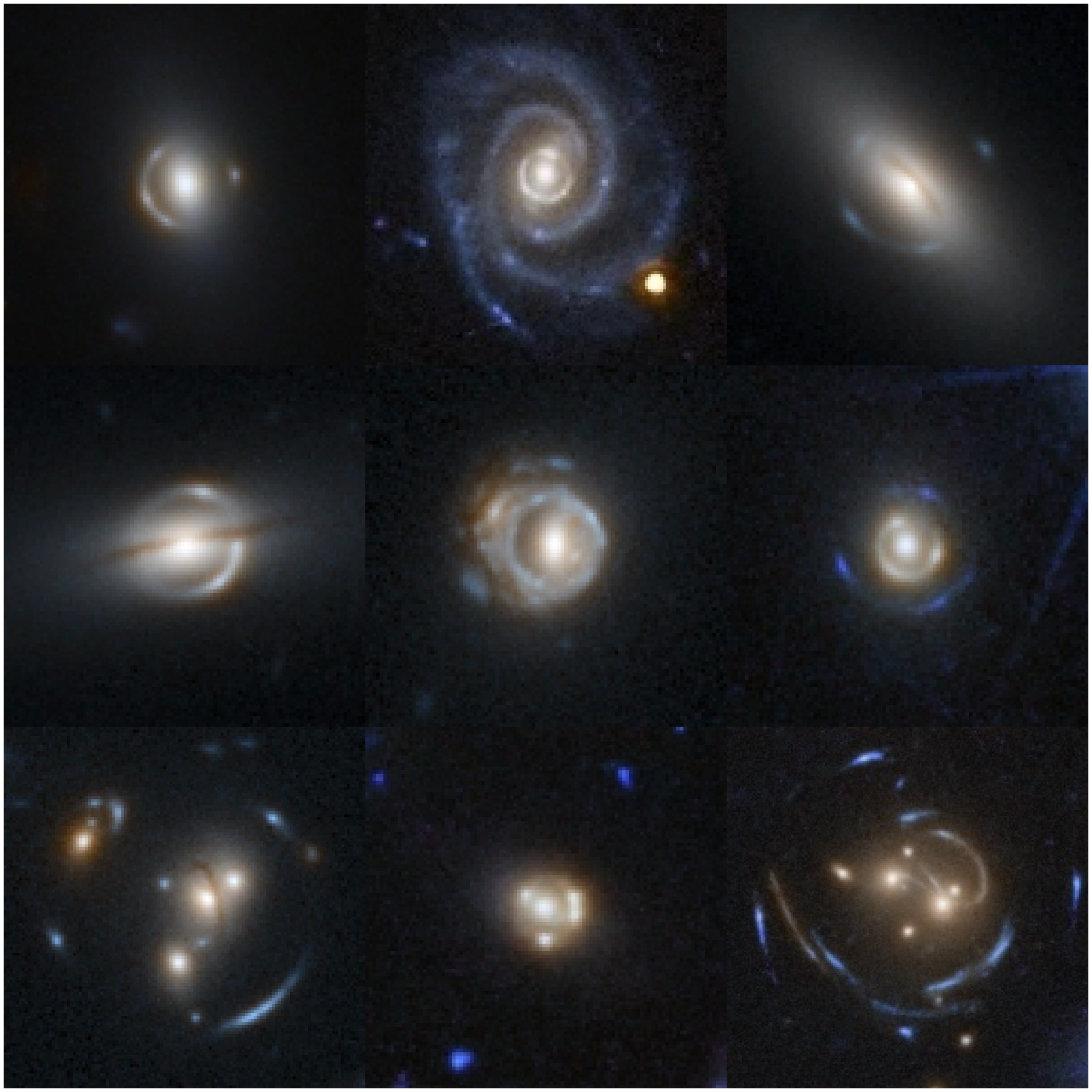
As part of its DR1 Foundation data release, Euclid has captured light from more than a billion objects across an area of sky equivalent to 9500 full Moons, laying the groundwork for its largest-ever 3D map of the cosmos. The new data release reveals unprecedented numbers of strong gravitational lenses, which form when the light travelling to us from distant galaxies is significantly distorted by a foreground galaxy. The upper six show mostly round or oval shapes with bright creamy-white or golden centres. The lower three show golden-white shapes surrounded by striking blue arcs, curved streaks and partial rings. As the brightness of the strong cosmic lenses varies over time, multiple images of the same background galaxy can help us measure the expansion of the universe. They are also sensitive probes of dark matter.
© ESA/Euclid/Euclid Consortium/NASA; Bildbearbeitung: N. Lines und T. LiWith this release, Euclid begins to reveal the dark cosmos. Scientists can mine the dataset to determine distances to individual galaxies and place them within the universe’s 3D structure, linking them to the vast, invisible mesh of the cosmic web. These distance measurements and mappings are achieved by Euclid through spectroscopy – by splitting the light from galaxies into ‘rainbows’ that reveal their distance (and, for especially bright ones, their origin and composition too).
“Euclid’s data has the potential to write an entirely new chapter in observational astronomy,” says Martin Kümmel (LMU). “Our images in the optical and the near-infrared, combined with the photometric redshifts, will lay the foundation for a vast number of exciting results.”
While enormous, the dataset covers only about 14% of the total sky area that Euclid will survey. The full Data Release 1, due in mid-2027, will then build on today’s release and add more crucial pieces to the cosmic puzzle, including observations of weak lensing to complement the strong lensing, and calculations of how galaxies and galaxy clusters fit into the cosmic web.
Background information
ESAs space telescope Euclid is imaging billions of galaxies across the universe and measuring distances for millions of them. It’s investigating dark energy and dark matter, and tracing the last 10 billion years of cosmic history.
The mission launched in July 2023 and began routine science observations on 14 February 2024. The full DR1 release will be completed in mid-2027, with the subsequent part of DR1 also bringing data on galaxy clusters and weak lensing.
From Germany, the LMU, the Max Planck Institute for Astronomy in Heidelberg, the Max Planck Institute for Extraterrestrial Physics in Garching, the University of Bonn, the Ruhr University Bochum, the University of Bielefeld, and the German Space Agency at the German Aerospace Centre (DLR) in Bonn are participating in the Euclid project.