How sustainable and fair is our healthcare system in a global context? LMU physician Guenter Froeschl discusses healthy living, planetary limits, and healthcare bottlenecks in the Global South.
LMU Global Health Day took place on 19 and 20 March. The theme of this year’s event was Global Health for Sustainability.
What has health got to do with sustainability?
Guenter Froeschl: Health is not just the absence of illness. This is a core principle of the World Health Organization. Health should be conceived in much broader terms, as well-being, as something we might succinctly describe as “good living.” One of the presentations at LMU Global Health Day explained that this good life is often misunderstood – as hedonism beyond the sense of Epicurean philosophy and as selfishness.
Actually, we should view it as a balanced life conducted in harmony with the environment, the animal world, and our fellow humans – which makes us feel part of nature and society, in which we have a stake. It is precisely this misunderstanding that gives rise to the notion of a sustainability dilemma. I’m convinced that we humans can lead a good life without continually exceeding our limits of planetary exploitation.
How can misconceptions regarding sustainability affect public health – in relation to how we deal with things like possible future pandemics or climate change?
In the course of my work, I gain deep insights into dysfunctional health systems, but also into distorted conceptions of health itself. In high-income countries, resources are wasted, and the health sector is a major contributor to greenhouse gas emissions and environmental pollution. Healthcare decisions are often driven by economic considerations without regard for the interests of patients.
At the same time, we see poorly equipped health systems in low-income countries, which lack adequately trained personnel, basic equipment, and essential drugs and medical products. All this is a manifestation of the extreme inequality on our planet.
The Covid-19 pandemic has clearly shown that these major events do not respect income boundaries – and the same goes for climate change. We should all recognize our own interest in combating this inequality without succumbing to anxiety that people in wealthy regions will lose anything essential in the process.
I’m convinced that we humans can lead a good life without continually exceeding our limits of planetary exploitation.
Günter Fröschl
The international political situation is volatile. The United States, for example, is withdrawing from numerous global agreements and projects in the health and sustainability sectors. What effects is this having on global health?
The effects are devastating. In my area alone – development cooperation – I see health projects grinding to a halt as a direct result; I see experts who are no longer able to pursue their work. But there’s also a meta-level, and that is the loss of trust, the lack of respect that is being conveyed toward agreements and norms which have been built up over many years. These effects will continue to be felt for a long time.
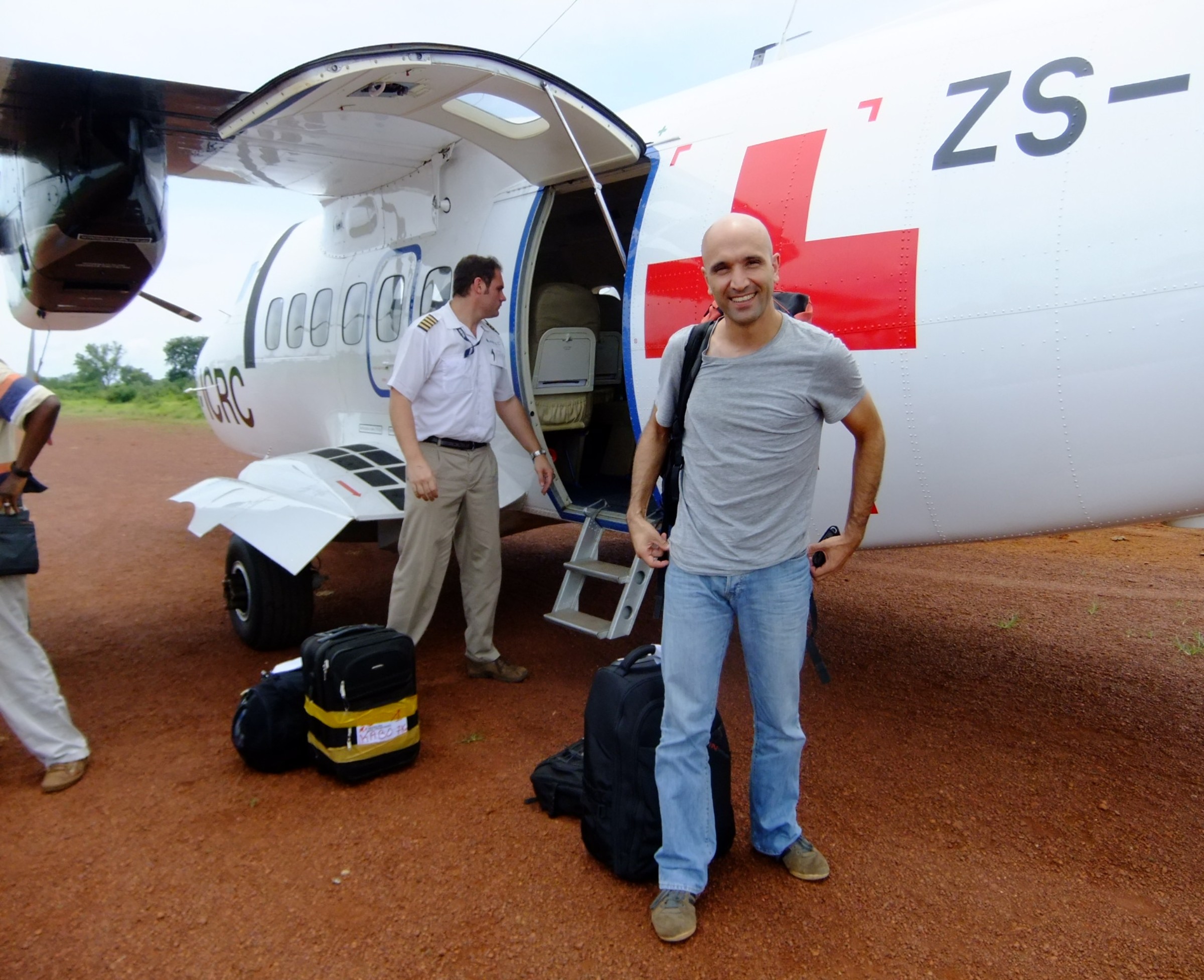
Guenter Froeschl during a mission with Doctors Without Borders in the Central African Republic, 2012
In your view, what are the major global health challenges of our time?
For me, it’s the unequal distribution of material resources and income on our planet – an intolerable situation. I’m convinced that with the resources at our disposal, we could achieve a good, healthy life for all, but that we squander this potential through demarcation and exclusion. This gives rise to the second major problem for global health: the destruction of our home, our planet, which is continuing unabated.
Is there a connection between global and personal health?
Yes, absolutely. Perhaps, however, this also applies to all our needs and actions. Our individual needs, whether concerning our health, our well-being, or our consumption, always have an effect on larger – and ultimately global – systems.
How we conceive of health, what we demand as patients, but also what we contribute as members of a community, ultimately affects what happens in the wider world. The substandard healthcare given to a pregnant woman in Chad has got something to do with my expectations in Munich. This may sound abstract at first, but it isn’t.
Our individual needs, whether concerning our health, our well-being, or our consumption, always have an effect on larger – and ultimately global – systems.
Health professionals who work here often come from countries in the Global South. What we take for granted is predicated on a system that draws talent and resources from poorer regions. Brain drain is not just an academic concept, but has a practical face.
In addition, there is the sheer consumption of resources of our health systems – of money, energy, and materials. Our ecological and economic footprints as patients compete with what is available globally for basic care. And what we demand as standard defines global norms: in trade agreements, pharmaceutical policies, and patent law. When western markets dictate the price for drugs, the pregnant woman in Chad is left without access to medicines that should really be available to her as a matter of course.
As long as we conceive health as a purely private commodity, as something that is due to me, that I consume, this connection remains invisible. But if we understand health as a global commons, we begin to ask different questions: What is appropriate? What is enough? This is uncomfortable. But these are the right questions.
What can every individual do for their own health and the health of society?
I think it’s very important to be aware of and understand the ramifications of our expectations and actions. In addition, we should place much greater emphasis on disease prevention. Role models who trade in the symbolism of traditional consumption behavior are unhelpful here.
If we understand health as a global commons, we begin to ask different questions: What is appropriate? What is enough? This is uncomfortable. But these are the right questions.
Günter Fröschl
How can we motivate people to take better care of their health?
It’s tragic to observe how easy it actually is to live a conscious, considerate, balanced life. Yet it is artificially made more difficult by distorted role models and economic interests, which cause blood vessels to get clogged up, fat and sugar metabolism to get out of control, our habitats to be destroyed and poisoned, and people to exclude and harm each other.
At the same time, there is almost nothing to which people are more resistant than the advice of others. We need role models who make it easy for people to live healthy, happy lives in peace and equality.
In what areas is LMU a leading player in health research?
Of course, LMU has a huge breadth of expertise in all major areas relating to health. And this includes not just medicine itself, but also the social sciences, climate research, geography, and law – ultimately, health comes into almost every field of academic inquiry.
I can only provide insights from my own area: Since 2009, we’ve managed to give many hundreds of health professionals from all regions of the globe the ability through education and the strengthening of local capacities to locally tackle health issues in low- and middle-income regions. We’re constantly being told that we have become a strong, credible, and reliable partner here.
PD Dr. Guenter Froeschl is a specialist physician in the Institute of Infectious Diseases and Tropical Medicine at LMU University Hospital, where he heads the Teaching & Training Unit, including a PhD program in international health and a master’s program in international health.
Froeschl is involved in several projects in the domains of international health and global health, carrying out research into malaria, HIV, neglected tropical diseases like Chagas and leprosy, health systems in low- and medium-income countries, antibiotic resistance, mental health, and medicine in disaster and refugee situations.
He is a member of the executive board of the CIHLMU Center for International Health at LMU and on the academic board of the EUGLOH European University Alliance for Global Health. In these capacities, he was involved in the conception and implementation of LMU Global Health Day, which took place on 19 and 20 March 2026.