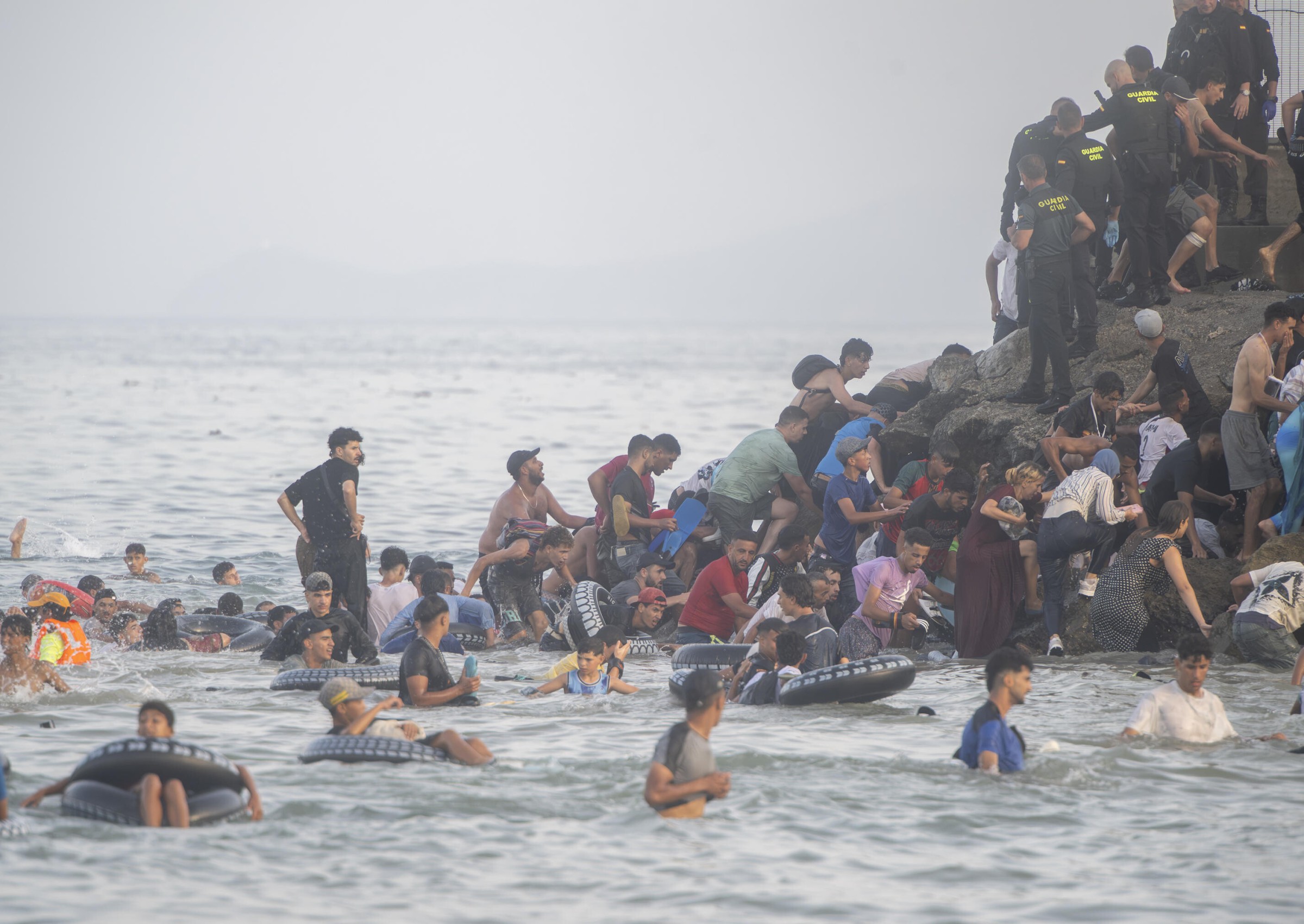
They swam, scaled cliffs, and risked their lives to cross the border. Within a few days at the end of July, according to official estimates, some 70,000 people reached Ceuta, the small Spanish enclave on the Mediterranean coast of North Africa. Global news stories were once again full of the events on the Strait of Gibraltar.
Yet behind the large numbers and reports of untenable conditions in an overwhelmed city, the plight of individuals was easily lost: their departure into a fraught and uncertain future, their desperate hope, their isolation – and not least the fact that around 150 people had died in the attempt to reach Europe, with about another 50 still missing at the time of writing.
Mass arrival in Ceuta
Hundreds of migrants have attempted to swim from Morocco to the Spanish city of Ceuta in North Africa on July 30, 2026.
© picture alliance / Anadolu | Marcos Moreno
Thousands entered the autonomous city by swimming and on foot, skirting the breakwater that separates Ceuta from Morocco. Hundreds of swimming tubes were left behind.
© picture alliance / Europa Press / ABACA
A question of life and death – the need for certainty
Gerhild Perl is all too familiar with the conditions on both sides of the strait, the boundary between Spain and Morocco, between Europe and Africa. It is almost 15 years since the anthropologist began investigating questions around migration and death in the Mediterranean Sea. Recently, the LMU professor co-edited the book An Anthropology of Disappearance, in which researchers shed light on various kinds of disappearances, along with their causes and subsequent effects. And whether we are talking about people who disappeared in wars and military conflicts around the world, who languished in the torture chambers of Latin American dictatorships, who were kidnapped by drug cartels, or who lost their lives trying to reach Europe – for Gerhild Perl, all these cases testify to the “social power” of the disappeared.
As explained in the volume, the category of the disappeared “brings us face to face with profound questions about human life: not only about absence and presence, but also about life and death.” It is about “rituals and mourning, protection and vulnerability, oppression and power, politics and intimacies.”
When Perl began her research, there were many research papers about why people flee their homelands, about their arrival in European countries, and about the associated challenges they faced. “But I found nothing on what happened to the people who did not survive the journey. And it is shocking how many of them there are.”
Anthropologist Gerhild Perl
© Johanna Weber / LMU
»Some families whose sons undertook the dangerous crossing back then still hope against hope. They live in a state of uncertainty, asking themselves whether their son is still alive, whether he might yet come back some day.«
Gerhild Perl, Professor at the Institute of social and cultural anthropology
Refugees in a boat off the Italian island of Lampedusa
© picture alliance / Laurin Schmid
How many people die on the dangerous migration routes?
According to official estimates, there have been some 35,000 such fatalities in the Mediterranean area alone over the past dozen years, while worldwide there have been over 80,000 documented cases. However, the real numbers are likely to be far higher, observes the anthropologist.
What do such losses mean? How do those left behind deal with the absence of family members and friends? With their disappearance, with not knowing what became of them? And on the other side of the Strait of Gibraltar? What does it mean for the people there when they have to retrieve dead bodies on the beach and identify and bury them?
Don't miss the next issue:
Drowned just a few hundred meters off the Andalusian coast
Gerhild Perl set out to investigate the “political and social afterlife” of the disappeared. She took as her starting point an incident in which around 40 Moroccans, mainly adolescents and young men, drowned just a few hundred meters off Rota on the Andalusian coast. The case contains many elements of a typical refugee tragedy of the kind that has been repeated many times since. For those left behind – and even for people only indirectly involved – the events remain an unfinished story. “Some families whose sons undertook the dangerous crossing back then still hope against hope,” says Perl. “They live in a state of uncertainty, asking themselves whether their son is still alive, whether he might yet come back some day.” Then a rumor might circulate in a neighboring village that someone has returned, and their hope is rekindled.
When somebody disappears, it is always possible they are dead. And the more time that passes, the more likely it becomes. “But it doesn’t become certainty,” says Perl, “rather it becomes an enduring torment” – one that does not constantly afflict them, but returns every now and then. On top of their mourning for the loss of a person comes the mourning for a lost body they cannot bury. “They cannot visit a grave, cannot integrate the dead person into the social world, as it were.” This creates, Perl explains, “a real yearning for this body,” as only the corpse “can confirm the death.”
Traces on the Wall
Graffiti in the southern Spanish town of Tarifa: a man with a surfboard and a man with a lifebuoy
© Driss Elhadj
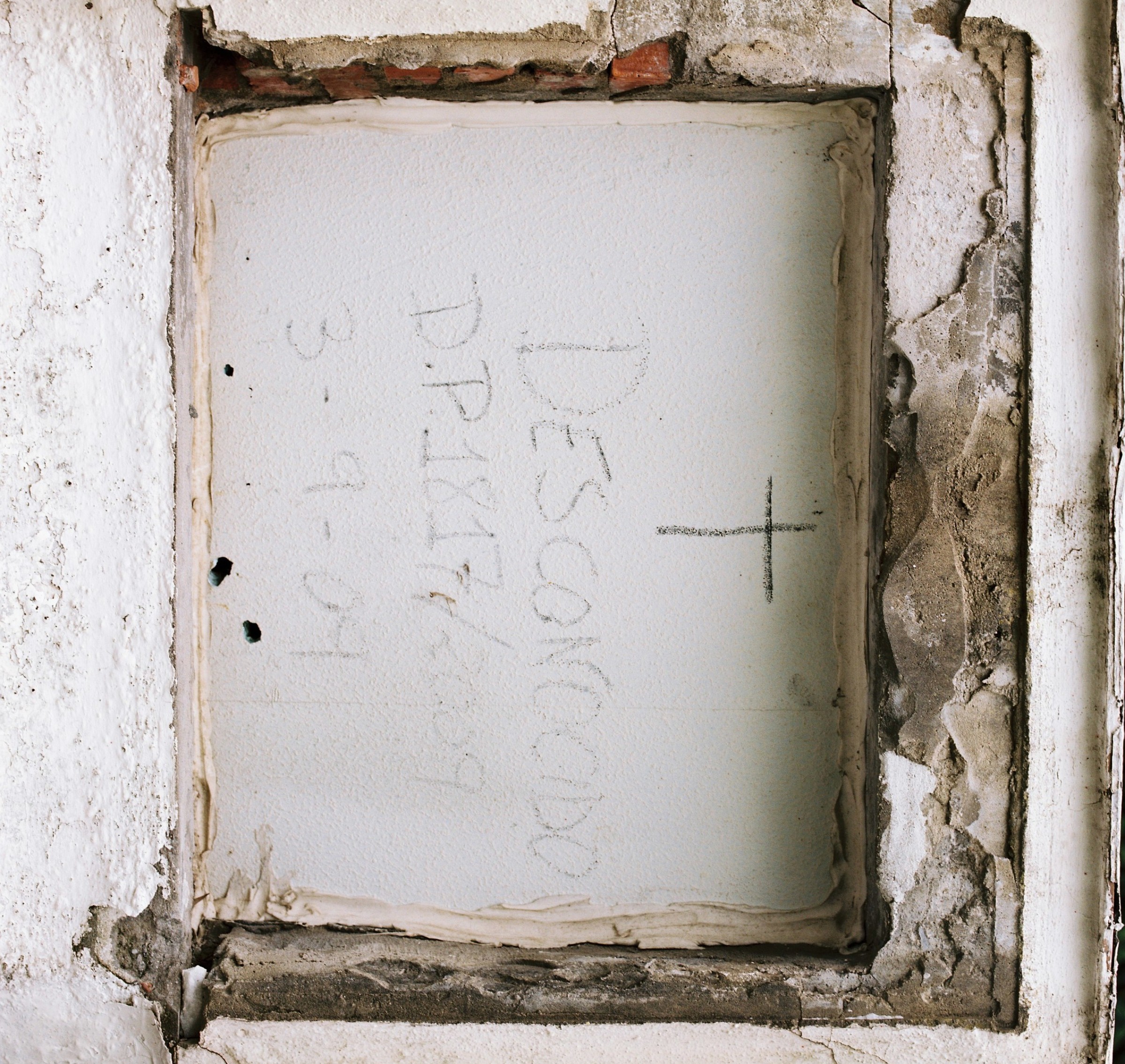
Anonymous niche grave at the old cemetery of Algeciras in southern Spain. The images are from the book "Hope", published by Christoph Merian Verlag, Basel.
© Sarah Hildebrand
On one side the dead bodies; on the other the names of the disappeared
And on the Spanish side? “The people who find corpses there are confronted with a body without a name.” When they try to identify a dead body, they often attempt to imagine who this person might have been. “A volunteer who helped recover corpses recalled the chickpeas he found in the trouser pockets of a dead man,” says Perl. “He said they came with chickpeas, they ate chickpeas. These little details turned the corpses into tangible human beings who had been alive just a short time before.”
A gap opened up: “On the one side are the bodies, and on the other are the families with the names and identities of the disappeared.” Gerhild Perl tells the story of a mortician who began to bridge this gap in the late 1990s through a mixture of voluntary commitment and entrepreneurial endeavor. On his own initiative, he looked for ways to identify the dead and return them to their kin. While private initiatives led the way at first, the LMU researcher explains, there is now a growing number of organizations working on the identification of corpses.
Ethnology: the beauty and horror of the world
Read more
Modern methods of forensic anthropology
It is no coincidence, notes Perl, that countries like Argentina, Bosnia, and Spain have driven advances in modern forensic anthropology in their efforts to identify dead bodies. In the relevant Spanish government agencies there are clear protocols for dealing with an anonymous body that has been found. DNA samples are taken and photographs are made, especially of any distinctive features. “In addition, fingerprints, which have often been washed away by the sea, are restored and entered into databases for comparison.” Yet very few of the dead can be identified in this way. The knowledge is generated on the Spanish side – and archived. “But the connection between the two sides is not functional.” For example, no relative from Morocco can obtain a visa for the purpose of a DNA comparison.
It is stories like these from which Perl draws her insights. And in her scholarship, too, she relates individual incidents, describes situational details, and cultivates a dialogical style of writing. “We have stories – that’s the way it is in anthropology.” People are “not merely research objects” for her. “In this kind of research, we enter into relationships with people. This is fundamental for us; we need people who invite us into their lives.” For her dissertation, she spent a total of 16 months in the border region between Spain and Morocco. Since then, she has frequently returned and maintains contacts there.
What counts for Perl is not the supposedly objective “view from nowhere.” As an anthropologist, she always writes in the knowledge that her accounts are not the whole story and cannot be separated from one’s own positionality and situatedness, both of which must always be reflected upon. “I observe, I empathize too, and I note everything down – my field diaries are essential companions.” It is an interpretative science: “For me, it’s about gaining a deeper understanding of a specific social world. I embed the situations I can observe into our present-day world as it is politically and historically constituted.”
»We have stories – that’s the way it is in anthropology. People are not merely research objects for us. In this kind of research, we enter into relationships with people. This is fundamental for us; we need people who invite us into their lives.«
Gerhild Perl, Professor at the Institute of social and cultural anthropology
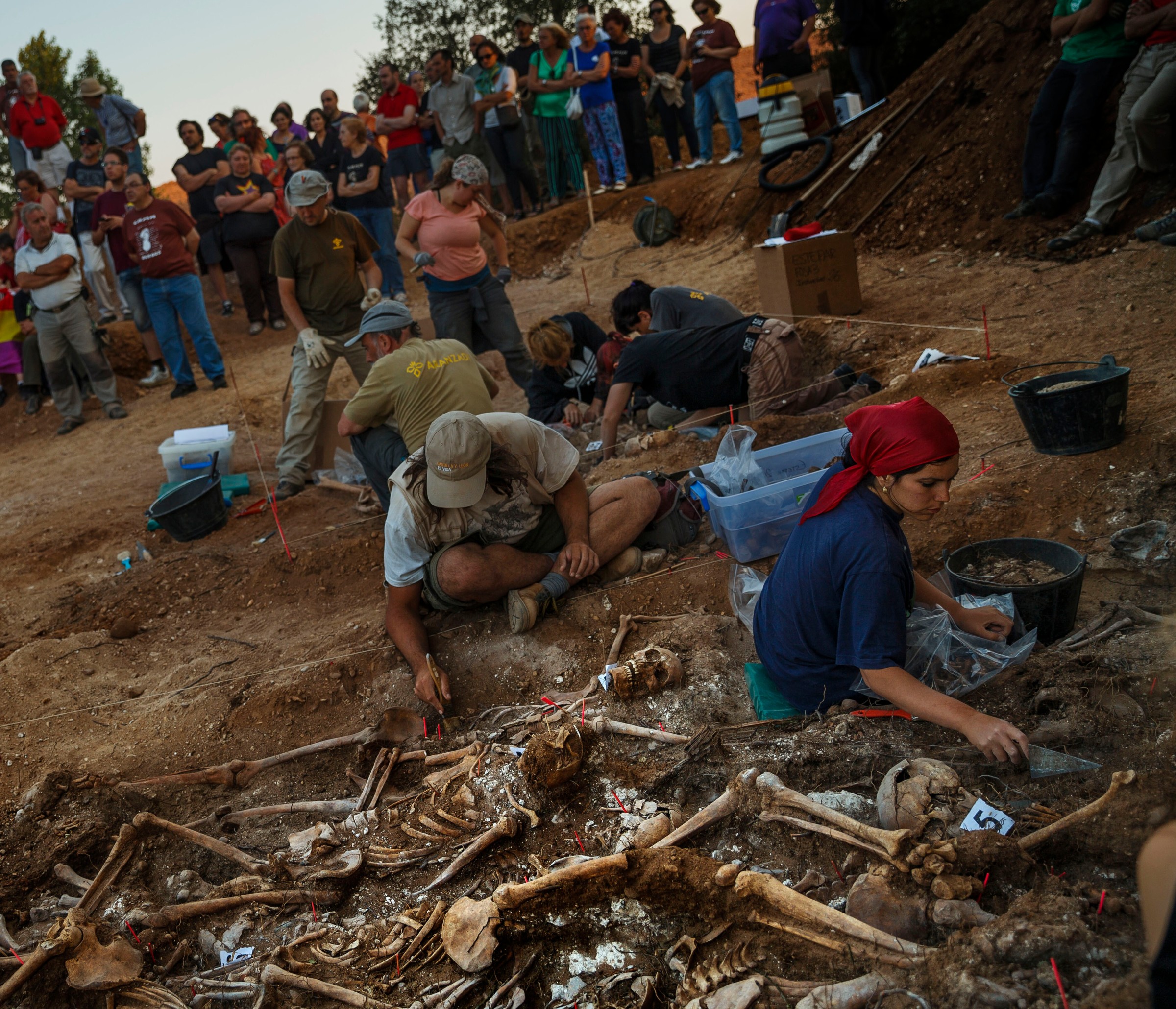
Mass grave from the Franco era
In this photo taken on July 26, 2014, volunteer archaeologists, anthropologists and forensic scientists from the Aranzadi Sciences Society and Association for the Recovery of Historical Memory of Burgos work in what it was a hidden mass grave in El Estepar, Spain. Across Spain, volunteer teams of archeologists, anthropologists and forensic scientists head out every year on expeditions to dig for suspected mass graves _ a legacy of Spain¿s fascist past during the time of General Francisco Franco.
© picture alliance / AP Photo | Daniel Ochoa de Olza
Contradiction: more freedom of movement in Europe, more dead in the sea
“My research took me to many archives and cemeteries. When visiting these places, you can really see the increase in the number of unidentified bodies washed ashore from 1991 onwards,” says the LMU anthropologist. “It’s a sad paradox” that this is linked to a major achievement: a Europe with open internal borders and freedom of movement. Spain joined the European Community in 1986 and the Schengen Area in 1991. As a condition of membership, the country had to close its external borders. Previously, there was visa-free travel between Spain and Morocco. “There were close relationships, and not only at the political level, but also in terms of everyday interactions.”
During the “Years of Lead” from the 1960s to the 1980s, Morocco was a country of repression. The regime of King Hassan II was responsible for the disappearance of thousands of people in prisons and camps. “This has lasting effects and shapes the relationship between an individual and the state,” explains Perl. Spain too has a history of disappearances that still influences society beneath the surface to this day. In the fifty years since Franco’s death and the end of the dictatorship, a powerful movement has emerged calling for the opening of the countless mass graves in which the victims of Spanish fascism were dumped, and for at least an initial attempt to identify some of the dead. Here once again, notes the anthropologist, it is the families, the descendants of the disappeared who are the driving force.
This is another illustration of the “social power of the disappeared,” which unites these very different stories from Spain and Morocco. Perl recalls a woman in Morocco whose son has been missing for 26 years, a young man who left home and never arrived “in Europe”. “She told me there’s always a little flame burning that never fully goes out.”
Gerhild Perl is professor at the LMU institute of social and cultural anthropology.
Text by Martin Thurau
More from LMU's research magazine:
Read more articles from LMU's research magazine in the online section and never miss an issue by activating the magazine alert!