Bringing masterpieces by women out of the shadows
Once a highly successful playwright, Elise Bürger languished in obscurity until LMU researchers set out on her trail.


Once a highly successful playwright, Elise Bürger languished in obscurity until LMU researchers set out on her trail.
LMU literary scholar Anna Axtner-Borsutzky is making space in the literary canon for female dramatists of the 18th and 19th centuries. Although some of these authors were highly successful in their time, they have largely vanished from our cultural memory. Axtner-Borsutzky and her team’s research into playwright Elise Bürger illustrates the reasons for this erasure.
What began as a bit of high-spirited fun turned out disastrously for the young Elise Hahn. Her verses praising the poet August Bürger were meant as a joke. Some friends of hers published them without her knowledge (although without naming her). The poems moved Bürger, who was 21 years her senior, so deeply that he sought out their author and made a marriage proposal. Elise was only 20 years old.
Two years after the wedding in 1790, Elise Bürger was divorced, impoverished, and deprived of contact with her son Agathon. She was also branded with a reputation for being “wanton, vain, extravagant, and argumentative,” as we can still read online today, over 200 years later, in the New German Biography, a standard biographical reference work.
Instead of withdrawing from the world, Elise Bürger looked to the stage and continued to write. In the following years, she established herself as a dramatist and actor. Her plays were frequently performed throughout Central Europe, and her artistic skill was celebrated. She often wrote about women who defended themselves against injustice or who challenged prevailing gender norms. Her work is unknown to posterity, however, and her plays are largely inaccessible.
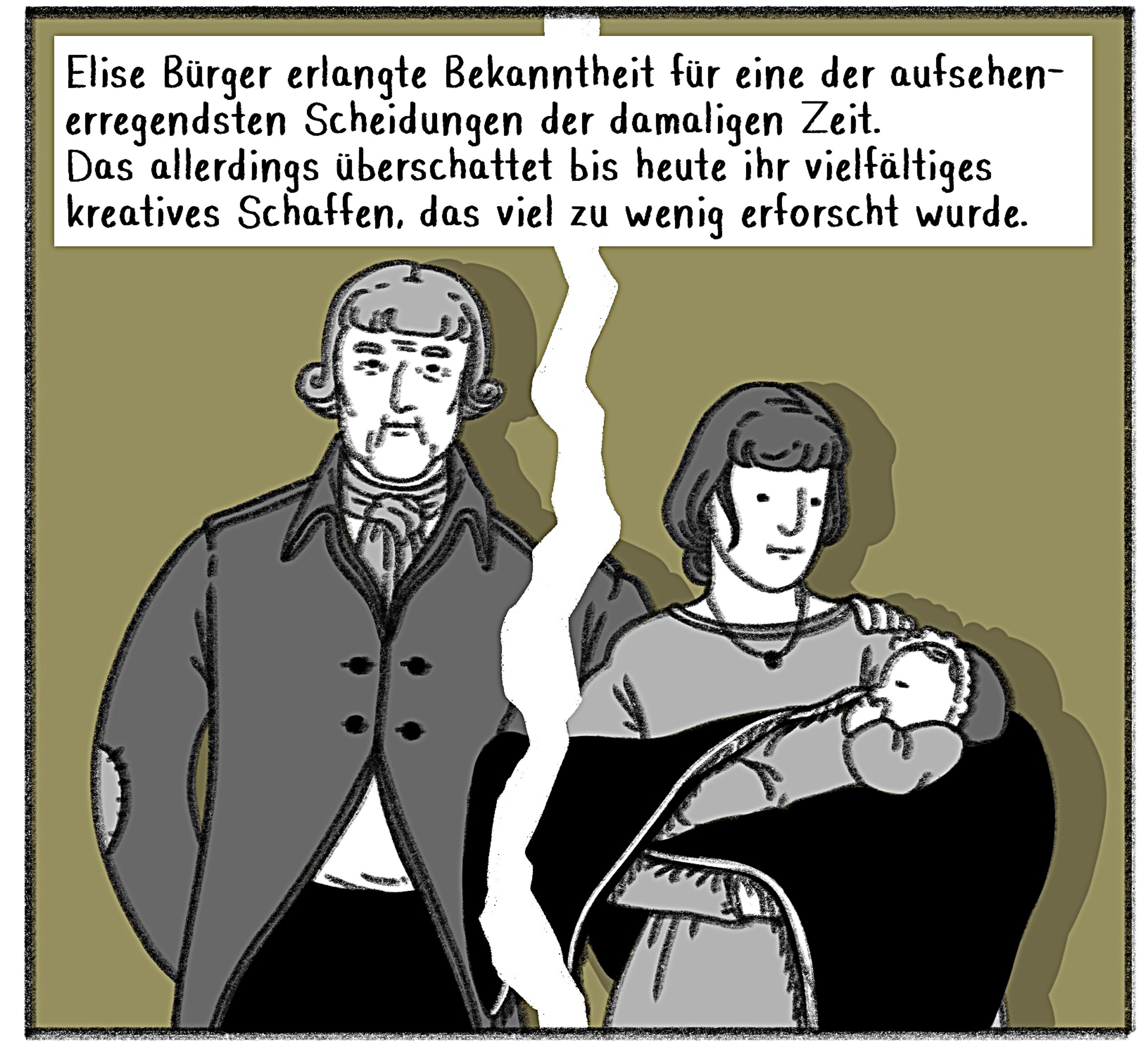
The “Lost in Archives” research project is making its findings accessible to a wider audience in the form of a graphic novel.
© Julia BernhardThis is changing through the research of Dr. Anna Axtner-Borsutzky, co-director of the Lost in Archives project. The LMU literary scholar and her team have been on the search for lost works by female playwrights from the 18th and early 19th centuries since 2024. “Elise Bürger is an excellent example,” says Axtner-Borsutzky. “We have only little snippets of her life story, and her life as a writer and actor has fallen into oblivion.”
Elise Bürger’s case is not unique. Two hundred years ago, there were highly successful female dramatists, whose plays were performed more frequently than those of their male counterparts, despite the fact that it was more difficult for these women to make a name for themselves due to their social position. Access to education was often restricted for women. Only women from the nobility and the educated bourgeoisie had any chance of developing their artistic talent and intellectual capabilities. And those who did so faced strong prejudices. Many published under a pseudonym, while others – when not reliant on earning income from their work, such as Charlotte von Stein – did not publish in the first instance, and later put out their work anonymously.
One thing that connects female authors as disparate as Elise Bürger and Charlotte von Stein is that they have chiefly been remembered in relation to a man. Charlotte von Stein is known as a friend of Goethe’s, while Elise Bürger is known, if at all, as the divorced wife of Gottfried August. “However, the story of Elise Bürger does not end with the marriage; actually it just gets going. Although it’s precisely this part of her story that’s obscure,” says Axtner-Borsutzky.

Anna Axtner-Borsutzky with her team at the Deutsches Theatermuseum München
© LMU/Florian GenerotzkyThe life circumstances of once successful female playwrights like Elise Bürger often worked against their inclusion in archives – whether because they published under a pseudonym or because there was no-one to look after their estate. Another decisive factor was the people who determined what was considered valuable and worthy of preservation. Scholars sometimes refer to archives as an instrument of power. “There have been many moments over the past 200 years in which the literary estates of women have not made it into these institutional archives. This creates the impression today that their works never existed. We have an example in which an archive director says quite frankly: We’ll take the estate of the man. The woman’s estate can go, unless there are letters from important men,” explains Axtner-Borsutzky. She describes her research in this area as “working with the gap”.
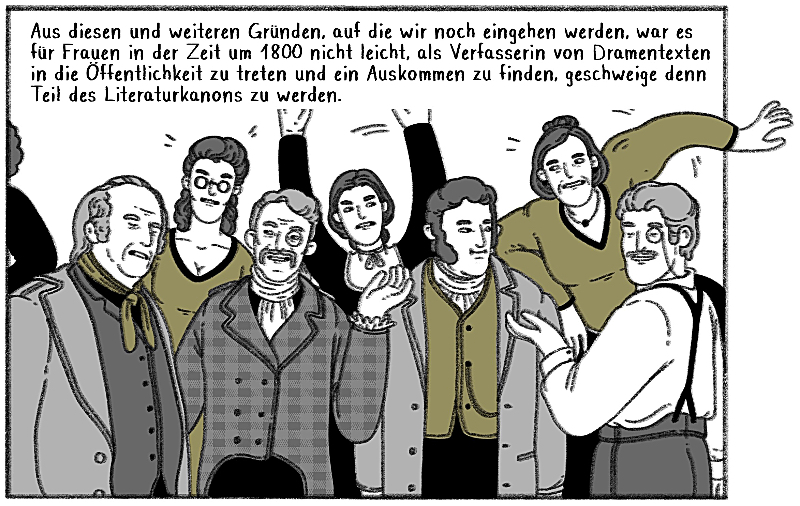
Around 1800, it was not easy for women to be recognized as playwrights. They were also usually denied a place in the archives. Today, it takes persistent research and investigation to rediscover the works of once-famous female authors.
© Julia BernhardElise Bürger, playwright and actress (1769–1833)

Anna Axtner-Borsutzky heads the theater subproject within “Lost in archives. In search of hidden women in the 18th century.”
Some of Elise Bürger’s manuscripts were considered lost. And initially the LMU research team chased clues down dead ends – for example, when libraries that were suspected to hold materials no longer exist. “It’s not enough to look in online catalogs, where you won’t find what’s thought to be lost or was not considered important enough to be included,” explains Axtner-Borsutzky. With her team, she went on the search for things like playbills, letters, and reviews. Since then, the researchers have rediscovered four manuscripts of Klara von Montalban, which was performed all over Central Europe into the 1840s. They are now editing the play and preparing a reading edition, which is due for publication next year.
This is just one of at least twelve plays written by Elise Bürger. And Bürger is just one of the many female playwrights whose works had been lost to cultural memory, and which the LMU project is now bringing to light, at least to some extent. “We didn’t expect to find so many manuscripts and so much work to be done,” says Axtner-Borsutzky. In respect of the research she has accomplished, she adds: “It’s just the tip of the iceberg.”
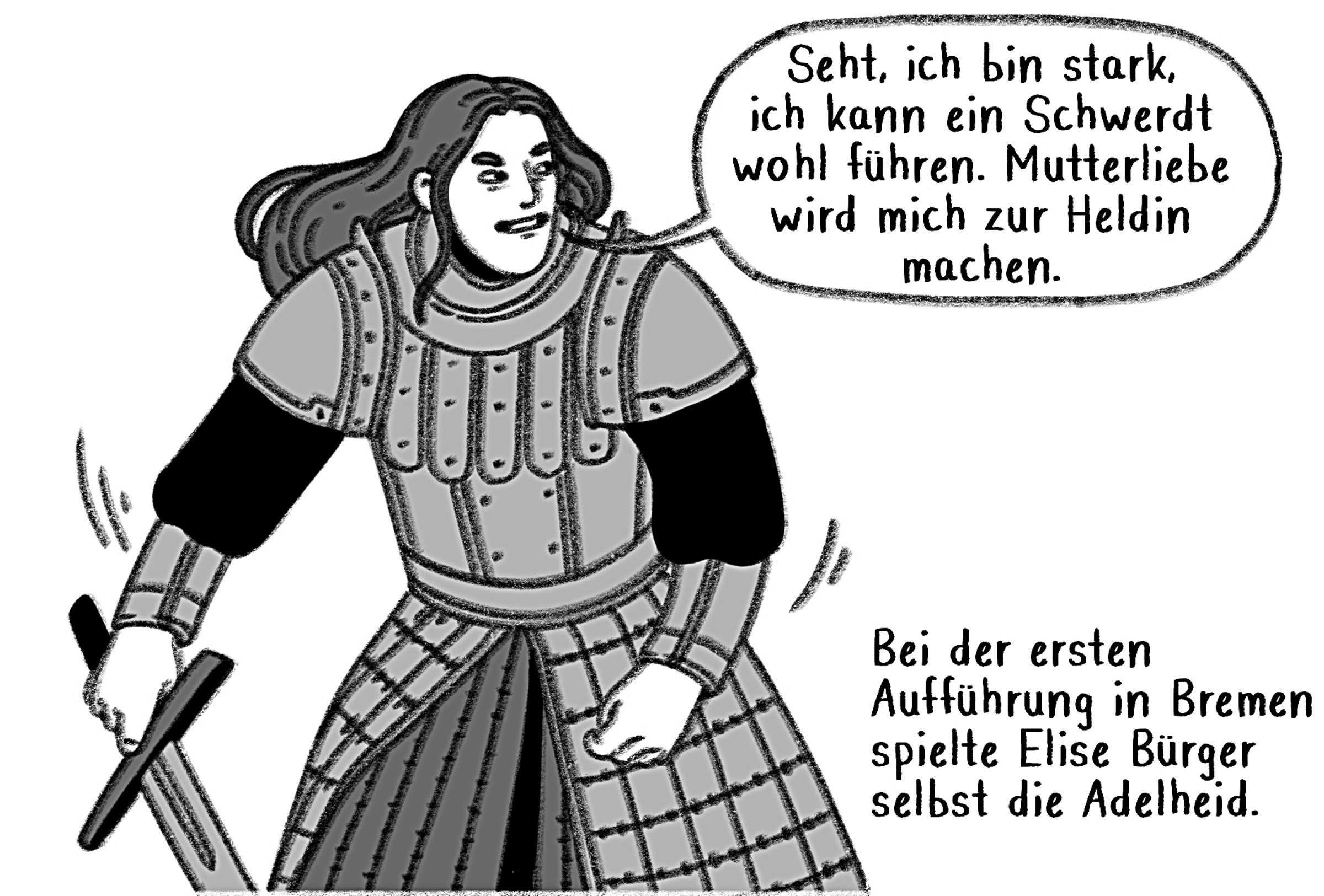
A widow takes up the sword to defend her castle and not have to remarry. Excerpt from the graphic novel of the “Lost in Archives” project
© Julia Bernhard
Elise Bürger, who was 30 years old at the time, played the lead role herself. “The perspective of a mother who takes on a male role, and dons armor to take up this role, makes the play highly unusual for its time,” says Axtner-Borsutzky.
© Staats- und Universitätsbibliothek BremenDr. Anna Axtner-Borsutzky is a lecturer at LMU’s Faculty of Languages and Literatures. She heads the theater subproject within “Lost in archives. In search of hidden women in the 18th century.”
Further information about the female playwrights and their female writing contemporaries is available on the website of the Lost in Archives research project.
The Lost in Archives research project is presenting its findings to the public by means of a traveling exhibition. In addition, a graphic novel is being published.
The exhibition will open on 12 November 2026 in the Schopenhauer Studio at Goethe University Frankfurt.
A collaboration with Darmstadt State Theater is bringing these works back to life. Audiences can enjoy performances and staged readings of works by 18C and 19C female playwrights that were rediscovered through the Lost in Archives project.
Elise Bürger: Unerhört at the Darmstadt State Theater
Read more articles from LMU's research magazine in the online section and never miss an issue by activating the magazine alert!