Drive and Urgency
LMU Germanist Frieder von Ammon on the significance of rhythm in poetry and prose and on what links classic poems and rap

LMU Germanist Frieder von Ammon on the significance of rhythm in poetry and prose and on what links classic poems and rap
“The fact I ( … ) used a beat, a certain kind of beat, that’s obvious to me.” Which poet uttered this quotation?
Frieder von Ammon: It was definitely Ernst Jandl.
Of course, this was a bit too easy for you as a Jandl expert. There was a famous event held in the Royal Albert Hall in London. It was the summer of 1965, 4,000 people were waiting to see Allen Ginsberg, the leading poet of the Beat Generation. The warm-up act, as it were, included the Austrian poet Ernst Jandl, who also recited his poems, for example the “Ode to N”. So there he was standing on the stage, looking nothing like a member of the Beat Generation. And yet he received thunderous applause for reciting this very poem. What exactly happened on this evening?
Fortunately, there’s a film capturing the moment: A large percentage of the audience, comprising several thousand mainly young people, joined in with the poetry recital, spontaneously creating a collective performance. Nobody knew this Ernst Jandl, nobody knew the poem, and almost nobody understood German. And yet despite this, it was still possible to have such an impact – simply because this poem has a beat, coupled with an anti-authoritarian gesture that translated directly to the audience. I’d have loved to have been there.

6:53 | 18 May 2026 | ©Peter Whitehead
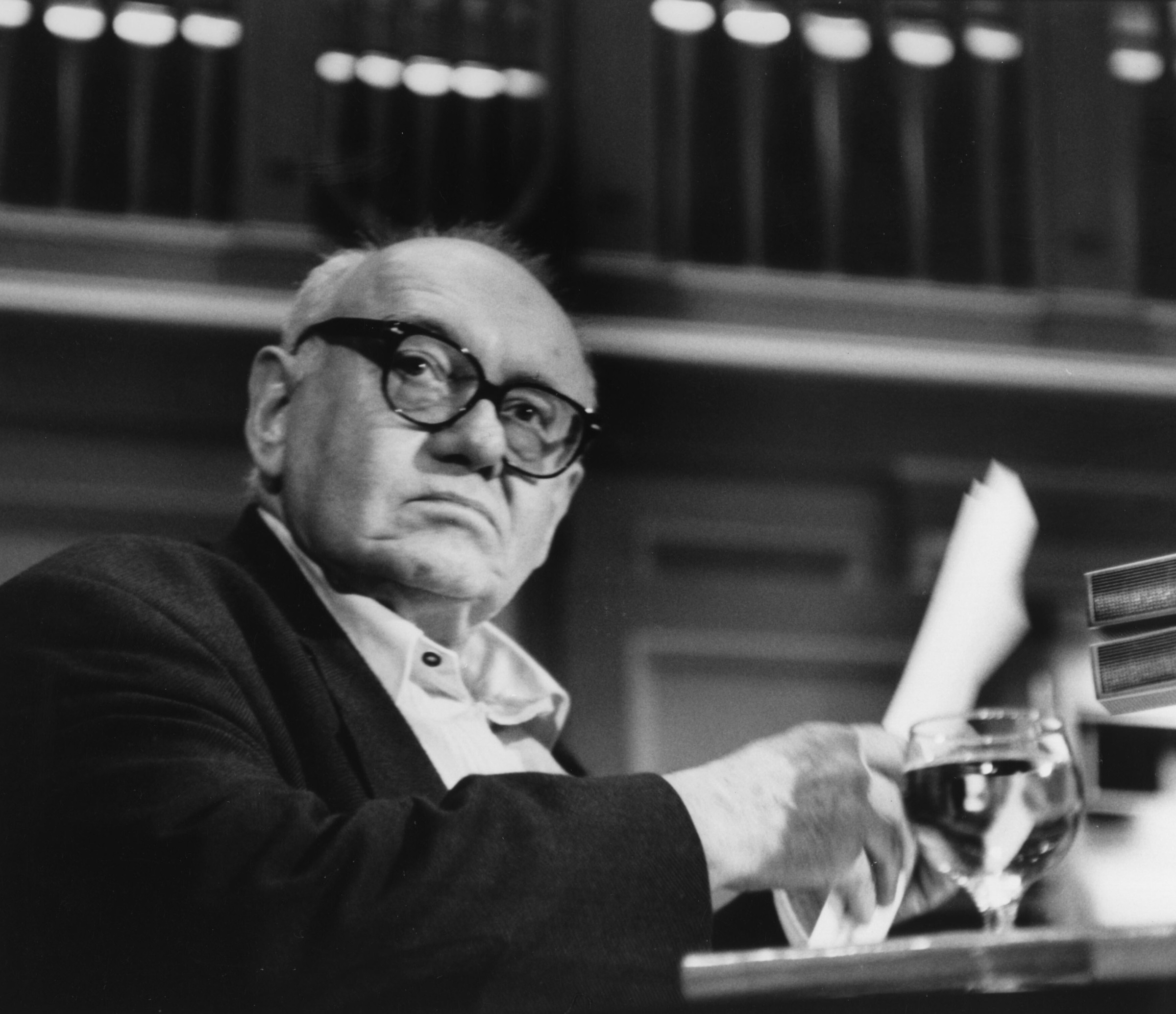
Ernst Jandl in May 1993 in the main hall of the Zurich Conservatory during a reading from his work "Weltgebräuche"
© picture-alliance / akg-images / Niklaus StaussWhat makes this poem so special?
The “N” in the title refers to the historical figure of Napoleon; here it represents tyrants, imperialists, warlords of all kinds, and of course the implication is that it also applies to Hitler and Stalin. And “N” is used as a synonym for all the others – because his name is broken down into its individual components and a beat is added to accompany the whole thing. This created a poem that sounds different to probably anything else that has ever previously been created in German-language poetry.
I once had the opportunity to recite “Ode to N” in China, standing in a huge auditorium full of students, and this recital also worked really well. The beat seems to convey elementary emotions that transcend semantics and can transmit across different cultures.
Jandl did more to popularize experimental poetry than almost any other poet. What exactly brought him to the beat?
Initially, Jandl didn’t in fact utilize the lyrical meters that were traditionally prescribed, romance stanzas, elegiac couplets, or whatever else. He had a different project in mind. He was completely obsessed by jazz, bought every record, attended every concert. And with the beat, he transferred some of the rhythmic intensity of this music, which is fundamentally different to that of European art music, to his texts.
His love of jazz was all about the music itself, but for him it also had a political dimension, which was partly to do with the fact that jazz was banned under the National Socialist regime. This meant that, for Jandl, jazz was an anti-totalitarian form of music that he associated with values such as democracy and freedom. Jandl had experienced the war as a soldier and, like many others in his generation, he felt that the war had robbed him of the chance to explore his interests and opportunities.
Frieder von Ammon
So after 1945 did he do everything in his power to make up for all that he’d missed out on?
Yes. On one occasion, as he vividly recounted, he was no longer able to use the record player, which would normally be playing day and night, because the power grid in the district of Vienna where he lived had been switched over from alternating current to direct current. Where he’d previously been able to listen to energetic, vital jazz, all of a sudden there was now silence. This was the moment when he decided to do something. He tried to “salvage” the rhythmic element of this music that was so integral to him, the beat, as he himself described it, by applying it to his poems. This was something completely new in the history of poetry.
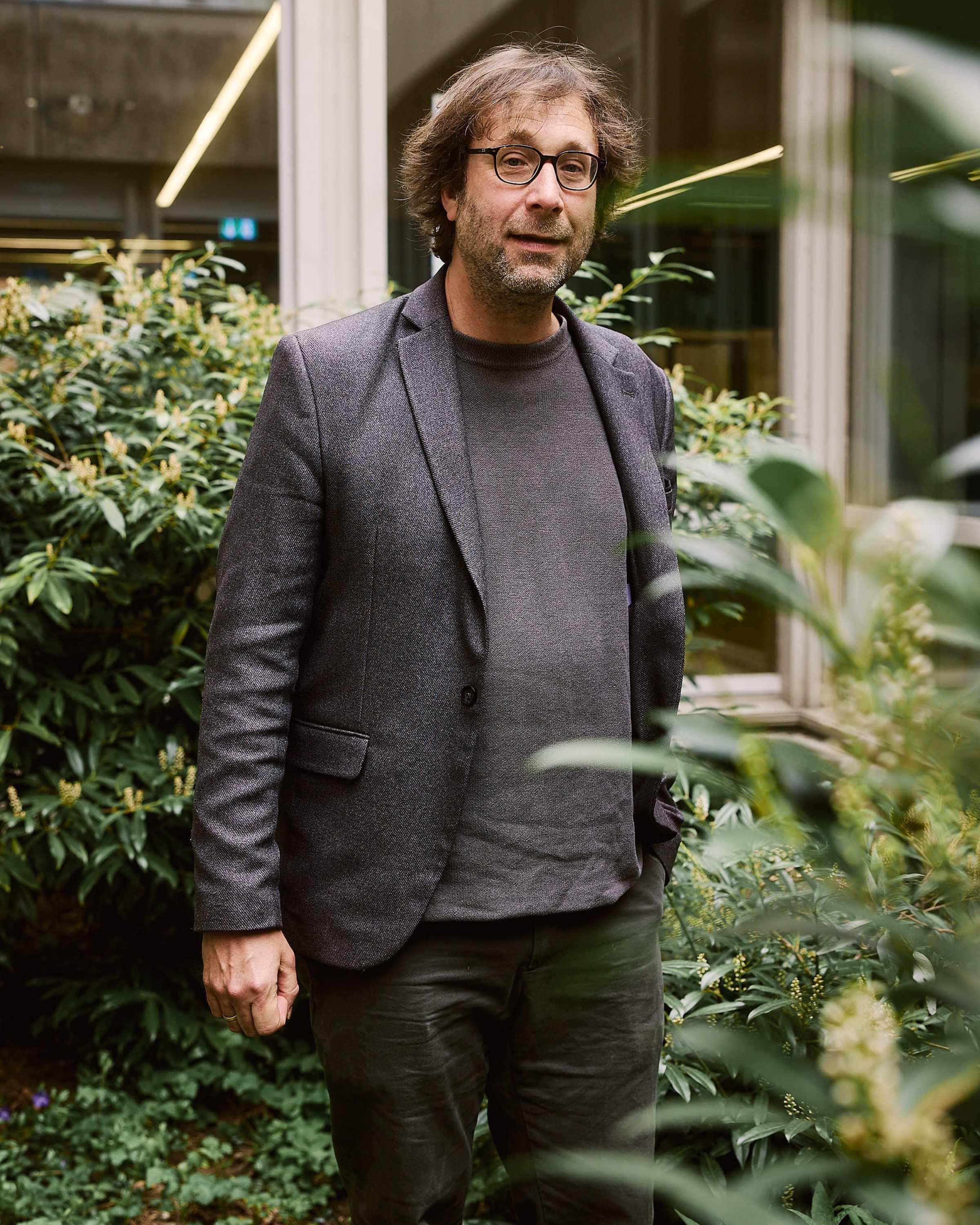
Frieder von Ammon in the garden of the Institute of Philology
© Florian Generotzky / LMUEver since they first emerged, poems have always had a close link to music. After all, the poem originated from song. It was only much later that it evolved to become an independent artform that then developed mainly in the form of text. How did this separation come about?
You shouldn’t think of this as a linear process in which poetry and music start off as one single entity and then end up representing two separate worlds. That’s not how it is. The magnetic bond between poetry and music has always remained strong and has always kept being reconstituted. But it’s correct to say that European poetry has been linked to music from the origins that we can trace historically, to the extent that it was sung during performances in front of an audience, also with musical accompaniment.
What role does rhythm play in this context?
You can’t separate the different levels from one another. In a poem by Sappho, for example, the text and the melody formed a single entity, and this also included the rhythm. But unfortunately, the melodies were not handed down, so we’re only aware of the texts with their very artistic meter. With a Roman poet like Horace, who several centuries later can reflect on early Greek poetry and write poetry using its meters, the situation is very different: Horace writes poems without any connection to music from the outset; to a certain extent, they’re songs without a melody.
Developments like this recur at different points in the history of poetry, such as in medieval German-language poetry. Walther von der Vogelweide, for example, also performed his songs in front of an audience. His lyrics were written down, but again his melodies were not, so we know very little about them. This process therefore resembles what occurred in ancient times. But there have also been many attempts to recreate the original unit – Jandl is just one example of many. And in some areas, it has never fully disappeared.
But in German classical poetry, for example, isn’t the process of separation largely complete?
Yes, but tellingly Goethe, for example, was very interested in his poems being set to music, and this did in fact happen to a very large extent, sometimes even before they were published. With his famous poem “Prometheus”, however, it took almost half a century for it to be turned into a song by Franz Schubert. This was not least due to the rhythm, as rhythmically this poem is highly complex and extremely interesting, precisely because it’s intended to represent a move away from the metrical patterns that were traditionally prescribed.
This is also reflected in the subject of the poem, which is about Prometheus rebelling against Zeus and the world he represents. Goethe depicts this rebellion at the rhythmic level by no longer using meter, with metrical fragments at most. Each verse in this poem has its own rhythmic form, it’s developed from what is said in each line, which is a gestural rhythm, so to speak. This creates an elemental force so powerful that it’s still communicated today.
Frieder von Ammon reads “Prometheus” by Johann Wolfgang von Goethe.
1 Jun 2026
Frieder von Ammon
When text is presented on stage and acted upon: On what levels is rhythm present here? Let’s maybe start with a minimally invasive intervention. In the Death of Wallenstein by Friedrich Schiller, it’s reported how Max Piccolomini dies …
Yes, these verses provide a good example of what a deviation from the metrical scheme can produce:
“Here comes fate – Raw and cold / It grabs hold of the friend’s tender form / And throws him under the hoofbeat of his horses. / This is the destiny of what’s beautiful on earth.”
Schiller does this with great skill: He operates in the meter of blank verse, which was made famous by Shakespeare; it’s a wonderful meter, very dynamic, multifaceted, with a wide range of expression. And then Schiller inserts an extra syllable at the very point where there’s a mention of the body being crushed by the horses, to bring this gruesome reality to life. The artistic skill here is the deviation. But to be able to emphasize points like these, you need a norm that you can violate, which in this case is blank verse. Schiller also knew that if you only ever use one meter and always follow the rules, it quickly becomes boring.
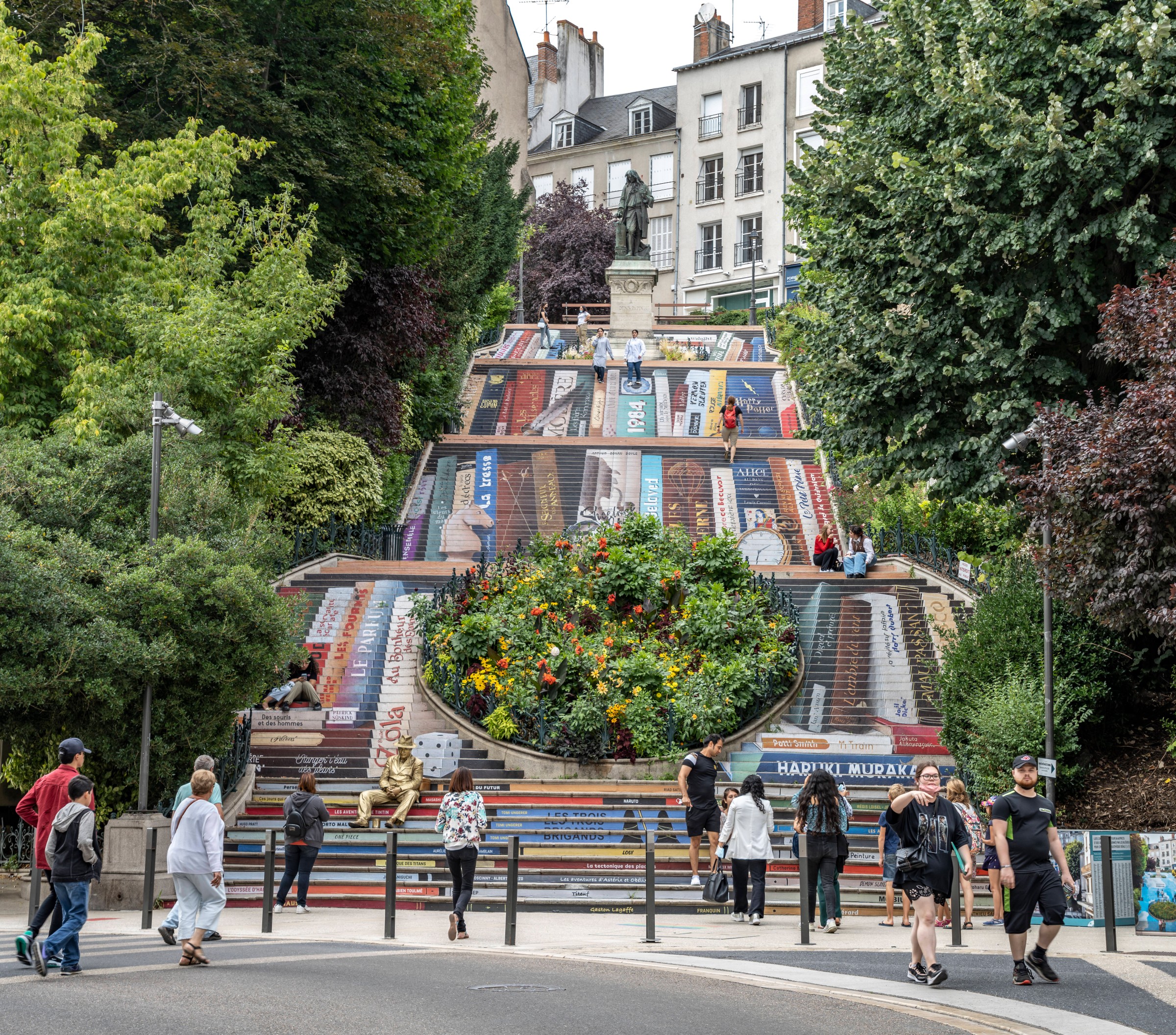
Art on the Denis-Papin staircase in Blois, Loire Valley, France
© IMAGO / Peter SchickertSo what can rhythm convey?
A very great deal, and you can’t reduce this down to a single common denominator. Goethe‘s Faust is a prime example of this. The range of different forms that Goethe plays with here is outrageous. And this is all functionalized with very careful calculation. Let’s take the so-called iambic trimeter, which is the main verse in ancient Greek tragedy. It had hardly ever appeared previously in any German drama. Goethe then recreates it at the point where he introduces the ancient figure of Helena. Using the meter alone, the scene is set in ancient times without the need for any backdrops or costumes. A similarly striking example is Faust’s famous opening monologue, in which he speaks in Knittel verses – a verse meter that was already outdated and completely unclassical at the time: “There I now stand, a poor fool / and I’m still as smart as I was before!” Goethe thus makes it clear that we’re not in the present, but somewhere between the late Middle Ages and the early modern period. He uses meter to transport his audience back to a period of upheaval, which corresponds to the upheaval seen in the period around 1800.
In addition, each of the main characters has a special metric signature. For example, Goethe assigns Mephistopheles what is known as the madrigal verse, which is noted above all for its dynamism and diversity. It’s a meter that is not strict but highly adaptable – ideal for a vibrant character like him.
If you now move away from the language that is couched in meters, as it were, and move on to prose text, don’t you lose the sense of rhythm? What do you take delight in here? Excitement, beauty, elegance?
All this and more. I also take great delight, for example, when elegance is not exactly strived for or even boycotted, provided this is done in a convincing way.
There are actually a series of terms that ascribe a rhythmic component to literature. What makes a text “flow” well?
If, for example, you say that a text has “drive”, then although you can imagine what this means, it’s not a precise description. In the field of prose literature, we actually only have a limited set of analytical tools at our disposal, especially in comparison to poetry. Sadly. That’s why we often resort to using metaphors like this.

Writer Thomas Bernhard at the dress rehearsal for his play "Heldenplatz" at the Burgtheater in Vienna in 1988. | © picture alliance / ÖNB-Bildarchiv/picturedesk | Weber, Harry
Well then, let’s be a little vague.
To quote just one example: The Austrian novelist and playwright Thomas Bernhard, now a modern classical author, developed a very specific prose rhythm that produces a strong pull. He learned from music that repetition can be a very effective principle of formal organization. Accordingly, he likes to work with individual elements, a subordinate clause or even a set phrase like “I thought”, “he said”. They’re repeated constantly, but always in different places, and they help to create “drive” or “flow”.
Like text patterns that shift around?
Yes, this technique makes his prose unmistakable. But the repetitions are more than just a structural phenomenon. They’re also related to the characters, who speak or recount the monologues that often extend throughout the book. In Woodcutters, for example, it’s a grumpy chap who, sitting in an armchair, observes a dinner and insults everyone else in his thoughts. He’s a completely obsessive character, a man trapped in his inner thoughts, and this is reflected in the rhythm of the sentences.
Frieder von Ammon reads from Thomas Bernhard's novel “Woodcutters”.
1 Jun 2026
Frieder von Ammon
If you think about words and rhythm today, you can’t help but think of rap. What makes this new, different?
First of all, as an emphatic, often virtuous rhythmic chant, rap is very far removed from conventional notions of singing and therefore also of poems, for example, when a text is rapped at great speed and the syllables almost seem to blend into one, not to mention the actual content. But a sense of rhythm and timing are absolutely crucial for both poetry and rap.
The German rapper Haftbefehl is a polarizing figure. Many people think that his lyrics are misogynistic and glorify violence. But despite this, for many years he has been regarded as a mouthpiece for young people mainly from a migrant background in Germany.
There are undoubtedly more virtuosic rappers than Haftbefehl. But his lyrics come across – even though you should be careful about using this term – as so authentic that many people can identify with them. And that’s amazing because rap normally thrives on stylization, on self-fashioning. Eminem, for example, takes on very different personas. With Haftbefehl, on the other hand, you get the sense that he is pretty much reflecting exactly what he experiences in his life.
Doesn’t this include plenty of stylization?
Yes, of course it does. But I also perceive his lyrics, despite all the gangsta poses, to be “real”. And this effect is also linked to the rhythmic way in which he raps.
What impression does this forceful urgency leave on you?
I get the impression that I’m listening to someone who can’t do anything else, who’s rapping for his life.
This makes the next question almost superfluous. Are lyrics like these a form of lyricism, of poetry in its own right?
I would say yes, initially without making any judgement. From a systematic perspective, there are definitely many elements that link this form of rhythmic chanting to other forms of poetry. In a certain way, this takes us right back to the origins of poetry: Rap is also performed in front of an audience with musical accompaniment, it’s just not sung in a traditional sense.
But it’s probably different to any of the other forms of poetry you normally encounter in your research, isn’t it?
Yes, although there are definitely areas of similarity, especially given that many of today’s poets grew up listening to this music and to some extent have been inspired by it. For example, there’s a greater freedom to experiment with rhyme, which for many years was frowned upon as an element of a seemingly outdated esthetic genre. And now rappers are showing what you can do with rhymes, what flow you can create using deliberately placed internal rhymes, for example. And this is also making poets think about rhyme in a whole new way.
Are your analytical tools still fit for the modern age?
Many of the tools we use when we want to study the meters and rhythms of verse texts originate from ancient times and for us represent a legacy of humanistic education. But today, we see authors with a wide range of educational paths and backgrounds. This is reflected in the rhythm of the texts they produce. We need to develop different analytical tools to keep pace with these new developments. This is an open, fascinating situation.

© Florian Generotzky / LMU
Frieder von Ammon holds the Chair in Modern German Literature with a focus on literature of the 20th century and the classical modern period. He is also founder of the Center for Contemporary Literature Munich at LMU.
Read more articles from LMU's research magazine in the online section and never miss an issue by activating the magazine alert!