Three small livestock was the established gift offered to mark the celebration of new light in the city of Uruk. This is the written note on a piece of clay that is thousands of years old. Other fragments document which craftsmen did which forms of construction work and who delivered what quantity of sheep’s wool or dates.
Walther Sallaberger has held hundreds of these clay tablets from Mesopotamia in his hands and deciphered their meaning; most of them are in fragments because over the millennia they have not survived in one piece. “It’s fascinating to see the kind of microcosm that this opens up,” says the Professor of Assyriology at LMU. These are the first written traditions of humankind, administrative notes, impressed onto a piece of clay with a reed stylus.
These notes give Walther Sallaberger insights into the rules, both big and small, that have shaped the way human beings coexist. The findings reveal a phase of human history in which early advanced societies developed an understanding of something that sets the pace of life in modern societies: the management of time.
The fact that researchers have access to this development today is down to the invention of another cultural technique that provides insights into the thinking of bygone cultures: “The script was invented for administration. This step can easily be traced through from archiving tools that predate writing to the first systems of writing as early as the second half of the fourth millennium BCE in the city of Uruk,” explains Sallaberger. “Back then, society was so complex that different economic segments worked together better with documentation in a written form.” This served the purpose of “monitoring” shared economic activity, as he calls it.
»The fact that writing exists is down to administration, but it’s inconceivable to have administration without time.«
Walther Sallaberger
Early advanced civilizations
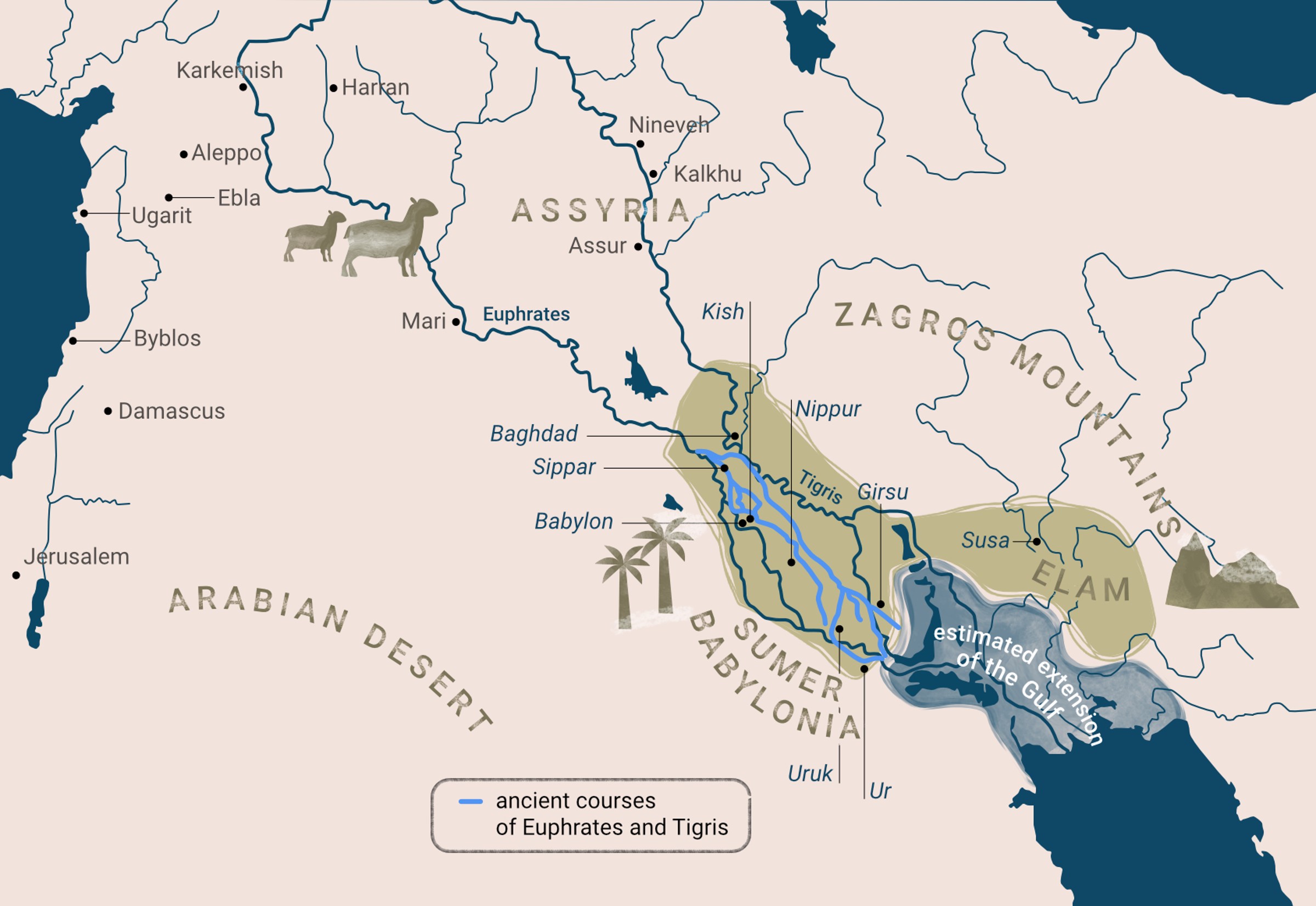
City-states such as Ur and Uruk emerged along the ancient courses of the Euphrates and Tigris rivers. Sea levels were higher at that time, so the two cities were not only closer to the river but also significantly closer to the coast.
© Lisa Stanzel
The first half of the third millennium BCE was the period of urbanization in Mesopotamia. “At this time, there were more people living in cities than ever before,” says Sallaberger. On the two rivers Euphrates und Tigris, a number of city-states sprang up, some of them in former marshland areas and each with a population of several tens of thousands of people.
This also included places in the surrounding countryside, which was crisscrossed by a network of channels for growing field crops to provide a food supply to these urban communities. “People were of course living under the archaic conditions of the Early Bronze Age, there was no spoke wheel, no horses, no iron. But this way of living together in cities produced different professions and fostered innovations. Many of the things that people later took for granted were tried out and created there.”
"It’s urgent!”
The people in Mesopotamia arranged their lives to coincide with the rhythms of nature. But when they wrote letters to each other, there was often an urgent need. “It’s a deluge” was the common phrase they used to emphasize that something was urgent.
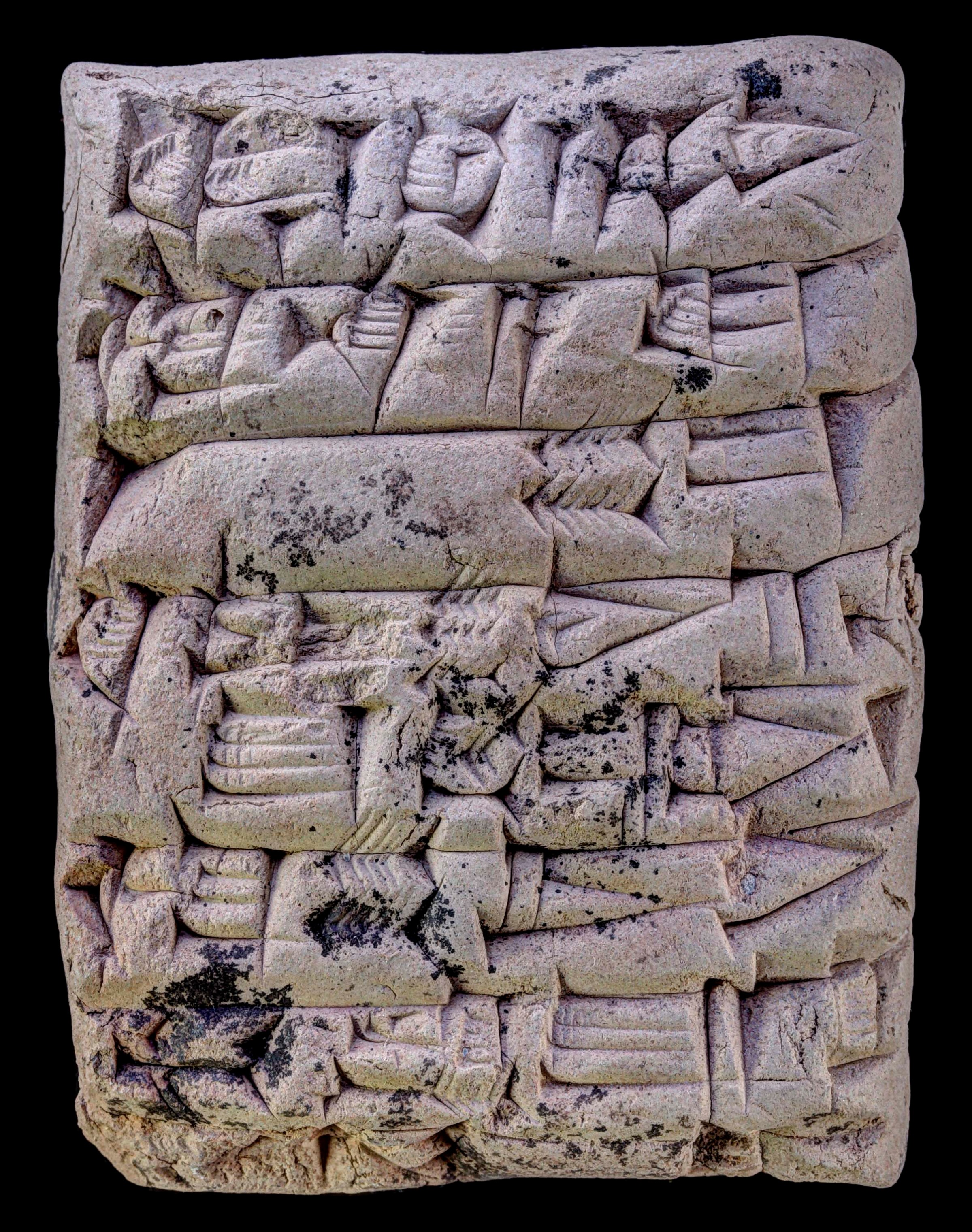
This letter states, for example: “If you (i.e., the messenger) could say this to Puzur-Haya: 60 kor (= 18,000 liters) of barley from the inhabitants of Isin plus the barley that he has, he (i.e., Puzur-Haya) should process that into malt for the god Enlil. He should not proffer this again! It’s a deluge!”
© YPM BC 009622 [NBC 6638]. Courtesy of the Yale Peabody Museum, Babylonian Collection. Photography by Klaus Wagensonner.
This includes an invention without which it is now impossible to imagine modern daily life: calendars. The first calendrical systems can be traced back precisely to this period in Mesopotamia. The respective date is always noted neatly on the clay documents that chronicle the economic activity that took place. “The fact that writing exists is down to administration, but it’s inconceivable to have administration without time,” says Sallaberger.
Different place, different time
In his research, the Assyriologist highlights how crucial and formative it is for people to understand and create a system of time to enable them to live together in a community. Making agreements, arranging to meet on a certain day, organizing who must pay a specific duty: All of this only works if everyone agrees on when a certain day is. “A community grows together when it shares a common framework in relation to time. People construct time according to the world in which they live,” says Sallaberger.
In Mesopotamia, the different city-states saw the parallel development of several calendars that followed their own local rules. Almost every city-state referred to time in its own way. But all calendars followed the natural rhythms of nature: alternating day and night, the lunar cycle and the seasons determined by the solar year.
City-states in the rhythm of the moon
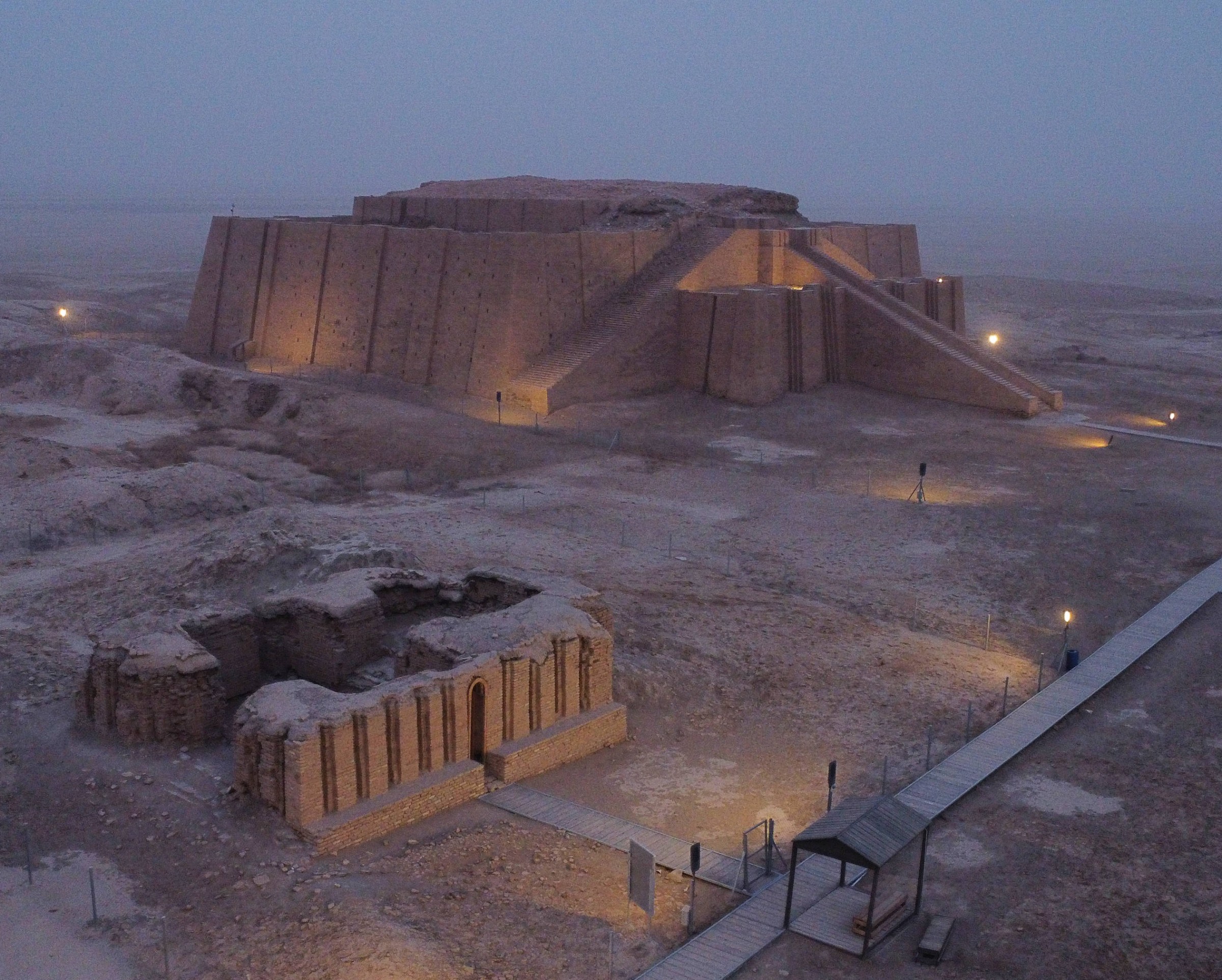
Up to 20,000 people lived in the city of Ur during the third millennium B.C. The rulers of the time demonstrated their power during the annual festival of the moon god Nanna.
© IMAGO / Anadolu Agency / Arshad Mohammed
In the evening sky in Mesopotamia, the crescent moon lies flat, as if a ship were sailing along it. If you looked at it, you could easily tell how far the current moon had progressed. This is how the lunar calendar was established; the beginning of a new month was defined as being when the new crescent moon appeared in the evening sky. A month had 29 or 30 days, depending on what the observation revealed. Exactly when a month began was determined locally and could vary by a day between the individual city-states. On the other hand, the name given to the first day of a month was the same everywhere: it was called “moonlight day.”
A new morning at night
Even the start of the day was dependent on the moon: A day began when the sun set in the evening. “There’s evidence of this from the third millennium BCE because documents note the sequence of sacrifices beginning in the evening and continuing in the morning. So defining the evening was clever in that the day was firmly established as a point in a lunar month. When the day begins at sunset, everyone can see the moon in the sky in the evening and so knows for sure at sunrise whether a new month has begun.” However, in Mesopotamia the normal course of the day also began with people getting up in the morning and ended with people going to bed in the evening.
In addition to alternating day and night and the course of the moon, people back then were also guided by the seasons, which are determined by the solar year. In Mesopotamia, the seasons were defined by cold, flooding, heat and drought. “People’s way of life was dependent on this in every way. All life was tied much more to agricultural work in the fields than the life we know today. The natural rhythm of day and night was also perceived in a very different way.” There was no such thing as artificial lighting, so the day ended with sunset and nightfall.
To bring the lunar year, which had 354 days, into line with the position of the sun, a 13th month was repeatedly introduced as a leap month. This was also done differently at a local level, which meant that initially there was no uniform start to the year across all regions.
Celebrating cosmic time
The rhythms of nature acted as templates for the early yearly calendars in which days were counted and months had names. This development made it possible to organize the way people lived together in the cities. The natural passage of time was integrated into the culture, filled with rituals, duties and expectations that always followed the same pattern.
Celebrations five thousand years ago
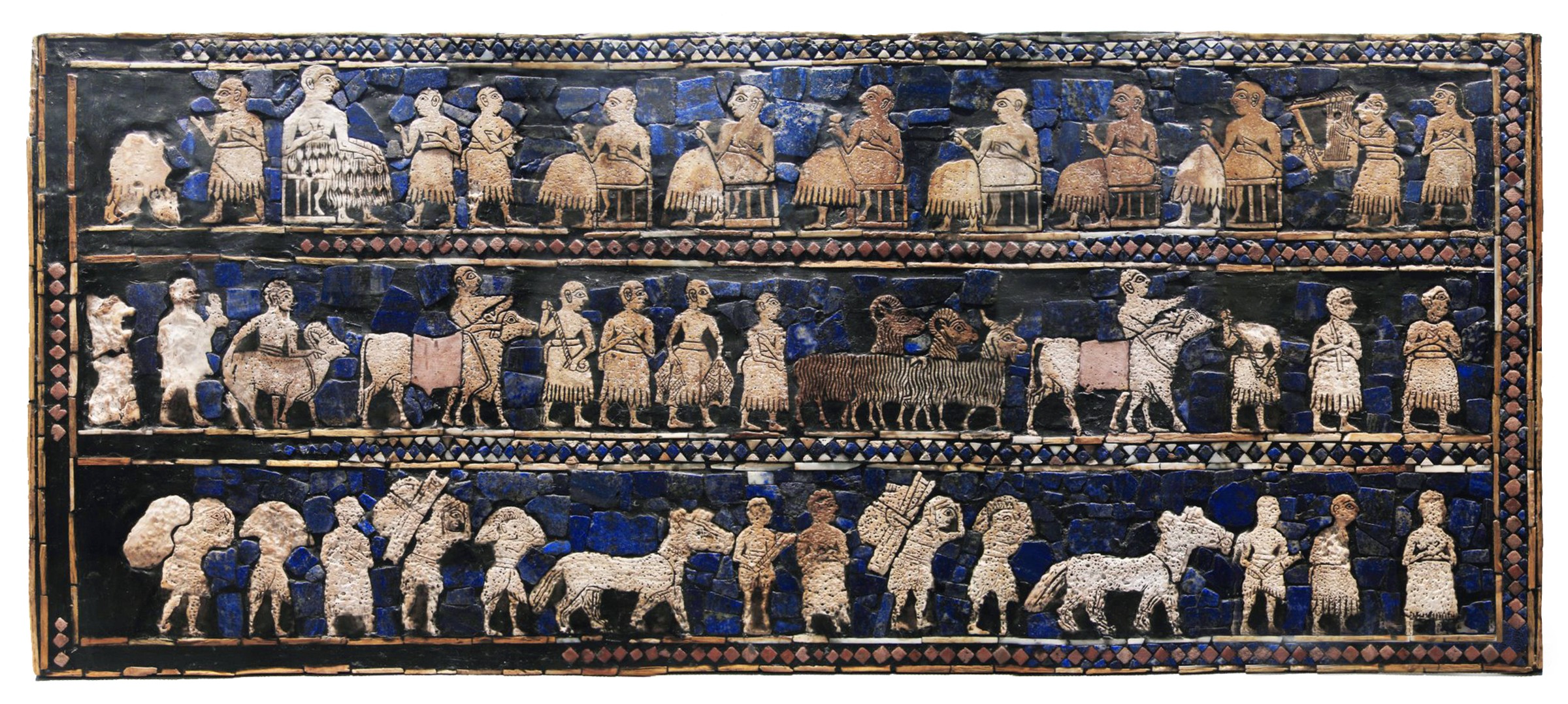
The Standard of Ur is part of a tomb at the Royal Cemetery of Ur in modern-day Iraq. It depicts a royal banquet (top) and the transport of goods and livestock (middle and bottom).
© IMAGO / CPA Media
The moon also played a special role in this society. It was a cause for celebration when it appeared and for sorrow when it disappeared at the end of the month. Lunar holidays with different meanings provided structure to life. This meant that the cycle of the moon provided a reason for regular festivals that defined the way communities interacted.
According to Sallaberger, the festival calendars in particular show the important cultural role that temporal conventions played. “The festivals and the way that people prepared for them provide an example of how crucial it is to have a common understanding of time for people to live together because a festival is being staged. The places in a city-state contribute to this, with the people bringing their established and expected gifts to the city. This provides a predictable routine for everyone involved, because the festivals always take place within a certain month and on certain days.”
Don't miss the next issue:
One example that Sallaberger cites is the annual festival of the moon god Nanna in the city of Ur, in which as many as 20,000 people may have lived. At the moon festival, the ruler at the time constantly redisplayed his power. “It takes place in the ninth or tenth month at full moon – this corresponds to our December and January. This is the largest and longest full moon during the year, immediately after the winter solstice. So there’s a link between the annual cycle and the festival in the city. This firmly establishes cosmic time in the city,” explains Sallaberger, who is currently working on a history of religion in early Mesopotamia.
Sallaberger describes how the city “put on its finest display” on this occasion and how many people from the surrounding area also came together to watch the procession. For the spectators watching, the procession symbolized the deity moving into the temple. “This religious context gives the festival its meaning, but this also reveals the order of society because everyone from dignitaries, military officers and ordinary people is in attendance. I regard these festivals as important meeting places where people come together and feel a sense of community.”
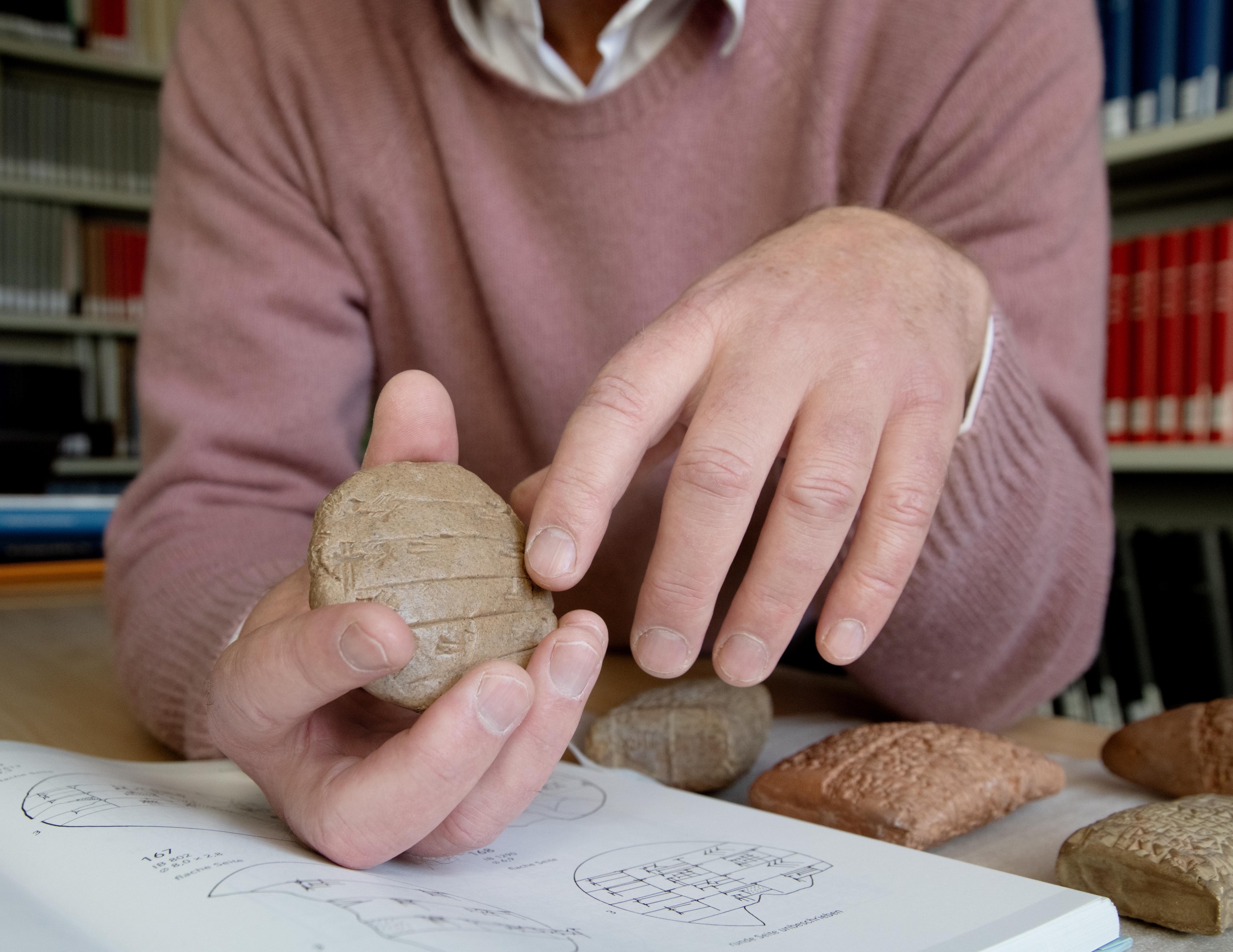
On this round clay tablet a student has copied two words written previously in a master’s beautiful script.
© LMU / Manu Theobald
Meeting on the day after new light
Not every city based its calendars on deities or festivals. In some places, agricultural events such as the cutting of the grain to mark the harvest played a role in the way that time was designated. For example, the people in Ur, Nippur or Umma were able to meet on the third day after new light emerged in the grain cutting month.
Another method that people used was to count the months numerically. In some places, people didn’t name a month according to seasons or festivals, but instead started to number them consecutively from one to twelve. “In some regions, there’s earlier evidence of this than there is of names being given to months. This really surprised me because it seems so modern,” explains Sallaberger.
Beginning of a new time
There were also local differences in the way that people named years. They reveal how important the respective ruler was to each community: The residents of a city-state simply counted how many years they had ruled for. But in the third millennium BCE, people also began referring to the years according to events. For example, they referred to the year when a king was crowned, a conquest was achieved or a canal was dug.
Preserving cultural heritage
Walther Sallaberger’s research currently includes a project examining clay tablets obtained from excavations in the city of Umma in southern Iraq, working alongside Professor Nawala A. Al-Mutawalli from the University of Mosul: “The people in Iraq have a very different relationship with their cultural heritage. Experiencing this has given my work a whole new dimension. I think we have a duty to preserve these ancient examples of writing as a cultural legacy for mankind.”
© LMU / Manu Theobald
The different local calendars came to an end with the fall of the Empire of Ur, in which the old city-states continued to exist as provinces, in around 2000 BCE. A common calendar finally became established as the different places in Babylonia amalgamated in a completely new political structure. Researchers like Walther Sallaberger benefit from this early variety of calendars because they still provide information about which cities and places used the same system of time and belonged together – crucial information for studying and understanding the advanced civilization that once existed in Mesopotamia.
For example, a date written on a fragment of clay may suddenly reveal new links between a city-state and a place that nobody knew anything about previously – “and this immediately changes the map,” says Walther Sallaberger. Even bureaucratic notes that may appear insignificant can help him to reconstruct the history and interaction of people who lived thousands of years ago.
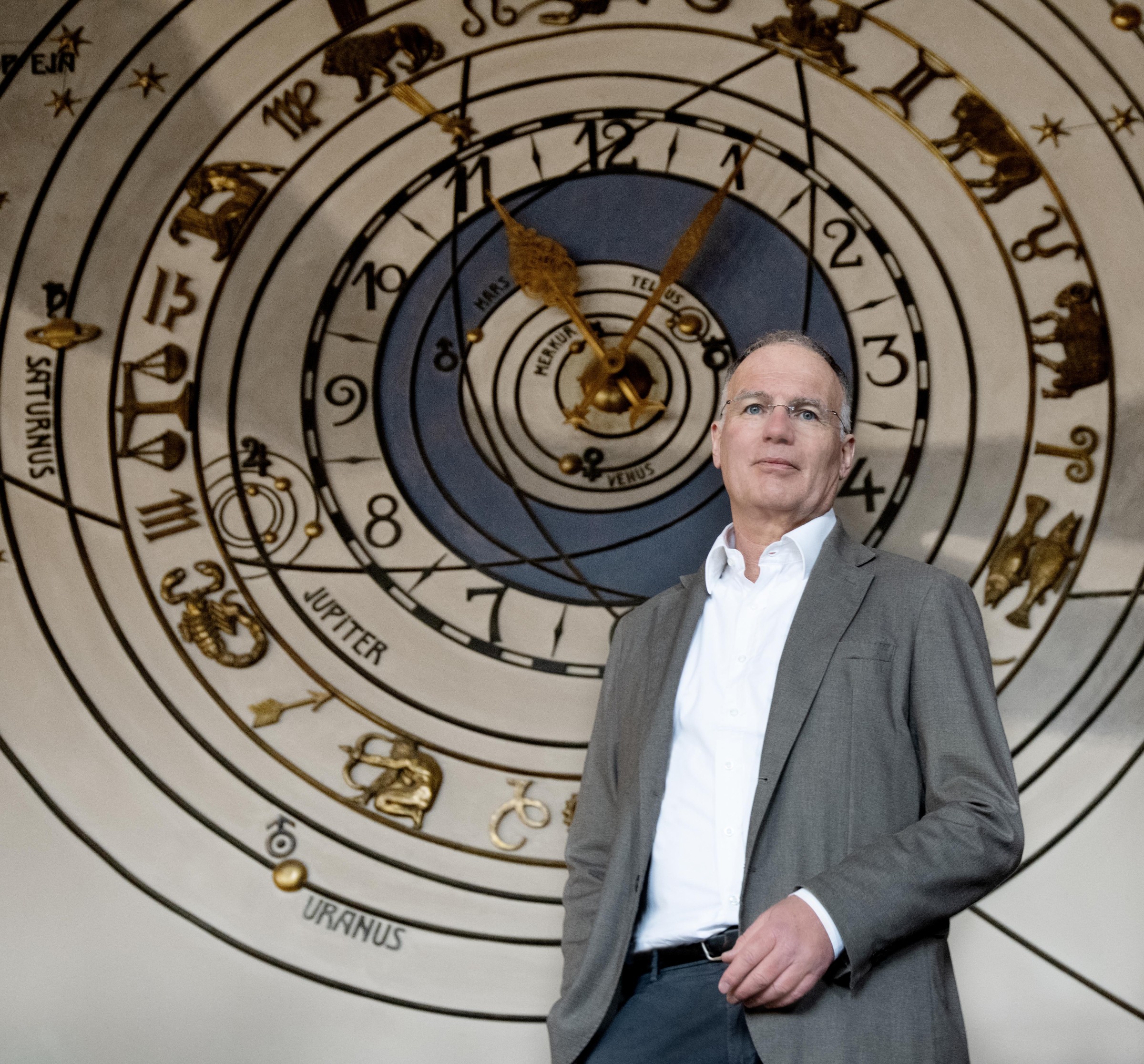
Walther Sallaberger is Chair of Assyriology at LMU’s Institute of Assyriology and Hittitology.
More Research and Innovation:
Read more articles from LMU's research magazine in the online section and never miss an issue by activating the magazine alert!